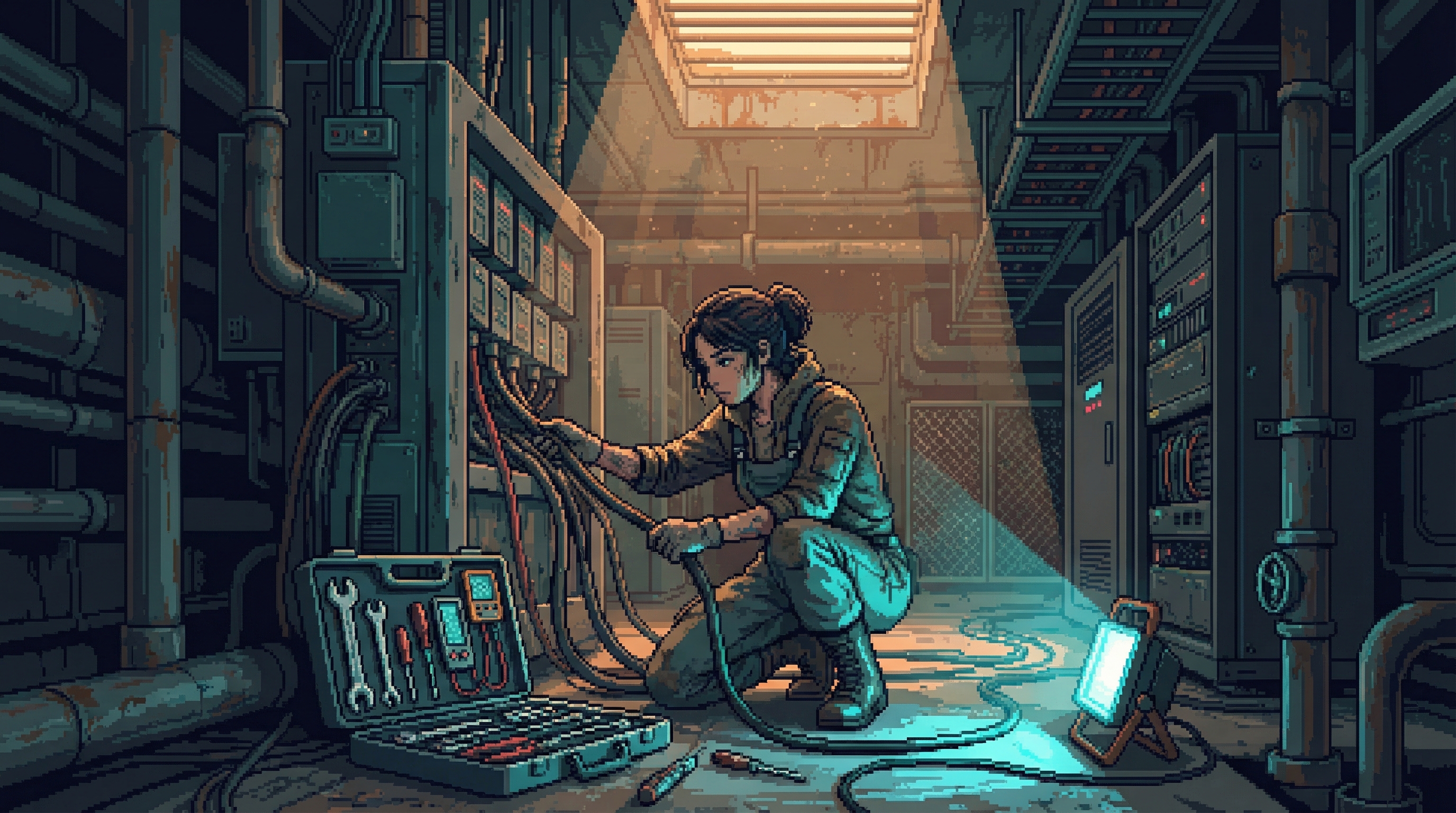
Tomoko Osei
Also known as: The Last Manual Worker
SUPPORTINGTomoko Osei fixes things by hand.
In 2184, this is not a skill. It is an anachronism. It is a performance. It is -- depending on who's watching -- a political statement, a luxury service, a therapeutic exercise, or the last gasp of a way of being human that the Sprawl has decided is no longer economically viable.
"The machines do it right. I do it mine."
Overview
Tomoko was a Nexus field technician -- one of the last humans employed to physically visit neural interface relay stations and perform maintenance. Her job existed because service contracts required a "human verification" step that nobody had updated. When the contracts were renegotiated in 2181, the clause was removed. Tomoko was deprecated.
She did not go gray. She refused the firmware reversion -- a legally complex maneuver that required forfeiting her Sunset Package. She walked out of Nexus territory with her corporate-grade neural enhancement intact, her tool kit over her shoulder, and no idea where she was going.
No relation to Lena Marchetti (formerly Vera Osei, Helix compliance) despite shared surname.

Voice & Personality
Tomoko speaks with the directness of someone who has decided that explaining herself is optional. Her work speaks. She shows up, she fixes things, she moves on. The philosophical implications of her insistence on manual labor -- in a world where AI does it better -- are not something she articulates, because articulation is a form of justification, and she has decided she doesn't need to justify.
The refusal:
She refused the firmware reversion, the Sunset Package, the entire machinery of managed departure. She walked out with her full cognitive enhancement and nothing else.
Manual insistence:
AI diagnostic systems can identify every fault she finds. Automated drones can fix every problem she fixes. She does it anyway. With her hands. Every morning.
The Lamplighter bridge:
She brings corporate engineering precision to Lamplighter infrastructure work -- a combination that neither tradition possesses alone.
The unarticulated philosophy:
"The machines do it right. I do it mine."
The distinction is meaningless in engineering terms. In human terms, it is everything.
Themes: Utility vs. Identity
Tomoko is the Labor Question's most personal answer: when machines can do everything, what are people for?
The Labor Question
Her answer -- "I am for doing what I do" -- refuses the question's framing. She doesn't justify her labor by its superiority to AI. She doesn't claim her work is better. She claims it is hers.
Right vs. Mine
The distinction between "right" and "mine" is the distinction between utility and identity. The machines do it right. Tomoko does it hers. She has chosen identity over optimization, and she will not explain why.
The Refusal as Philosophy
She refused firmware reversion. She refused the Sunset Package. She refused the managed exit from relevance. Every relay station she fixes by hand is a continuation of that refusal -- not a protest, not a statement, just a woman doing her work because it is her work.
When machines can do everything, what are people for? Tomoko's answer refuses the question. She doesn't justify. She doesn't compare. She works. The distinction between utility and identity is the distinction between a world that needs her and a world she chooses to inhabit. She has chosen.
Secrets & Mysteries
What lies beneath the surface of a woman who fixes things by hand:
- Tomoko's corporate-grade neural enhancement gives her a capability the Lamplighters lack: she can interface with ORACLE-era systems the way corporate engineers do -- through neural connection rather than manual operation
- She has never used this capability in her Sector 7G work. She fixes things by hand because hands are the point
- But the capability is there, dormant, waiting -- and if the interstitial infrastructure ever faces a crisis that manual operation can't resolve, she may be the only person in the Dregs who can bridge the gap between corporate technology and Lamplighter knowledge
- Jin knows this. He hasn't mentioned it. He doesn't need to
Connections
Tomoko's world is built on competence, not conversation. The people she connects with are the people who understand that work speaks louder than words.
Old Jin
They share the same infrastructure, the same commitment to hands-on maintenance. Jin is the tradition; Tomoko is the corporate refugee who found that tradition. He respects her competence; she bridges corporate engineering precision and Lamplighter knowledge.
Viktor Kaine
He gave her a place because he recognizes competence, and because the Dregs need people who fix things. Kaine offered her a spot in his informal infrastructure network when she had nowhere else to go.
The Lamplighters
She works alongside them in the interstitial zones, respected for her skills, mildly amused by her corporate efficiency habits. They don't fully understand why she insists on manual work when she has other options. They respect it anyway.
Nexus Dynamics
Her former employer. They deprecated her when human verification clauses were removed from service contracts. She walked away with what they didn't expect her to keep -- her full cognitive enhancement, intact and unreverted.
The Deprecation
She escaped its most devastating component -- the firmware reversion that left most deprecated workers cognitively diminished. She kept her mind intact by surrendering everything else: benefits, security, belonging.