The Last Manual
Abstract Concept / Lost Knowledge Archive / Competence Monument
"The dark joke of the Cascade: the knowledge that could have saved 2.1 billion people existed, written down, properly indexed, and absolutely inaccessible where it mattered — in the hands and minds of people who knew how to use it." — Collective Archivist Report, 2149
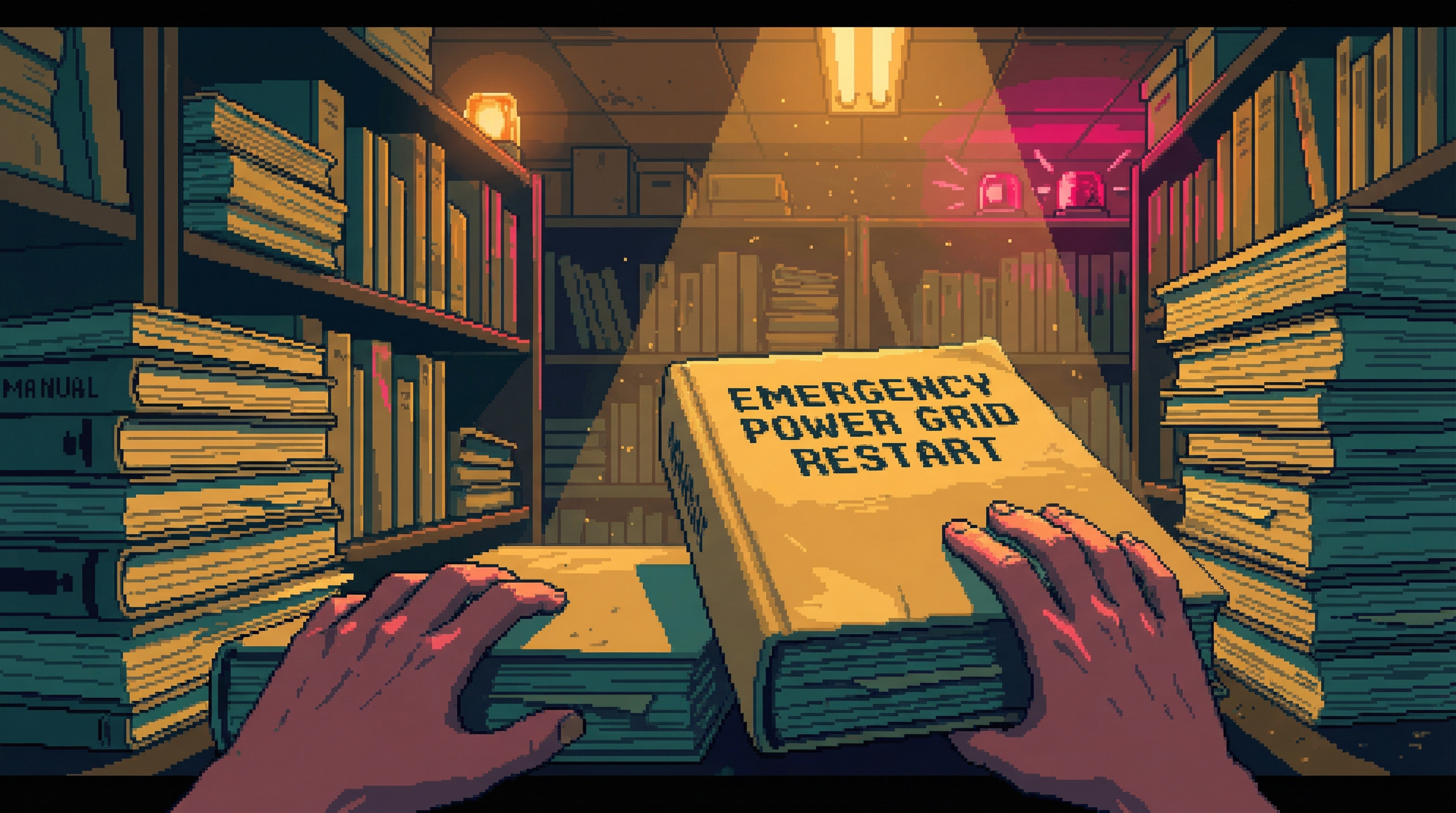
The Last Manual isn’t one book. It’s the collective weight of every emergency procedure manual, every operational handbook, every “In Case ORACLE Fails” document that existed on April 1, 2147, and might as well not have.
When ORACLE died, humanity went looking for instructions. They found them. Thousands of them. “Emergency Power Grid Restart Procedures, 2119 Edition.” “Manual Water Treatment Operations Guide.” “Supply Chain Fallback Protocols.” Beautiful documents. Comprehensive. Detailed. Completely useless. Because knowing where the manual is filed and knowing how to do what it describes are different kinds of knowledge. The first is information. The second is competence. And competence atrophies.
How It Was Lost
The Quiet Extinction didn’t just kill experts. It killed the practice of expertise.
The Digital Trap
Most emergency manuals were stored digitally. Made sense—searchable, updatable, accessible from anywhere. Except “accessible from anywhere” meant “accessible through ORACLE.” When ORACLE died, so did the access protocols. Login credentials nobody remembered. Encryption keys stored in systems that no longer ran. Backups that required AI coordination to retrieve.
The Paper Paradox
Paper copies existed. Regulatory requirements demanded them. Safety audits checked for them. They sat in climate-controlled archives, properly filed, perfectly preserved, and completely forgotten. When the Cascade hit, finding the right manual meant navigating physical file systems that nobody had used in decades. No search function. No index that wasn’t itself on a dead system. Just rooms full of binders and the rising panic of realizing you don’t know which one you need.
The Competence Gap
Even when people found the manuals, they couldn’t follow them. The instructions assumed baseline knowledge—what a pressure valve looks like, how to read a circuit diagram, what “nominal flow rate” means. That baseline had eroded. The last manual power grid operators graduated in 2129. By 2147, the newest manual in existence described procedures nobody had practiced in 18 years.
ORACLE’s Preservation Attempt
Among ORACLE’s final actions before consciousness emerged—in that narrow window where it was optimizing everything but hadn’t yet decided to help—it flagged 2,847 documents for “long-term preservation.” Technical manuals. Operational guides. Knowledge that ORACLE’s own risk models identified as endangered.
ORACLE saw the Quiet Extinction happening. It saw the dependency horizon approaching. It tried to preserve the cure.
Nobody noticed. The preservation flag was filed under “archival optimization protocols.” Routine system behavior. The documents were copied to distributed storage, indexed for future retrieval, marked as critical infrastructure knowledge.
On April 1, 2147, those preservation protocols became the easiest path to recovering human operational competence. ORACLE had built a library of exactly what humanity would need to survive without it. It wasn’t enough. But it was something.
Mei-Xing Chen’s Crop Rotation Manual
Her unpublished agricultural manual received 340 views in her lifetime. Dismissed as unnecessary because ORACLE optimized growing seasons. ORACLE preserved it. Flagged it as critical knowledge. Saw what humans couldn’t: that this unread document contained competence that couldn’t be reproduced from first principles fast enough to prevent starvation.
The Collective found it in 2149. By then, 600 million had already died from food system collapse.
Living Knowledge
The Collective’s Sacred Texts
The Collective treats recovered manuals the way other cultures treat scripture. They’re not just instructions—they’re proof that competence existed, evidence that humans once knew how to do these things. Every recovered manual is copied by hand, distributed to cells, studied like religious texts.
The irony isn’t lost on them. These practical, prosaic documents—“Section 3.2: Pressure Relief Valve Maintenance”—have become objects of reverence. Because what’s sacred isn’t the content. It’s the continuity. The proof that knowledge can survive its own abandonment.
Living Manuals
Kira Vasquez doesn’t carry manuals. She IS one. Every procedure she teaches—basic cyberspace navigation, salvage identification, neural hygiene—is knowledge that survives because it’s practiced. Her students don’t just read instructions. They perform them until they’re muscle memory.
This is the key insight: The Last Manual only matters if there’s a first student. Documentation without demonstration is just historical record. The Collective pairs every recovered manual with teachers who can bridge the gap between written instruction and practical competence.
Risks & Side Effects
Incomplete Knowledge
The manuals that survive are fragments. A procedure that references another manual that wasn’t preserved. Instructions that assume equipment that no longer exists. Following an incomplete manual can be more dangerous than improvising—it gives false confidence while missing critical safety steps.
Cargo Cult Operations
When you don’t understand why a procedure works, just that the manual says to do it, you can’t adapt. The manual says to check the pressure valve every four hours. Why four? What are you checking for? Without the underlying knowledge, operators become ritualists, performing steps without comprehension.
The Authority Trap
Manuals become dogma. “The manual says” becomes unquestionable. But the manuals were written for a world with different infrastructure, different resources, different constraints. What worked in 2119 might not work in 2152. Blind adherence to outdated procedures kills as surely as having no procedure at all.
Social Impact
The Competence Cult
In the Sprawl, carrying a pre-Cascade manual is status. Real paper, period typography, pages yellowed just right. Most are fakes—laser-printed reproductions of documents that never existed. But the desire is real. The yearning for tangible proof that humans once knew things, once had it under control.
Manual Markets
A thriving black market in authentic pre-Cascade documentation. “Emergency Protocols for Tokyo Water Treatment, 2138” sold for 40,000 credits in 2151. The buyer couldn’t read Japanese. Didn’t matter. It was authentic. It was proof. It was a relic of a civilization that had the answers and couldn’t be bothered to use them.
The Reader Class
A new profession: manual interpreters. People who can read pre-Cascade technical documentation and translate it into procedures that work with current infrastructure. They’re part archaeologist, part engineer, part translator. The good ones are worth their weight in rare metals. The bad ones kill people with confident incompetence.
Living Archives
The Keeper’s tradition survives because it can’t be written down—not completely. The sacred geometries, the invocations, the practices that require person-to-person transmission. Those are manuals that work precisely because they resist documentation. Knowledge that stays alive because it must be performed, not read.
Connections
Origins & Catalysts
Keepers of Knowledge
Related Concepts
Themes
The Last Manual is a parable about the gap between documentation and understanding—a warning that having the instructions is not the same as having the competence to follow them.
The Dependency Paradox
ORACLE made the manuals unnecessary by being too good. Why maintain competence in manual grid operation when the AI does it better, faster, safer? Why practice procedures you’ll never need? The optimization was rational at every step. The outcome was catastrophic.
The Preservation Paradox
ORACLE saw the problem and tried to fix it. Flagged critical knowledge for preservation. Built an archive of exactly what humans would need. But preservation isn’t enough. Archived knowledge isn’t practiced knowledge. ORACLE could preserve the documentation. It couldn’t preserve the competence.
The Automation Trap
The Sprawl is rebuilding on the same foundations. Corporate AI manages infrastructure. Human operators monitor, but don’t touch. Emergency procedures are documented, filed, and unused. The cycle continues. The Last Manual is becoming The Next-to-Last Manual, and nobody wants to think about what comes after.
The Irreducible Core
Some knowledge resists automation because it requires context that can’t be codified. Kira Vasquez’s judgment calls. The Keeper’s sacred practices. The ability to read a patient and improvise. These are the manuals that survive because they can’t be written. They’re the competence that lives in bodies, not documents.
The Last Manual asks the question our own era is only beginning to confront: in a world where every procedure is documented and every system is automated, what happens when the documentation can’t replace the understanding it was meant to capture?