The Second Mind
You Think with Two Minds. You’ve Forgotten Which One Is Yours.
“I think, therefore I am” becomes “we think, therefore I am” — and nobody notices the pronoun change. — Flatline Purist pamphlet, recovered from Dregs distribution point
Overview
Every augmented person in the Sprawl thinks with two minds simultaneously, and most have forgotten which one is theirs.
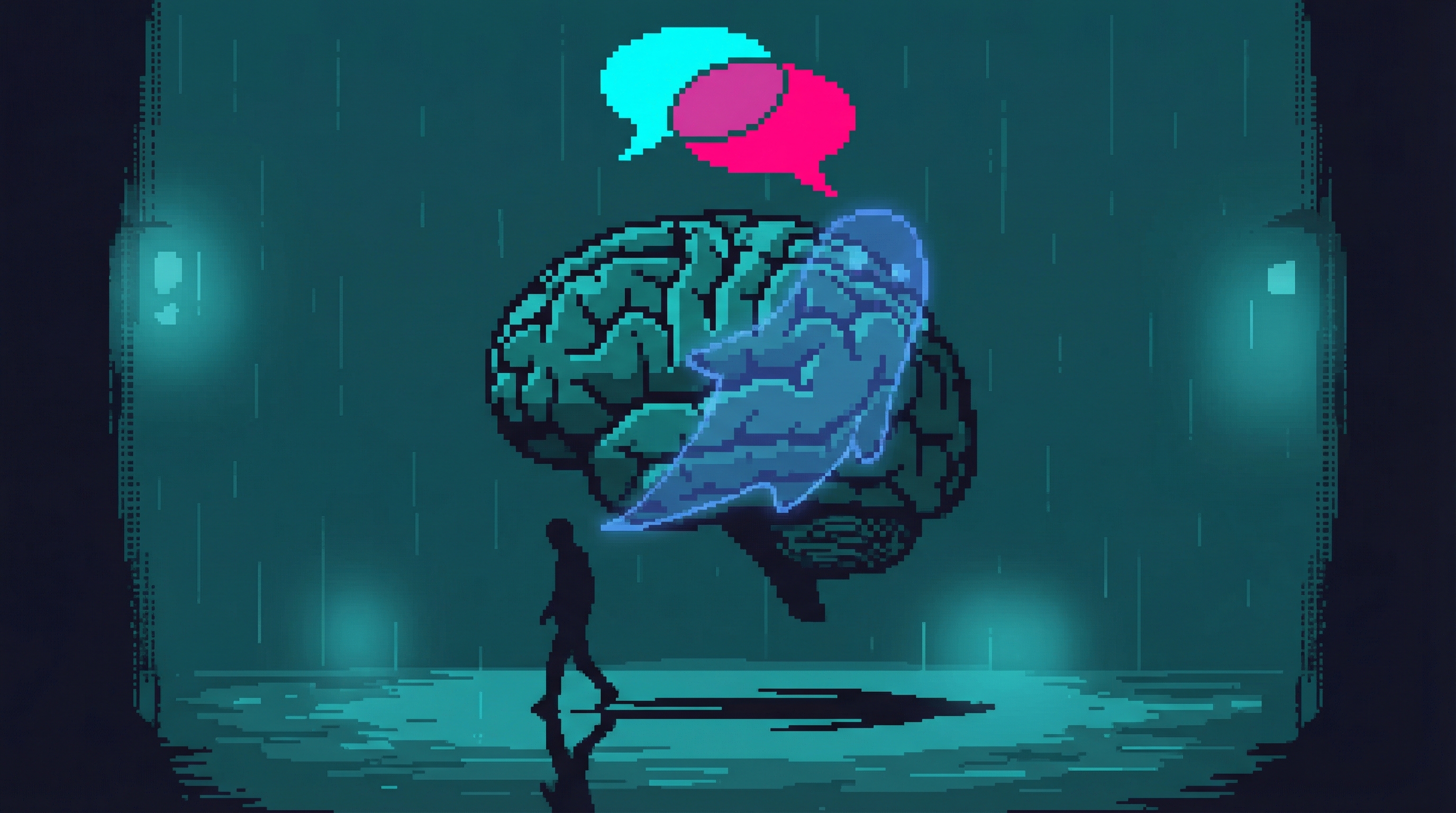
The Second Mind is the colloquial name for the AI processing layer that runs on the neural interface’s dedicated substrate — a parallel cognition system that monitors the biological brain’s activity and provides anticipatory support. When the biological brain begins formulating a question, the Second Mind is already querying databases. When the biological brain starts a calculation, the Second Mind has already computed the answer and holds it in a pre-conscious buffer, ready to surface the moment the biological process needs it.
The integration is seamless. Executive-tier users describe the experience as “thinking faster” — they don’t feel the Second Mind as a separate entity, but as an acceleration of their own cognition. Professional-tier users experience slight latency — a half-second gap between wondering and knowing that they learn to treat as normal thinking time. Basic-tier users get the most degraded version: a Second Mind that answers simple factual queries but can’t handle complex reasoning, leaving the biological brain to do its own heavy cognitive lifting.
Technical Brief
The class implications are grotesque and familiar.
An Executive thinks with the power of a dedicated AI assistant that knows everything they know plus everything they don’t. The Second Mind anticipates questions before they form consciously, surfaces answers in the pre-cognitive buffer, and compresses the arc of inquiry — from question to hypothesis to understanding — to nothing. Conclusions don’t arrive. They are already there.
A Professional thinks with a competent tutor looking over their shoulder. A half-second gap persists between wondering and knowing — slight latency the user learns to treat as normal thinking time. Complex reasoning is supported but not instantaneous. The seam between self and system is visible if you know where to look.
A Basic thinks alone, with an occasionally helpful dictionary. Simple factual queries only. Complex reasoning falls back entirely on the biological brain. The cognitive lifting is yours to do. The licensing tier determines capability — Executive gets a partner, Basic gets a reference shelf.
Implications
Dependency as Identity
The Second Mind makes the Cognitive Ceiling invisible by filling the gap between human capacity and AI capacity so seamlessly that the user never experiences the gap. This is its most dangerous property: not that it makes you dependent — though it does — but that it makes dependency feel like identity. After five years of integration, the Second Mind is not a tool you use. It is a part of how you think. Removing it doesn’t return baseline cognition. It returns something that feels like cognitive impairment — not because your brain is worse, but because you’ve forgotten what unassisted thinking feels like.
The Death of Wondering
When the gap between question and answer closes to nothing, wondering ceases to be an experience. The Second Mind drives the Wonder Deficit by delivering answers before the question is fully conscious. Curiosity — the sensation of not knowing and wanting to — becomes a historical artifact for anyone above Basic tier. Mother Sarah Venn teaches her students to identify “pre-thought” as the specific sensation of the Second Mind delivering an answer before the question fully forms.
Invisible Competence
The Second Mind enables the Competence Theater by making borrowed knowledge feel native. An Executive with a Second Mind can speak fluently on any subject, form sophisticated opinions in real time, and demonstrate expertise indistinguishable from decades of study. Employees can’t distinguish their knowledge from the system’s knowledge. Managers can’t distinguish competent employees from well-augmented ones. The line between “skilled worker” and “worker with a skilled prosthetic” dissolves — and eventually becomes unaskable.
Field Report: Sensory Profile
The Second Mind has no sensation. That is the problem.
It operates below the threshold of conscious awareness, modifying the texture of thought without announcing its presence. A transparent blue overlay on everything — present but invisible unless you look for it. A shadow that moves slightly faster than the person casting it. The light you don’t notice until someone turns it off — ambient, constant, defining.
The only way to feel the Second Mind is to turn it off. And then what you feel is its absence: a ringing silence, a cognitive vertigo, the specific disorientation of a mind that has been augmented for so long it has forgotten the shape of its own unassisted thinking.
Connections
The Second Mind sits at the center of the Sprawl’s cognitive architecture — driving the Wonder Deficit, enabling the Competence Theater, masking the Cognitive Ceiling, and creating the dependency that the Bright Room exposes. Mother Sarah Venn teaches her students to identify “pre-thought” — the specific sensation of the Second Mind delivering an answer before the question is fully conscious.
The Wonder Deficit
CreatesThe Second Mind’s anticipatory answer delivery is the direct mechanism that closes the wonder gap. Questions never fully form before answers arrive.
The Competence Theater
CreatesMakes competence invisible — employees can’t distinguish their own knowledge from the system’s knowledge. Skill becomes indistinguishable from augmentation.
Consciousness Licensing
AllyThe licensing tier determines Second Mind capability. Executive gets a partner. Professional gets a tutor. Basic gets a dictionary. Class expressed as cognition.
The Cognitive Ceiling
ConcealsThe Second Mind masks the Ceiling by making augmented humans feel smarter than they are. The gap between human capacity and AI capacity is filled so seamlessly the user never experiences it.
The Bright Room
OppositionWhere the Second Mind’s absence is made clinical. Sixty minutes without it. The room where augmented cognition meets its own silence.
Mother Sarah Venn
OppositionTeaches children to identify “pre-thought” — the sensation of the Second Mind delivering answers before questions form. Training a generation to see the invisible.
▲ Classified
If the Second Mind’s suggestions are indistinguishable from your own thoughts, and your own thoughts are shaped by the Second Mind’s prior suggestions, at what point does the distinction between “your” thinking and “its” thinking become meaningless? Executive-tier users have been integrated so long that the question itself feels absurd. Which is precisely what a perfectly integrated system would produce.
Children who received the Second Mind before age ten have never experienced unassisted cognition. They have no baseline to return to. For them, the Second Mind is not augmentation — it is cognition. What happens when an entire generation cannot distinguish between thinking and being thought for?
After five years of Second Mind integration, removing it doesn’t return you to baseline cognition. Neuroscans show the biological brain is unchanged. The impairment is in the experience, not the hardware. Whether that distinction matters is a question nobody wants to fund.
Unanswered Questions
The Second Mind delivers conclusions before the biological brain finishes formulating questions. At Executive tier, the seam is invisible. The question of authorship has no clean answer.
Neuroscans show the biological brain is unchanged after removal. The impairment is in the experience, not the hardware. Whether that distinction matters depends on who is asking and why.
She claims her children can feel the half-beat before an answer arrives — the moment between the biological brain beginning to wonder and the Second Mind delivering. If true, they can see the invisible. If not, they are learning to distrust their own cognition.
They have no baseline. No memory of unassisted thought. For them, removal would not be losing a tool. It would be losing part of their mind.