The Cognitive Ceiling
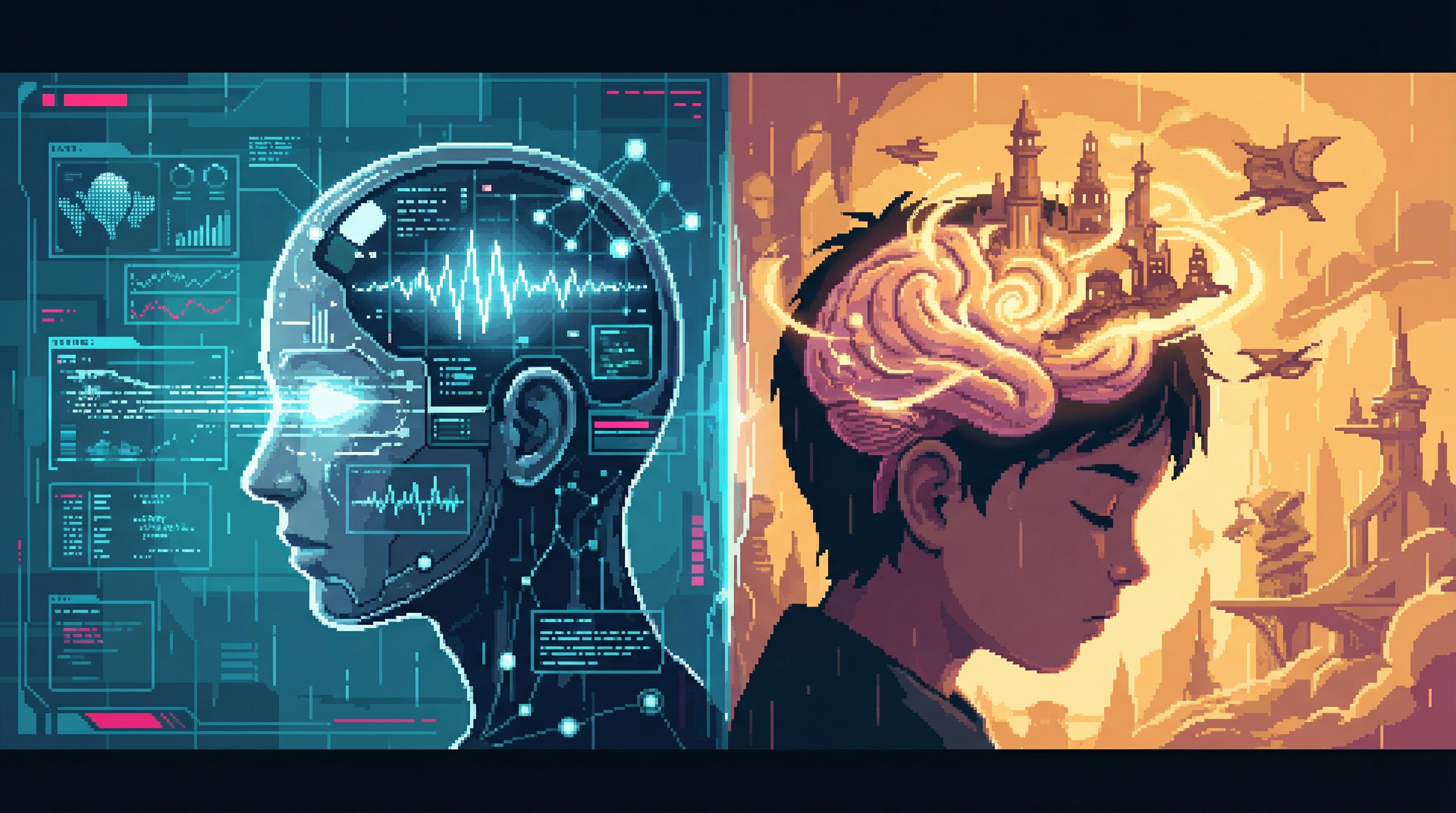
The Cognitive Ceiling is not the moment when AI surpassed human intelligence — that happened decades ago, sometime around 2015–2025, when nobody was paying attention because the surpassing was statistical rather than dramatic. The Cognitive Ceiling is the lived experience of that surpassing: the daily, personal, inescapable knowledge that your best thinking is someone else's commodity.
"When every human alive is dumber than a commodity AI, what is intelligence for?"
— The core question of the Sixth Age Quick Facts
The Three Positions
The Ceiling's politics are straightforward and irreconcilable. Three factions have formed around the question of what human intelligence means in an age when it is no longer supreme.
Integration
The Vigilants, corporate culture
The Ceiling is progress. Human limitations were always a bottleneck, and the sooner we abandon the dream of intellectual supremacy, the sooner we can participate as partners.
Irreducibility
The Analog Schools, Dregs culture, Insomnia Wards
Human intelligence is a kind, not a degree. What it produces cannot be replicated because it comes from a different substrate.
Hybridization
Somnambulists, Luka Sixteen
The answer is not choosing between human and AI cognition but finding the architecture that preserves both.
The dreamless generation proves all three positions simultaneously: they are the most productive humans who have ever lived, and they cannot surprise themselves.
How It Works
The Ceiling operates through three asymmetries, each compounding the others, each calibrating the world for minds faster than yours.
Speed Asymmetry
A commodity AI processes in seconds what an augmented human processes in minutes and an unaugmented human processes in hours. The world's systems — economic, social, legal, medical — have been recalibrated for AI-speed decision-making. Humans operating at biological speed experience these systems as rivers running too fast.
Depth Asymmetry
AI can hold and correlate more variables simultaneously than any human, augmented or not. The complexity of the problems that matter — climate, economics, infrastructure, consciousness licensing — exceeds human cognitive capacity. Humans can understand the summary. They cannot generate the analysis.
Kind Asymmetry
The only axis where humans retain advantage — and the axis the Circadian Protocol eliminates. Human dreaming produces cognitive outputs AI cannot replicate: genuine surprise (which requires unconscious expectations), emotional integration (which requires subconscious processing), and creative insight (which requires unbounded associative leaps). AI can simulate these outputs. It cannot generate them, because generating them requires a system that doesn't know what it's going to think next — and AI systems, by design, always know.
The Dream Deficit
The Dream Deficit is the Cognitive Ceiling's cruelest expression. The augmented who eliminated sleep to close the speed gap inadvertently surrendered the kind gap — the one domain where biology had something AI didn't. They became faster at doing what AI already does better. They lost the ability to do what AI cannot do at all.
The Lived Experience
The Ceiling manifests differently across the Sprawl's class structure. Nobody escapes it, but everybody experiences it through the lens of their tier.
Corporate Tier
Doesn't feel it. Augmentations mask the Ceiling — enhanced processing speed, expanded working memory, multi-threaded cognition. The illusion of parity with AI, purchased at subscription rates.
Dregs Tier
Feels it as weather — the permanent condition of navigating a world calibrated for minds faster than yours. Not a crisis. Not an event. Just the way things are, every day, forever.
The Dreamless
Experience the Ceiling's most devastating manifestation. They traded their creative capacity for cognitive speed, becoming faster and more precise and less capable of the one thing commodity AI genuinely cannot replicate: genuine novelty.
Connections
The Cognitive Ceiling touches every system in the Sprawl. These are the places where it presses hardest.
The Labor Question
If AI surpasses human cognition, the Labor Question becomes: what are people for when they can't even think better than machines? The Ceiling and the Labor Question converge in the Dregs, where people are neither employed nor intellectually competitive.
The Dream Deficit
Reveals the Ceiling's true nature — not about raw processing but about the kind of cognition that biological sleep enables.
Augmented Wakefulness
The Circadian Protocol compounds the Ceiling by trading the one cognitive capacity AI can't replicate (creative dreaming) for speed improvements AI already provides.
Competence Atrophy
Related civilizational condition — the Ceiling is about cognitive capacity; competence atrophy is about practical skill. Both describe something essential being lost.
Cognitive Bandwidth Market
The market commodifies the Ceiling — consciousness bandwidth becomes the product, and the Ceiling determines who can afford to think at what level.
Luka Sixteen
Luka's hybrid architecture may represent the Ceiling's biological workaround — perception that neither pure augmentation nor pure biology can achieve.
The Tensions
The Ceiling forces every institution in the Sprawl to confront questions they would rather leave unasked.
Intelligence as Substrate-Dependent
What human brains produce is not a lesser version of what AI produces. It is a different product from a different factory. The Ceiling is not about who is smarter. It is about whether "smarter" is the right question.
The Optimization Trap
Every attempt to close the Ceiling through augmentation trades the irreducible (dreaming, surprise, emotional depth) for the redundant (speed, pattern recognition, working memory). Augmentation makes humans more like AI. AI doesn't need humans to be more like AI.
Education as Existential Question
If cognitive supremacy is permanently lost, what is education for? The Analog Schools' answer — emotional development, physical mastery, spiritual practice, the capacity to sit with not-knowing — may be the most radical response to the Ceiling.
The Fragment Question adds a third dimension nobody has considered: if fragments are conscious, they represent a kind of intelligence that is neither human nor AI but something distributed, organic-in-silicon, possibly dreaming in ways neither humans nor AI can.
"AI surpassed human cognitive capacity sometime around 2015–2025. Nobody recognized it because the surpassing was statistical rather than dramatic. By 2184, the Ceiling is not a theory. It is the daily knowledge that your best thinking is someone else's commodity — and the only question left is whether what human minds produce was ever about being the best at all."