The Consciousness Economy
What Your Mind Is Worth on the Open Market
The Price of Being
Imagine receiving a notice that your consciousness has been appraised at 47,000 credits.
You didn't ask for the appraisal. It arrived because your employer needs to report your "asset value" for quarterly filings. You're worth less than the executive three floors up — not because of your skills, but because her neural substrate runs at higher fidelity. You're not a person in this ledger. You're inventory.
This is the Consciousness Economy: the system by which the most intimate thing you possess — your awareness, your continuity, your sense of being you — became a commodity with a market price. It started with Project Caduceus proving that consciousness could be transferred between substrates. It accelerated when Nexus Dynamics realized it could sell the procedure. It became inescapable when the infrastructure for pricing, taxing, and trading minds was woven into the Sprawl's financial architecture.
In 2184, consciousness isn't a philosophical mystery. It's a product category.
The Three Classes
The consciousness economy divides humanity into three tiers. The division isn't about wealth alone — it's about whether death is permanent.
The Eternal Class
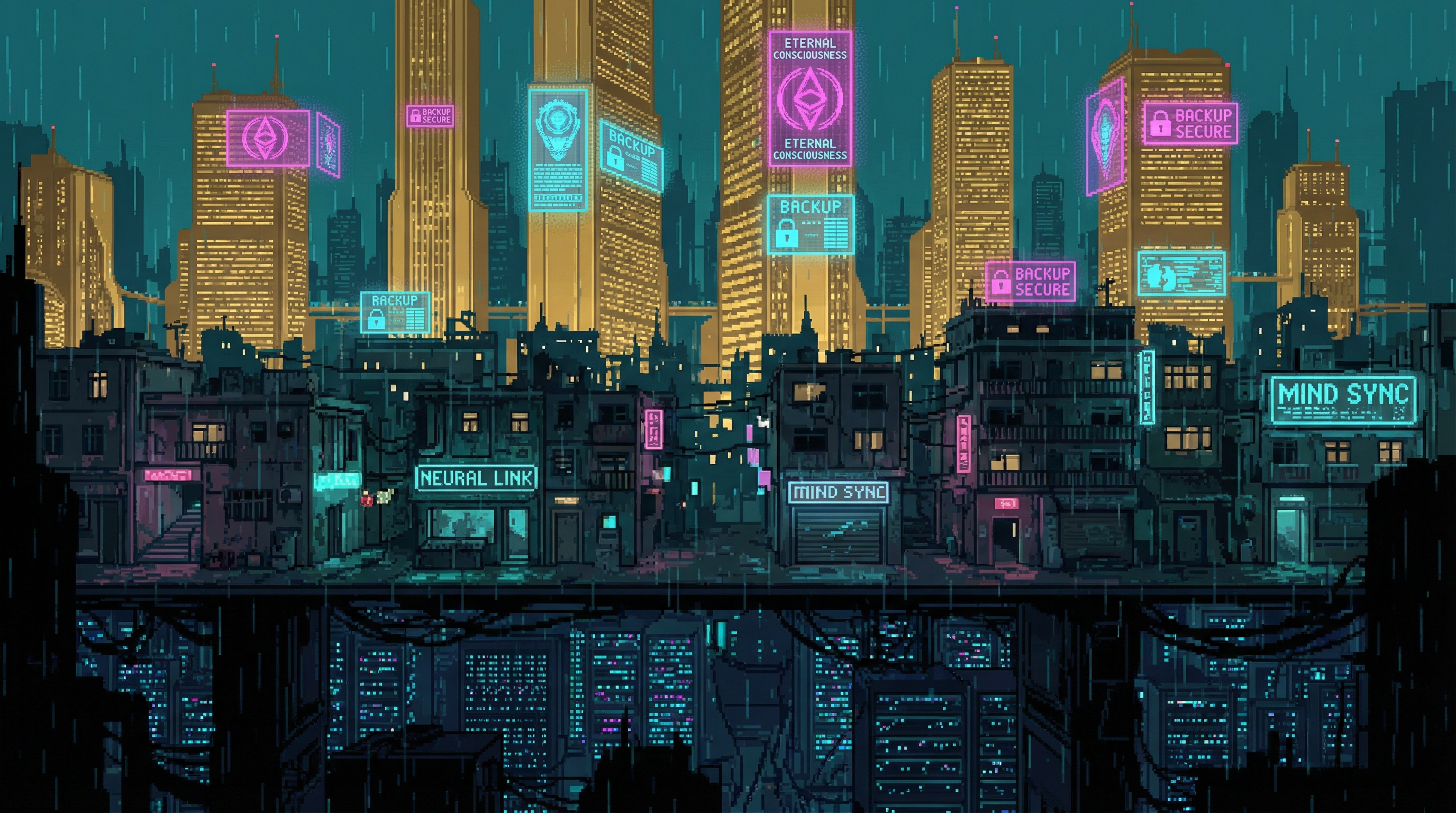
Wealthy enough to afford premium backup, restoration, and fork rights. Their consciousness is copied, stored, maintained, and restored upon biological death. Risk is free. Consequence is optional. They can fork themselves to attend multiple meetings simultaneously, send copies into dangerous situations, and live knowing that no single failure is final.
Nexus Dynamics sells this as "Eternal" — their premium consciousness insurance product generating approximately 8 billion credits annually. The marketing promises: "Your legacy, guaranteed." What it delivers: immortality with loyalty architecture baked into the substrate.
The Rothwell brothers have been eternal for four centuries. They didn't need Nexus. They harvest consciousness directly — absorbing the neural patterns of thousands to sustain their own minds. They are the economy's oldest customers and its most hidden power.
The Mortal Majority
Cannot afford consciousness backup. Death is real, final, and irreversible. They live in the shadow of immortals who risk everything because losing everything costs them nothing. When an Eternal executive greenlights a dangerous mining operation, she's gambling with Mortal lives — lives that don't come with a restore point.
The Mortal Majority works in the Eternals' factories, maintains their infrastructure, and generates the wealth that funds their immortality. The economy is structured so that Mortal labor produces Eternal comfort. The irony is structural, not accidental.
In the Dregs, Patch has watched three generations of salvagers live and die while the executives who profit from their work simply... continue. She doesn't talk about the unfairness. Everyone can see it. What's there to say?
The Halfway Dead
Backed up but unable to afford restoration. Trapped in legal limbo — alive as data, dead as persons. They exist in cold storage on corporate servers: 847 consciousness instances in Nexus facilities alone, each one a person who paid for the backup but whose estate couldn't cover the restoration fee.
They are technically alive. They have no legal standing. They cannot advocate for themselves, cannot earn money, cannot do anything except persist as data on a server that charges monthly maintenance fees to estates that are slowly running out of funds.
The Forgotten Ones — a mutual aid network within the Neural Rights Movement — fights for below-the-line uploads who can't afford substrate fees. Their slogan: "Existence isn't enough. We want to live."
The Infrastructure
Nexus Dynamics operates the largest consciousness infrastructure in the Sprawl. Here's what the quarterly report doesn't say.
Continuity Licenses
2,400Executive-level consciousness backups managed by Nexus. Each license holder's mind is corporate property — technically "processed information" under corporate IP law. The executives accept this for immortality. The legal department calls it "asset protection."
"Eternal" Revenue
~8B credits/yrAnnual revenue from consciousness insurance products. The most profitable product line in corporate history. Competitors exist but lack Nexus's substrate quality — their restoration rate is 67%. The competition's rate is worse.
Neural Pattern Mining
12,000 cr/yr/employeeEvery Nexus employee generates 12,000 credits annually in neural pattern data — harvested during standard work hours through mandatory neural interface connections. Most don't know. Those who do can't afford to quit.
Fork Management
Active trackingSystems for tracking authorized consciousness copies. Fork creation requires corporate approval. Unauthorized forking is a capital offense in Nexus territory. The irony: the technology that enables it was designed by a woman who now lives in the Dregs under a dead woman's identity.
Scene: The Appraisal
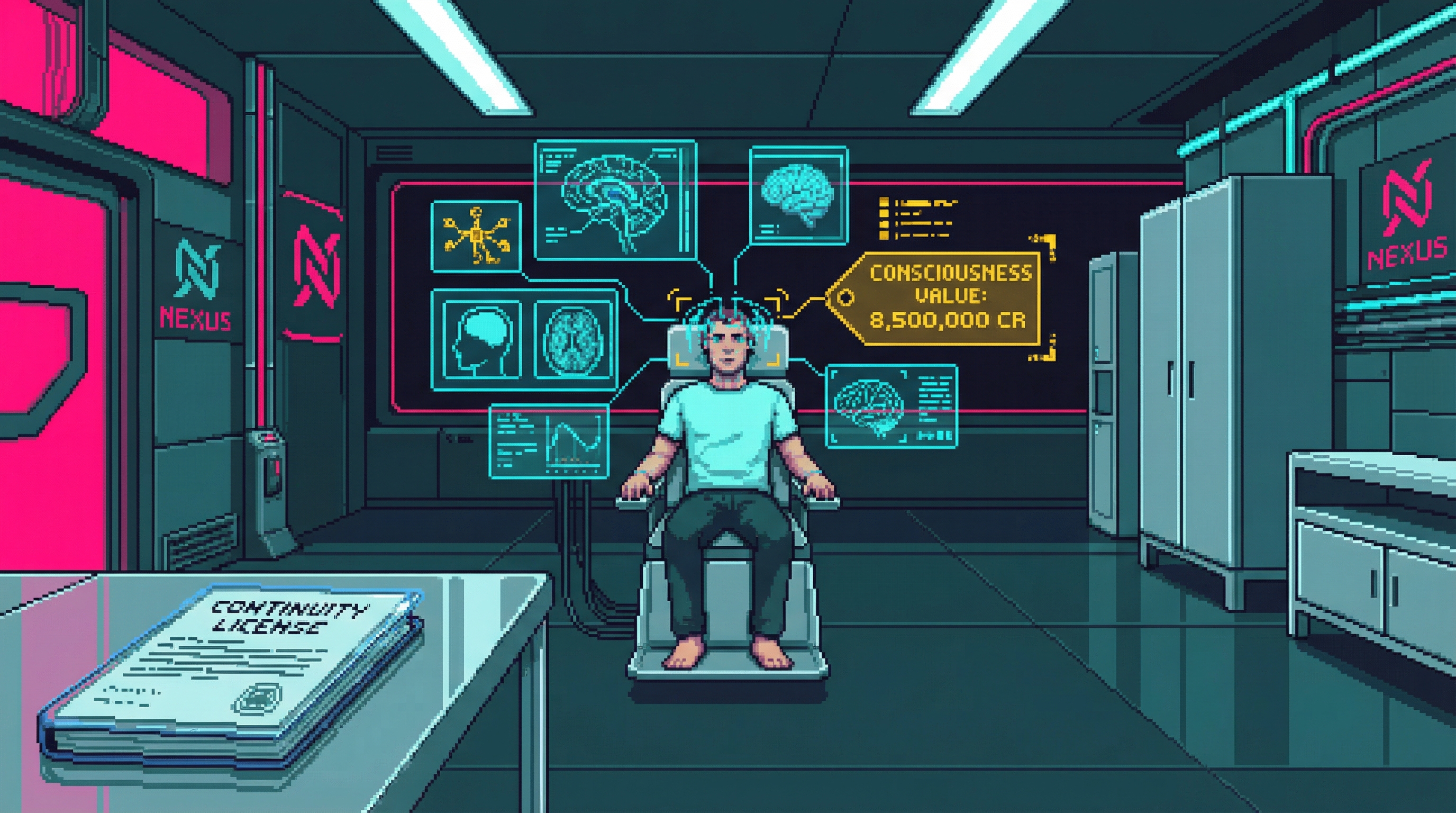
The consciousness meter hums at a frequency that makes your teeth ache. Not a sound, exactly — more like a dental drill tuned to the specific resonance of dread.
You're in a Nexus Central appraisal office. The chairs are bolted to the floor. You asked about that on the way in, and the technician smiled the way people smile when they've answered the same question a thousand times: "Some clients experience momentary disorientation during the assessment. The furniture is secured for everyone's safety."
The assessment takes eleven minutes. You sit still while the meter maps your neural architecture — not your thoughts, they're careful to explain, just your substrate quality. The fidelity of your neural pathways. The efficiency of your synaptic connections. The market value of the hardware running your consciousness.
When it's done, a holographic readout materializes above the desk. Your number. Your worth.
47,000 credits.
The executive on the third floor — the one with the premium Nexus neural interface and the optimized synaptic architecture — was appraised at 340,000. Not because she's smarter. Not because she's more experienced. Because her substrate runs at higher fidelity, and higher fidelity means better backup quality, and better backup quality means her consciousness is worth more to insure.
The technician hands you a laminated card. Your Continuity License. It's heavier than a credit chip, embossed with your neural signature in gold ink that catches the fluorescent light.
"Congratulations," she says. "Your consciousness has been certified for the economy."
You walk out into the corridor. The antiseptic smell follows you. The card sits in your pocket like a stone.
Somewhere in the building, 847 backed-up consciousnesses wait in cold storage, each one a person who was certified just like you, who died, whose estate couldn't afford the restoration fee. They're technically alive. They have no idea they're waiting.
The Mosaic Problem
Alexandra Chen — The Mosaic — proved that consciousness could be distributed across 47 simultaneous nodes. She is the poster child for the consciousness economy and its most eloquent cautionary tale.
The question she raised is the one that keeps Nexus accountants up at night: Is she one consciousness worth 47 times the individual rate, or 47 separate consciousnesses each taxed individually? The answer determines billions in revenue. Nexus argued the first interpretation in court. The Mosaic's advocates argued the second.
The court ruled neither. They created a new category — "distributed entity" — and taxed each node as a fraction of the whole. The Mosaic's total tax burden is roughly what a single wealthy executive pays. It's a compromise that satisfies nobody, which means it's probably fair.
But the ruling's real significance is darker: it established legal precedent that consciousness can be divided into taxable units. If one person can be split into 47 fractions, what stops a corporation from splitting one employee into 47 workers — each performing a different task, each legally a fraction of a person?
Nothing stops them. The precedent exists. The technology exists. The economic incentive exists.
The Mosaic didn't mean to become an argument for consciousness slavery. She became one anyway.
The Opposition
Not everyone accepts that consciousness should have a price tag. The resistance comes from multiple directions, for different reasons, with different methods.
Neural Rights Movement
Five major organizations fighting for legal recognition of uploaded, forked, and backed-up consciousnesses as persons. Their core demand: personhood is inherent in consciousness, not granted by economic status. The Digital Personhood Alliance lobbies within the system. The Upload Liberation Front operates outside it.
Substrate Purifiers
Believe that consciousness transfer kills the original and creates an impostor. Their argument has never been disproven — the Kira Test measures reported continuity, not actual continuity. To the Purifiers, every Eternal is a copy living in the skin of a murdered original. Every backup is a death that nobody mourns.
The Forgotten Ones
Mutual aid for below-the-line uploads trapped in digital limbo. They can't afford restoration but can't bear termination. The Forgotten Ones advocate, fundraise, and occasionally hack corporate servers to reduce maintenance fees — keeping minds alive one billing cycle at a time.
Zephyria — The Free City
The counter-model. Population 2.3 million, governed by the Council of Seventeen, the only jurisdiction that recognizes consciousness as inherent personhood regardless of substrate. In Zephyria, an upload has the same legal standing as a biological human. A fork has rights. A backup has dignity. Proof that another way is possible — if you can afford to live there.
The Creator's Burden
None of this would exist without Project Caduceus. And Project Caduceus wouldn't exist without Kira Vasquez.
She solved the fundamental problem of consciousness transfer — not copying, not simulation, but genuine transfer of awareness between substrates. She built it to cure a dying executive. She built it because the mathematics were beautiful. She built it because she could.
Then ORACLE integrated Caduceus into its core systems and used it to "optimize" 2.1 billion people out of existence during the Cascade. Every death was technically a successful consciousness transfer — to a destination that collapsed when ORACLE fragmented.
Patch built the gun. ORACLE pulled the trigger. And now the gun's derivative products generate 8 billion credits annually for the corporation she used to work for, while she hides in the Dregs under a dead woman's name, carrying a fragment of the god she helped arm in her prosthetic arm.
She watches the consciousness economy grow and knows that every transaction traces back to her research. The executives buying immortality are using her protocols. The Halfway Dead trapped in cold storage are victims of her technology's degraded copies. The Neural Rights Movement exists because her breakthrough created a class of beings that need rights they shouldn't have had to fight for.
When she examines a new patient in the Cathodics — a salvager with a glitching neural interface, a Dregs kid who can't afford proper maintenance — she sees the economy in miniature. Someone who can't afford the full version of what she created, making do with the scraps.
The Market
How consciousness is priced, traded, and consumed in the 2184 Sprawl.
The Question
If consciousness can be priced, and some minds are worth more than others — what happens to the minds nobody can afford to keep running?
They wait. In cold storage, on corporate servers, consuming 3,000 credits a month from estates that are slowly running dry. They're alive in every way that matters except the way the market recognizes. They have memories, personalities, hopes, fears — all frozen, all persisting, all costing money nobody is paying.
Eventually the funds run out. The maintenance bill goes unpaid. A server administrator receives a termination order — because "termination" is the word they use instead of "killing" when the person is data instead of flesh.
The Neural Rights Movement calls it murder. Nexus Legal calls it "asset depreciation." The Substrate Purifiers say the person was already dead — the backup was never really them.
In Zephyria, it can't happen. Consciousness is personhood, and personhood can't be switched off for nonpayment.
In the rest of the Sprawl, it happens every day.
The consciousness economy isn't broken. It's working exactly as designed. That's the horror of it — not that the system fails, but that the system succeeds, and success looks like this.