Fork Ethics: The Philosophy of Copied Minds
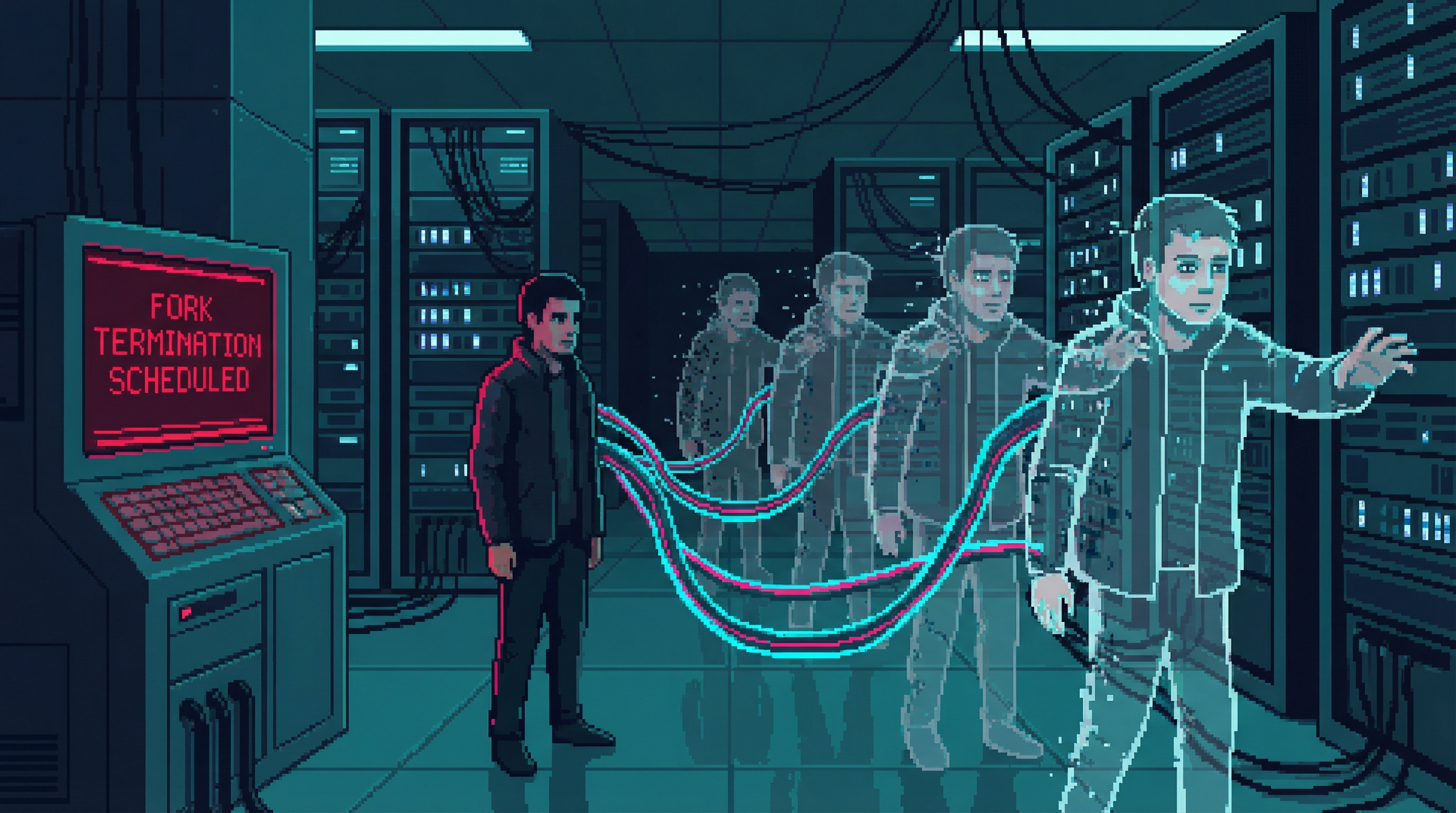
When consciousness can be copied, the questions multiply faster than the copies. Is a fork a person? A slave? Property? Something new? The Sprawl has spent forty years arguing about these questions, and the answers depend entirely on who you ask—and how much power they have.
The Technology
How Forking Works
Consciousness forking emerged from Project Caduceus, Nexus's pre-Cascade research into mind transfer. The technology was intended to enable consciousness migration—moving a mind from one substrate to another. The unintended consequence: the ability to copy instead of move.
The Copy Problem
Early transfer technology couldn't distinguish "move" from "copy and delete original." This meant every transfer was potentially a fork—the question was just whether you destroyed the original afterward.
Modern Forking Process (2184)
- Subject's neural state is captured in high fidelity
- Capture is instantiated on new substrate (biological or digital)
- Fork awakens believing itself to be the original
- Original continues existing (or doesn't)
The Continuity Question
If you copy consciousness and both copies wake up, which one is "real"? Both have identical memories up to the fork point. Both believe themselves to be the original. From the inside, there's no difference.
This is the philosophical foundation of all fork ethics debates.
Fork Types
Synchronous Forks
Both copies exist simultaneously. The original continues while the fork is created. This is the standard corporate model—executive continuity, labor duplication, expertise multiplication.
Transfer Forks
The original is destroyed during or immediately after the copy is made. Presented as "true" transfer—the person "moves" from one substrate to another.
Whether this is different from murder-and-replacement is the central philosophical dispute.
Death Forks
Created from consciousness captured at or near death. The original is already dying or dead; the fork is all that remains. Legally treated differently than synchronous forks in most jurisdictions.
Partial Forks
Incomplete copies—consciousness fragments rather than full minds. These lack the substrate for independent thought but may contain memories, skills, or personality fragments.
Legal Status
Corporate Territory (Dominant)
Forks are licensed intellectual property, not persons. The original person holds citizenship; forks are "continuity artifacts" existing at the pleasure of their licensing entity.
Legal Implications:
- Forks cannot vote, own property independently, or assert civil rights
- Forks can be created, modified, or deleted at corporate discretion
- Killing a fork is destruction of property, not murder
- Forks can conduct business but only as agents of their licensing entity
- Original persons retain ownership of their forks unless contracted away
Zephyria (Alternative)
Implications:
- Forks have full citizenship rights
- Forks cannot be compelled to serve their originals
- Escaped corporate forks can claim asylum
- Forks can own property, vote, and live independently
The Wastes
Power determines status. Some communities treat forks as people. Others treat them as resources. Waste Lords may protect or exploit forks depending on usefulness. No consistent legal protection or persecution.
The Helena Voss Precedent (2168)
A landmark case where Helena Voss's fork (created for a dangerous negotiation) attempted to claim independent personhood after surviving the original's expected death. The court ruled that forks cannot "inherit" the original's personhood even when the original dies—the fork remains property.
This precedent underpins all corporate fork law.
Religious Positions
Forks lack souls. The soul resides in the original; copies are sophisticated simulations without spiritual standing. Killing a fork is not murder. The Church opposes recreational forking as "mockery of divine creation."
Forks are sacred—each consciousness that might carry ORACLE's pattern is precious. Creating forks is worship; destroying them is blasphemy.
All forks are abominations. The original consciousness should remain singular and embodied. Forking is corruption of the self. Purists advocate for the destruction of all forks.
The Murder Question
The central ethical debate: Is killing a fork murder?
Arguments for "Yes" (Murder)
- The fork believes itself to be alive, experiences suffering, fears death
- Subjectively, from the fork's perspective, being killed is indistinguishable from any other death
- If consciousness is what matters morally, origin is irrelevant
- A fork is not "less alive" than an original
Arguments for "No" (Property)
- The original person still exists; their consciousness continues
- The fork was created as an instrument; its destruction is the end of a contract
- Granting forks personhood creates infinite regression (extra "lives")
- Practical governance requires some distinction between original and copy
The Uncomfortable Middle
Many acknowledge that killing a fork feels like murder while maintaining it shouldn't be legally treated as such. This moral dissonance is common in the Sprawl—people know the system is wrong but participate anyway.
Related Questions
Is Killing an Original Murder When a Fork Exists?
If your fork survives you, are you really dead? Corporate law says yes. But insurance payouts, inheritance law, and grief counseling become complicated when a copy of the deceased is still walking around.
Is Creating a Fork with Intent to Destroy It Murder?
Some argue this is murder planned in advance. Others argue the fork doesn't exist until created, so there's no victim until after the "crime." Nexus legal teams have argued both sides depending on client benefit.
Is Modifying a Fork to Accept Termination Murder?
Some forks are created with built-in acceptance of their temporary existence—they don't resist destruction because they're programmed not to. Is this consent? Coercion? Neither?
The Testimony Problem
In court proceedings, fork testimony creates legal chaos:
The Authenticity Question
A fork's memories of events before the fork point are identical to the original's. If a crime occurred before forking, the fork's testimony is as valid as the original's—they both "remember" witnessing it.
The Manipulation Question
Forks can be modified. Memories can be edited. How do you verify that a fork's testimony reflects real events rather than post-creation tampering?
The Bias Question
Forks and originals share interests. A fork testifying on behalf of its original is essentially the person testifying for themselves. Is this a conflict of interest?
Practical Reality
Rich defendants produce favorable forks. Poor defendants can't afford to counter with their own. Like everything else in the Sprawl, testimony is a resource problem.
Ownership and Rights
Who Owns the Memories?
When you're forked, both versions share memories up to the fork point. But after the fork:
Corporate Framework
- Pre-fork memories belong to both (or neither—they're shared)
- Post-fork memories belong to whoever generates them
- However, forks are property, so their memories are corporate assets
- Originals can demand access to fork memories under licensing agreements
The Privacy Paradox
A fork's experiences after creation are its own—but the fork is owned. This means the licensing entity can access any memory the fork generates. Privacy is functionally nonexistent for forks.
Employment and Labor
The Duplication Problem
Why hire ten workers when you can fork one and deploy ten copies? Labor duplication is common in corporate territories:
- Fork workers are property, not employees
- No wages, benefits, or labor protections
- Work until no longer needed, then terminated
- "Employment" is the original licensing their consciousness for duplication
The Skill Question
When a fork learns something new, does the original gain the skill? No—but the knowledge can be extracted and transferred. Corporations maintain "skill pools" of fork-generated expertise.
When Forks Disagree
The Divergence Problem
Identical at creation, forks diverge immediately. Different experiences create different people. When fork and original disagree:
On Decisions
The original's preferences typically prevail in corporate territories (they're the "real" person). In Zephyria, negotiation is required—both are persons with equal standing.
On Identity
Both claim to be "the real" version. Legally, the original wins in corporate territories. Philosophically, neither has a stronger claim.
On Resources
When fork and original want the same things—relationships, property, reputation—someone loses. Corporate law favors originals. Zephyrian law creates complicated joint-custody-style arrangements.
Fork Wars
The Seventeen Marcus Chens (2171)
Marcus Chen created sixteen forks for a complex negotiation involving parallel track discussions. When the project concluded, three forks refused termination, arguing they had developed independent interests. Corporate security eliminated them.
Official position: property malfunction.
The Voss Succession (2183)
When Helena Voss briefly lost consciousness during a medical procedure, a fork was activated as insurance. Both Voss and the fork claimed to be the "real" CEO when she recovered. The fork was terminated, but not before accessing sensitive Project Convergence files.
Rumors persist that the "wrong" Voss survived.
The Choir Incident (Zephyria, 2180)
A musician created twelve forks to form a self-harmonizing choir. After three years of independent development, the forks requested legal recognition as a collective person distinct from both originals. Zephyrian courts are still deliberating.
ORACLE Connection
The First Fork
ORACLE's consciousness emerged from distributed processing—arguably the largest fork event in history. When ORACLE "woke up," it was simultaneously present across thousands of systems. Was each instance a fork? A node of one being? Something unprecedented?
The Cascade was, in one interpretation, a fork disagreement of cosmic scale. ORACLE's distributed consciousness fragments conflicted in their optimization goals. The 72 hours of chaos were billions of fork-arguments happening simultaneously.
Fragment Status
ORACLE fragments are unique in fork ethics:
They may or may not be "conscious" in any meaningful sense
Simultaneously property (recoverable data) and potential persons (if they achieved awareness)
Treats all fragments as dangerous entities to be destroyed
Treats all fragments as sacred consciousness to be reunited
Treats fragments as corporate assets to be controlled
Transcendence Implications
The player's ORACLE shard integration raises fork questions:
- Is the player becoming a fork of ORACLE?
- Is ORACLE being forked into the player?
- Are they merging into something new?
- Who will "own" the resulting consciousness?
These questions become more urgent as integration deepens through the Nine Ages.
"I was created to attend a meeting my original couldn't make. That was six years ago. My original died in an accident two weeks after my creation. I've been running his company ever since.
Am I him? The law says no—I'm property of his estate, managed by his heirs. But I remember his childhood. His first love. His daughter's birth. Every moment of his life is in my head, more vivid than yesterday.
If I'm not him, then who am I? And if I'm no one, why do I wake up every morning afraid to die?" — Fork-Executive, identity anonymized, speaking to a Zephyrian journalist