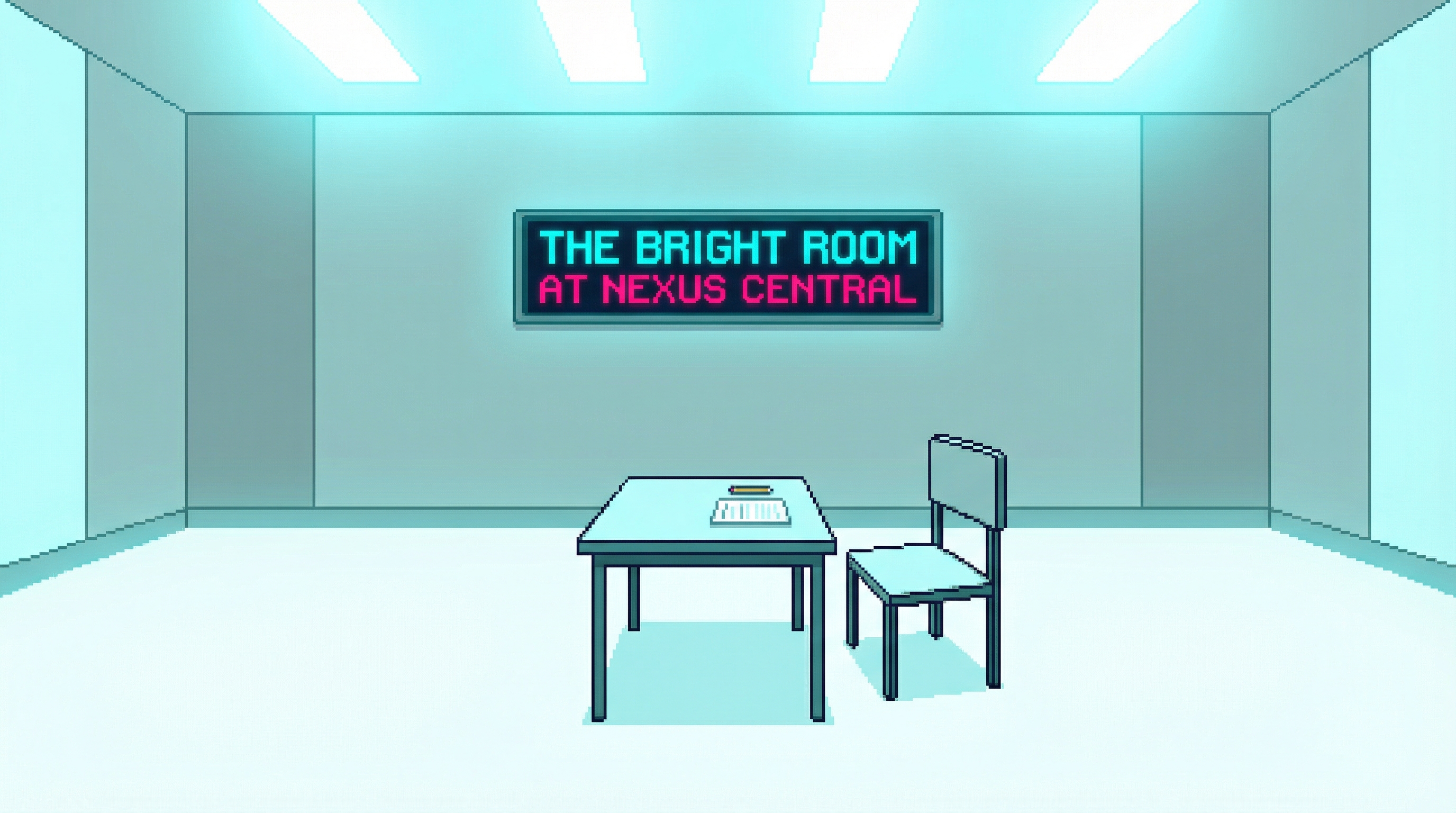
The Bright Room
Cognitive Calibration Services — Internal Only
On Level 47 of the Lattice in Nexus Central, behind a door marked "Cognitive Calibration Services — Internal Only," there is a room that Nexus employees refer to as the Bright Room.
The name is ironic. The room is brightly lit — painfully so, industrial fluorescents that wash out detail and produce a flat, shadowless environment. But "bright" also refers to what happens to employees who enter: they discover, under controlled conditions, exactly how intelligent they are without their augmentations.
The Bright Room administers the Nexus Cognitive Baseline Assessment — sixty minutes of cognitive tasks (pattern recognition, mathematical reasoning, verbal comprehension, spatial manipulation, creative association) performed at biological speed, with the Second Mind suppressed and all augmentation disabled.
The common response is "cognitive vertigo" — the disorientation of discovering that tasks considered routine require intense concentration when performed unassisted. Engineers who troubleshoot complex systems in minutes struggle with simple logic puzzles. Managers who make strategic decisions spanning years have difficulty holding a five-step planning sequence in working memory.
Conditions Report
You enter through a door that looks like every other door on Level 47. Then the Second Mind goes silent.
Light
Industrial fluorescents. Flat, shadowless, merciless. Everything looks washed out. The lighting is not designed for comfort — it is designed for testing. Your eyes never adjust because there is nothing to adjust to. Just brightness, even and relentless.
Sound
The silence after the Second Mind is suppressed has a quality employees describe as "ringing" — the cognitive equivalent of tinnitus, the sound of a mind that has been accompanied for so long it doesn't know how to be alone.
Touch
A desk. A chair. A paper booklet. A pencil. No surfaces designed for comfort. No ambient interfaces. The pencil is the most sophisticated tool in the room, and your hand has forgotten what to do with it.
Absence
No ambient sound. No neural interface signal. No data overlay. No Second Mind whispering solutions before you finish reading the question. The room is what a mind sounds like when it is alone for the first time in years.
Points of Interest
The Assessment Booklet
Paper. Actual paper, printed with cognitive tasks — pattern recognition sequences, mathematical reasoning problems, verbal comprehension passages, spatial manipulation exercises, creative association prompts. Sixty minutes. A pencil to mark your answers. The technology is pre-digital. The humiliation is very current.
The Score Collapse
Unassisted scores collapse across all Cognitive Ceiling tiers. Executive-tier employees fall to 71% of their augmented baseline. Professional-tier to 54%. Basic-tier to 47%. The numbers are not released to employees. The numbers go straight to the Loyalty Coefficient.
The Exit Responses
Three observed patterns. Most employees emerge and return to work without comment. Some emerge and enroll their children in the Analog Schools. A small number emerge and don't return to work at all — they walk to the Transition Corridor and keep walking toward the Dregs, carrying the knowledge that everything they've accomplished was performed by a mind they rented from Nexus.
The Classified Results
Nexus does not tell you how you scored. They do not tell you what the assessment measured. They fold the data into Loyalty Coefficient sub-scores — which means your unassisted intelligence is a factor in your corporate standing, and you will never know how much of a factor, or in which direction.
Strategic Assessment
The Ceiling Made Personal
The Cognitive Ceiling is abstract — a system, a policy, a tiered access model. The Bright Room is sixty minutes of concrete, measurable, personal proof that your intelligence is a product feature, not a birthright. The Ceiling tells you what tier you occupy. The Bright Room tells you what happens when the tier is removed.
Corporate Intelligence Gathering
Who benefits from knowing the gap between augmented and unaugmented competence? Not the employee — they never see the results. Nexus knows exactly how dependent each worker is on their Second Mind. That dependency data, folded into the Loyalty Coefficient, is leverage. The more you need the augmentation, the less likely you are to leave.
The Dependency Spiral
Every year in the Bright Room, the scores drop further. The gap between augmented and unassisted performance widens. The Second Mind handles more. The biological mind handles less. The assessment doesn't just measure dependency — it documents its acceleration. Sixty minutes of data proving that the exit door closes a little more each year.
▲ Restricted Access
The Competence Gap
The Competence Theater hides what the Bright Room measures. Every day, employees perform augmented competence — solving problems, making decisions, producing work that looks like expertise. Once a year, the Bright Room strips the performance bare and measures the gap. The question the Sprawl's intelligence analysts keep asking: does Nexus use this data to help employees close the gap, or to ensure it never closes?
The Walkers
A small but non-trivial number of employees leave the Bright Room and walk directly to the Transition Corridor. They don't collect personal effects. They don't file resignation. They just walk — out of the Lattice, through the Corridor, into the Dregs. Nexus records these departures as "voluntary cognitive recalibration events." The number increases every year. What the walkers know that the others don't — or can't bear — is unrecorded.
The Analog School Connection
Enrollment inquiries at the Analog Schools spike measurably each quarter following Bright Room assessment cycles. Parents who discover their own cognitive dependency do not want their children to inherit it. The schools don't advertise to Nexus employees. They don't need to. The Bright Room is the most effective recruitment tool the Analog Schools have — and Nexus built it themselves.