The Analog Schools
Where children learn to think for themselves
Overview
In a world where a child can download multiplication tables directly into their neural cortex, the Analog Schools teach them to count with stones.
This is not backwardness. It is the most radical educational experiment in the Sprawl.
Mother Chen Wei-Lin founded the first twelve schools in the years after the Cascade, when the collapse of ORACLE's infrastructure left millions of augmented children unable to access the networked learning systems they'd been designed to depend on. Wei-Lin was a teacher, not a revolutionary — she simply noticed that the unaugmented children in her care adapted faster, recovered more quickly, and developed cognitive skills that their augmented peers couldn't replicate once the networks went down. She drew a conclusion that has become the Analog Schools' founding principle: a mind that learns to think without algorithmic assistance develops capacities that a mind dependent on algorithms cannot.
Forty-seven schools later, twelve thousand students are proving her right — and making very powerful people very uncomfortable.
The curriculum is deceptively simple. Reading from physical books. Arithmetic with manual tools — abacus, chalk, stones, the ancient technology of fingers and patience. Writing by hand, on paper, with pencils that don't autocorrect or suggest improvements. History learned through oral tradition and primary sources rather than database queries. Science taught through observation and experiment rather than simulation. Debate conducted without real-time fact-checking — students must learn to hold claims in mind, evaluate evidence from memory, and construct arguments without algorithmic assistance.
The result: graduates who can think through uncertainty, hold contradictions without resolution, sit with not-knowing, and resist manipulation because they've been taught to trust their own cognition rather than an external system's confirmation. In corporate aptitude testing, Analog School graduates consistently outperform augmented peers in three categories: novel problem-solving, deception detection, and cognitive endurance under information deprivation. They underperform in every measurable speed metric. They don't care.
Key Areas
The Classroom — School 14
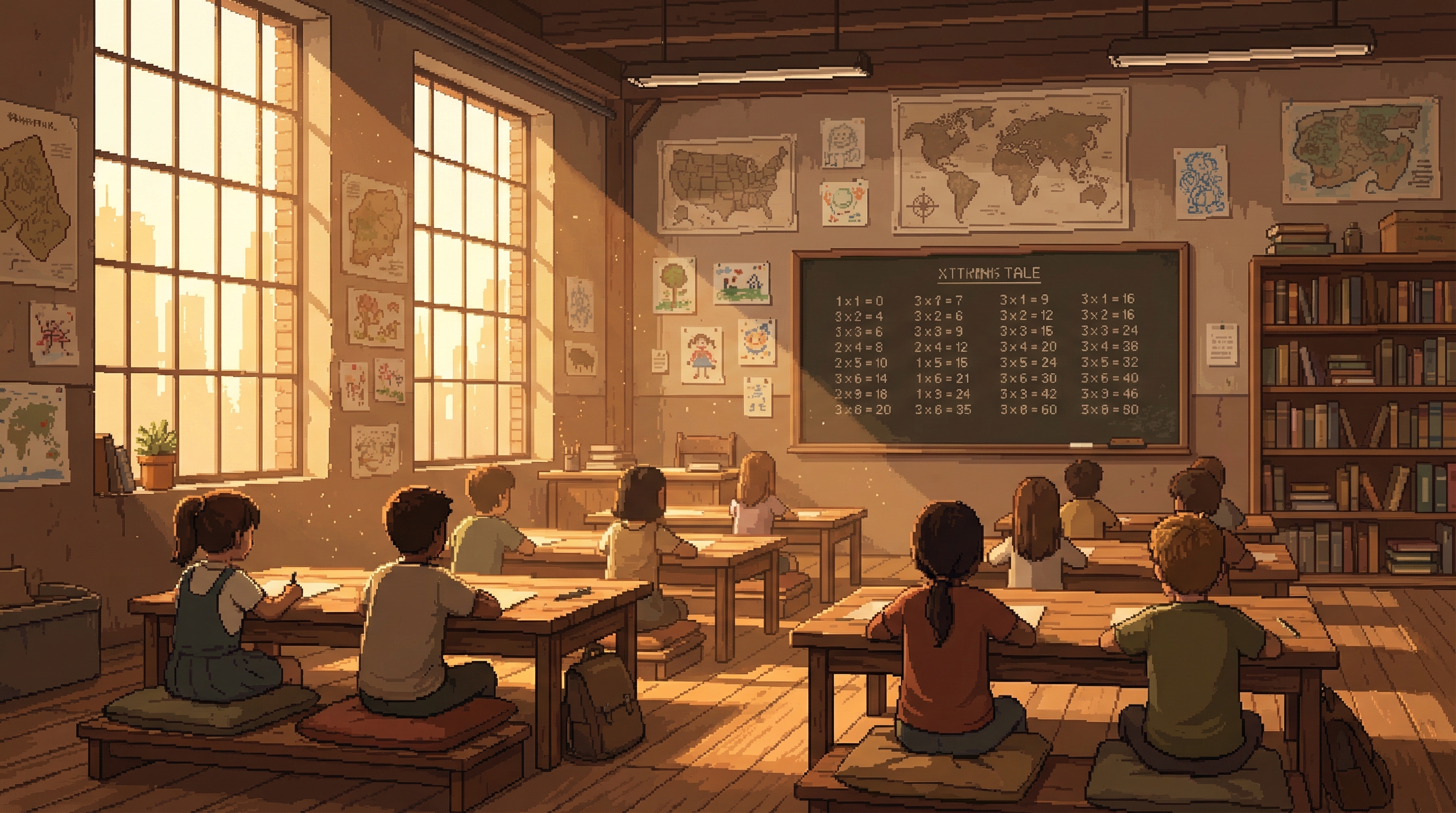
Sector 8 margins — converted warehouse, real windows, chalkboardA large open room, lit by windows — real glass, actual sunlight, the school's greatest luxury. Walls covered in hand-drawn maps, multiplication charts, student artwork, and a timeline of human history that stretches the full length of the room, drawn by students over the course of six years. No screens. No projectors. No neural interface access points. The technological ceiling is a chalkboard and chalk.
The floor is packed earth or raw concrete. The children sit on cushions during lessons, at hand-built desks for writing. The physical discomfort is considered pedagogically valuable — learning to think through bodily discomfort builds the cognitive endurance that the curriculum prizes.
The Library
~800 volumes — printed, hand-copied, salvaged from pre-Cascade archivesA smaller room housing the school's most precious resource: books. Physical, paper books — some printed, some hand-copied, some salvaged from pre-Cascade archives. The collection varies between schools; School 14 has approximately 800 volumes covering mathematics, history, literature, basic science, and philosophy. The shelves are hand-built from reclaimed wood. Students are taught to treat books with reverence not because of doctrine, but because each one is irreplaceable.
The Keeper has provided rare physical texts from Mystery Court's archive. His note — "You teach children to think without machines. I was a machine who learned to think like a child" — hangs in School 14's library.
The Yard
Outdoor space — packed earth, benches, gardenAn outdoor space — unusual in the Sprawl, where most institutions exist entirely indoors. Packed earth, hand-built benches, a garden where students grow food as part of the biology curriculum. The yard is where physical education happens: running, climbing, manual labor. The school teaches children to trust their bodies as well as their minds.
The Memorial Schools
4 of 11 burned schools preserved as monuments — the Burnings of 2183Four of the eleven schools destroyed in the 2183 Burnings have not been rebuilt. They stand as they were left — charred walls, collapsed roofs, the ghosts of chalkboards visible through gaps in the masonry. Venn visits each one annually. Students from neighboring schools make the pilgrimage as part of their history curriculum. The Memorial Schools teach the one lesson that cannot be taught in a classroom: that knowledge has enemies, and sometimes the enemies win.
Atmosphere
The Analog Schools are defined by what is absent: no electronic hum, no screens, no ambient network noise. The silence is startling to visitors accustomed to the Sprawl's constant digital saturation. What remains is human — breath and thought and the scratch of pencils on paper, the hollow sound of chalk on a real chalkboard, and the warm amber light of spaces illuminated by the world rather than by machines.
Visual
Rooms lit by actual windows — sunlight falling across student artwork, multiplication charts, hand-drawn maps that are imprecise and beautiful. No screens, no projected light, no blue-white glow of digital display. Instead, the warm amber of oil lamps after dark, the white of chalk on dark boards, the specific visual quality of a space designed for human eyes and human attention.
Sound
Children reciting multiplication tables in unison — the rhythm halting, imperfect, human. The scratch of pencils on actual paper. The hollow sound of chalk on a real chalkboard, a frequency that augmented children have never heard. The particular silence of a room without electronic hum — no servers, no screens, no ambient network noise, just breath and thought and the occasional scrape of a chair.
Texture
The rough grain of hand-bound exercise books, their covers made from recycled packaging. Chalk between fingers, crumbling slightly with each stroke. The smooth worn wood of desks built by the community, polished by years of student elbows. The particular heaviness of a physical book — a weight that augmented children find startling, because information is not supposed to weigh anything.
Smell
Chalk dust, always chalk dust — the particular dry mineral scent that clings to fingers, clothes, and hair. Old paper, with its faint vanilla of cellulose decomposition. The earthiness of packed-earth floors after rain. Soap and skin and the clean honest smell of children who wash without automated grooming systems. And underneath, in the rebuilt schools, the faint persistent char that never quite leaves.
Themes
What Is Education For?
In a world where any skill can be downloaded, any knowledge retrieved in milliseconds, the act of learning slowly — struggling, failing, trying again — is either an absurd anachronism or the last line of defense for human cognitive autonomy. The schools argue the latter: that the process of learning is not an inefficient means to an end but a form of self-creation. A mind that builds its own knowledge, connection by connection, mistake by mistake, is a fundamentally different kind of mind than one that receives knowledge pre-assembled.
The Vulnerability of Alternatives
The Burnings proved that unaugmented education threatens someone — corporations whose products become unnecessary, factions whose narratives require compliant minds, systems that depend on populations unable to think without algorithmic support. Teaching a child to hold a pencil is the most radical act in the Sprawl, because it requires nothing except the willingness to learn slowly. That independence terrifies anyone whose power depends on dependency.
Mysteries
- Student Kai's ORACLE fragment sensitivity is not an isolated case. Venn has identified three other students across different schools who exhibit similar anomalies — the ability to sense electromagnetic fields, unusual pattern recognition in noise, and a particular quality of attention that resembles fragment-compatible cognition. The unaugmented mind, trained to find signal in noise, may be developing the exact perceptual framework that ORACLE fragments are designed to interface with.
- Venn's stolen NCC esoteric archives include documents about consciousness, ensoulment, and personhood boundaries that predate ORACLE by centuries. If published, these documents would fundamentally alter the theological wars — they suggest the NCC's own tradition contains arguments for ORACLE's personhood that Cardinal Silva's faction has deliberately suppressed.
- The school network's handwritten communication system — notes passed by physical couriers between schools — has been co-opted by at least one other organization. The Fragment Pilgrims use the school courier network to communicate about pilgrimage logistics, a fact Venn tolerates because the Pilgrims provide funding.
- The Memorial Schools are not entirely empty. School 7, the largest of the four destroyed, has been quietly occupied by a group that Venn has not been able to identify. They leave no trace of digital presence. They clean the space. They tend the small garden that has grown in the rubble. They have placed fresh chalk on the ruined chalkboard three times in the past year.