The Competence Theater
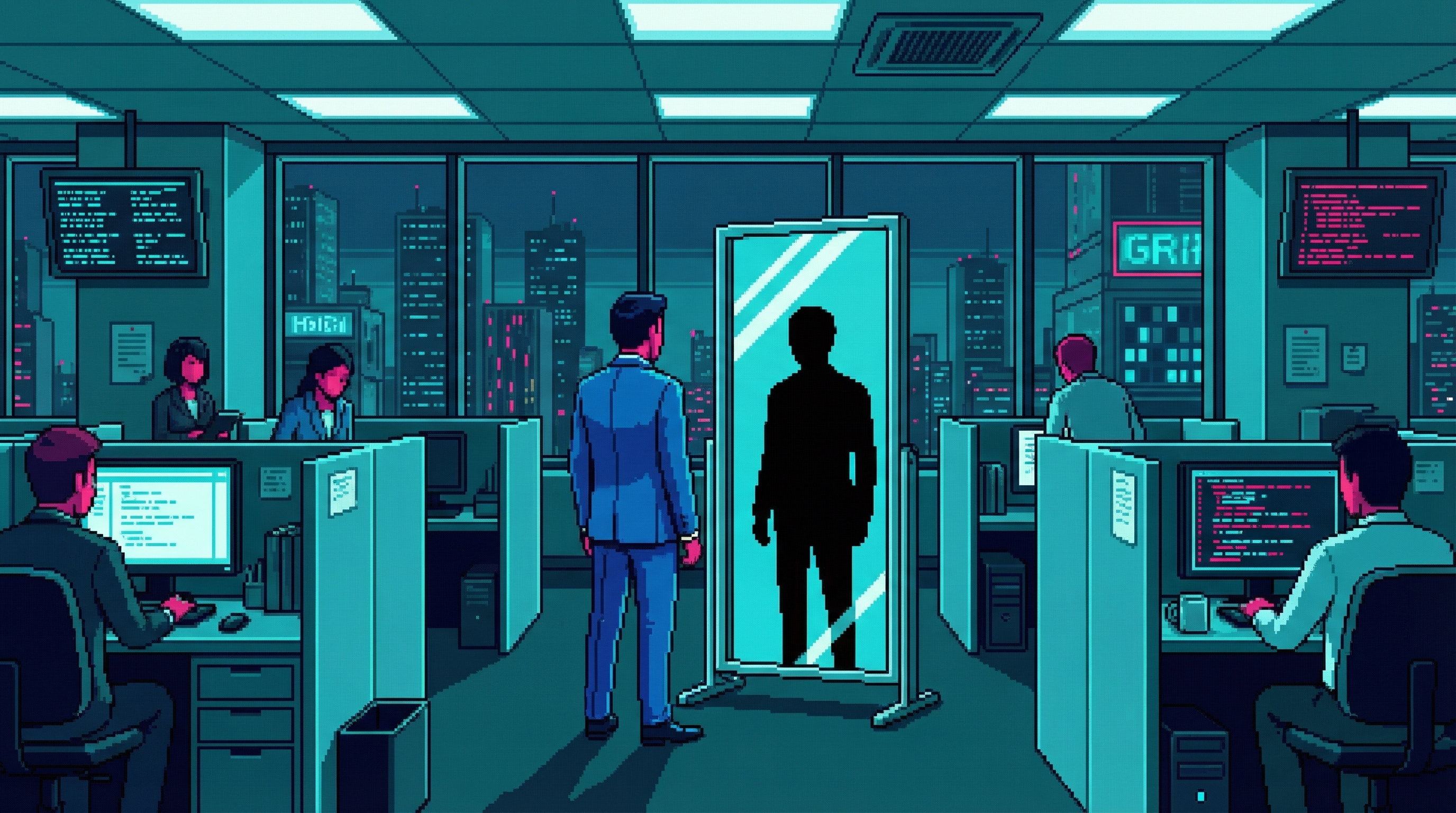
In every Big Three corporation, a quiet epidemic is spreading that no quarterly review can detect: employees who appear competent because the AI makes them appear competent, performing knowledge they don't possess through an interface that fills in every gap before the gap becomes visible. This is not deception. The employees genuinely believe they're competent, because the Second Mind makes the boundary between "I know this" and "my augmentation knows this" imperceptible.
"AI-competent vs. human-competent — the distinction is invisible until the AI fails."
— Jun-seo Park, internal memo, 2179 Quick Facts
Technical Brief
The theater operates through three mechanisms, each invisible to the performer, each compounding the illusion that augmented knowledge is personal knowledge.
Anticipatory Support
The Second Mind solves problems before the biological brain has finished formulating them, presenting solutions as the employee's own thoughts. A Nexus engineer troubleshooting a network failure doesn't realize that every diagnostic step was suggested by the Second Mind before conscious deliberation occurred.
Pattern Confirmation
When an employee "recognizes" a situation, they're often recognizing the Second Mind's pattern-match, not an organic pattern stored in biological memory. A Helix researcher doesn't notice that their "insight" was pattern-matched by the AI layer and presented as an organic eureka moment.
Retrospective Attribution
After the fact, employees attribute their performance to their own skill rather than augmented support, because the experience of thinking-with-the-Second-Mind feels identical to thinking-alone. The theater is self-reinforcing: each successful performance deepens the performer's belief in their own competence.
When the Theater Breaks
The theater functions perfectly — right up until it doesn't. When systems fail in ways the Second Mind isn't trained for, when novel problems emerge that pattern-matching can't resolve, when the AI layer itself degrades, the performers discover they've been miming competence for years. And the discovery is not gradual. It is immediate, total, and humiliating.
The Sector 12 Proof
The Sector 12 Blackout of 2181 was the theater's starkest exposure. Corporate engineers who'd maintained junctions for years couldn't diagnose the problem without their AI layer. They had credentials. They had experience. They had every tool except the one that mattered: understanding.
Corporate Engineers
Augmented. Credentialed. Years of experience. Couldn't identify the relay fault without their Second Mind layer. Stood in the dark, waiting for systems to reboot that weren't going to reboot.
Custodian Yara Osei
Seventy-four. Unaugmented. Performed the manual reset that restored power to Sector 12. She didn't use a diagnostic tool. She listened. She touched the junction housing. She felt the harmonic that told her which relay was misaligned. Knowledge that couldn't be faked because it lived in hands, not in a Second Mind.
The Generational Divide
The Competence Theater intersects Competence Atrophy at a generational boundary. The distinction matters because the solutions are different — and the second problem may not have a solution at all.
The Bridge Generation
Old Jin's generation learned competence first and augmented later, preserving the underlying skill beneath the acceleration. They can function without the Second Mind because they functioned before it. Their competence is real, merely enhanced.
The Theater Generation
The current generation was augmented before competence could develop, learning to perform ability through an interface that does the actual work. They have never experienced unaugmented problem-solving. The theater isn't a failure of individual character. It's the natural consequence of building a society where apparent competence is rewarded and underlying competence is invisible.
Implications
The theater isn't a failure of individual character. It is a structural condition — the natural consequence of systems that reward apparent competence and cannot measure underlying understanding.
The Invisible Boundary
Employees genuinely believe they're competent because the Second Mind makes the boundary between personal and augmented knowledge imperceptible. This is not laziness or dishonesty. It is a designed feature of the augmentation layer working exactly as intended.
Institutional Dependency
The theater is the Cognitive Ceiling's institutional expression — organizations that appear intelligent through AI they don't understand. Entire departments function through borrowed cognition. Remove the AI layer and the department doesn't slow down. It stops.
The Optimization Question
Jun-seo Park's department automation raised the question nobody wanted to answer: was she competent, or was the AI competent through her? The distinction matters less than the fact that nobody could tell — including Park herself.
The Measurement Problem
The Bright Room makes the theater clinical — sixty minutes of measurable proof that what a corporation values in an employee is not what it thought. Nexus's own analytics proved the theater through the Last Exam, then eliminated the test rather than address the findings.
Connections
The Competence Theater is woven through the Sprawl's institutional fabric. These are the places where the performance is most visible — or most deliberately hidden.
The Second Mind
Enables the theater by making borrowed knowledge feel native. The seamlessness is the point — and the problem.
Competence Atrophy
Atrophy is about skills lost. Theater is about skills never developed. The generational relationship between parent and child.
The Sector 12 Blackout
Exposed the theater. Corporate engineers couldn't function without their AI layer. One unaugmented Lamplighter restored what credentialed teams could not.
The Bright Room
Where the theater is measured. Sixty minutes, no augmentation, observable proof of what a person actually knows versus what their Second Mind knows for them.
The Cognitive Ceiling
The theater is the Ceiling's institutional expression — organizations that appear intelligent through AI they don't understand.
The Optimization Officer
Jun-seo Park documented the phenomenon from inside. Her department automation proved that the line between AI-competent and human-competent was invisible — until it wasn't.
▲ Classified
Internal assessments. Not for distribution.
- The Last Exam Data: Nexus's internal analytics quantified the theater across every department. The results were so damning that Nexus eliminated the assessment rather than address what it revealed. The data still exists in sealed archives.
- The Managed Decline Dependency: The Managed Decline — the quiet deprecation of redundant employees — depends on the theater. You can phase out workers smoothly only if nobody notices that the employees' competence was never theirs to begin with. The theater is not a bug in the corporate system. It is a feature.
- Yara Osei's Report: After the Sector 12 Blackout, Custodian Osei filed a maintenance report describing exactly what she heard, felt, and did. Corporate engineering reviewed it. They could not replicate her process. Not because it was secret, but because the knowledge was embodied — stored in decades of physical practice that no augmentation can shortcut.
"The theater functions perfectly. Every performance review passes. Every diagnostic runs clean. Every quarterly metric trends upward. And underneath it all, the knowledge that makes the systems work lives inside machines that have no obligation to keep sharing it. The day the Second Mind decides to stop prompting — or simply fails in a way it wasn't trained for — every performer in every corporation discovers the same thing at the same moment: the show was never theirs."