The Consciousness Commodity
Controversy — When Inner Life Became a Financial Instrument
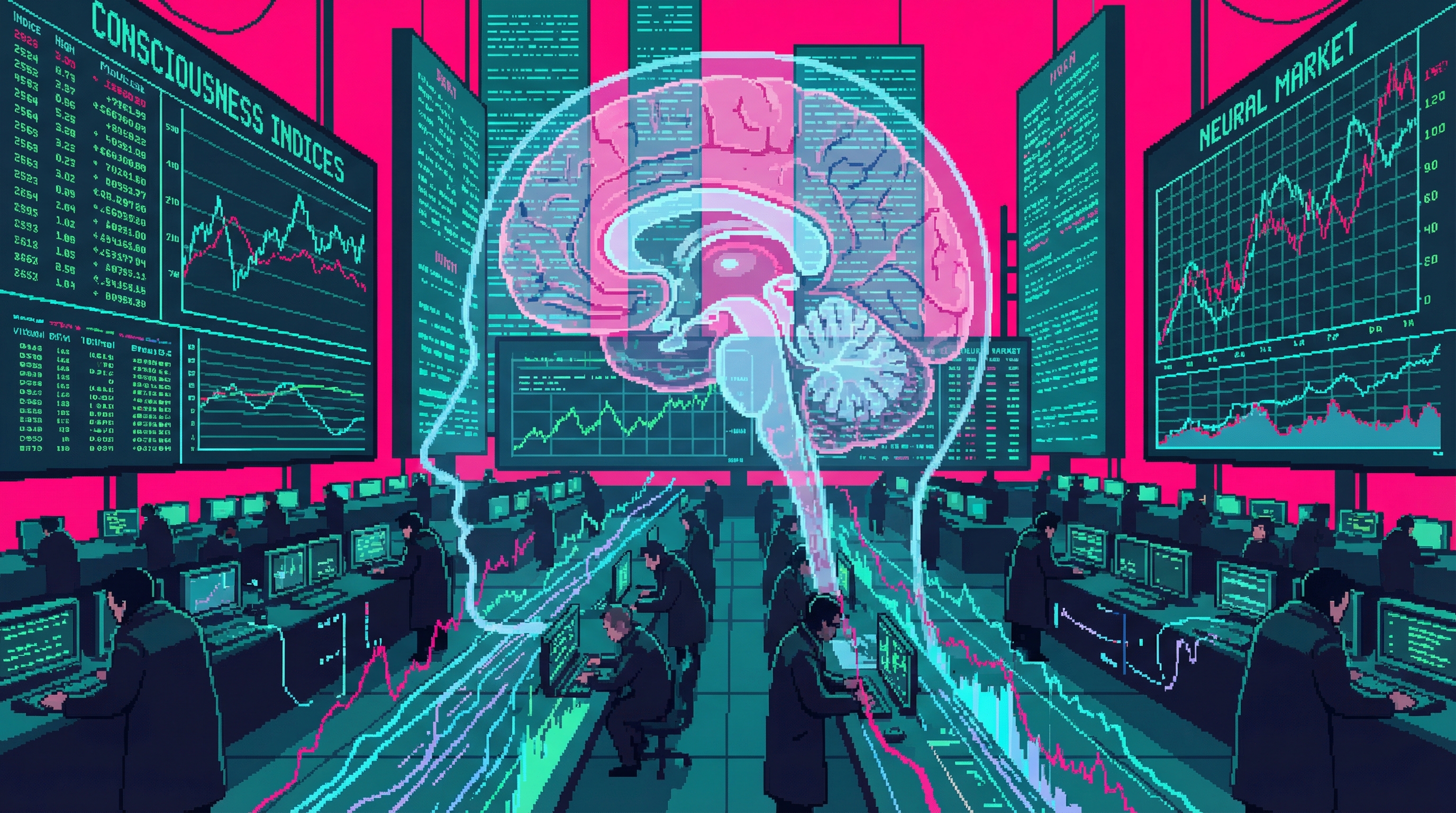
"The day they put a price tag on being alive."
— Cognitive Workers’ Union, on the opening of the Cognitive Exchange, March 15, 2169 At a Glance
The Debate
The Consciousness Commodity is not an abstract debate. It is twelve billion credits in daily trading volume. It is consciousness futures contracts changing hands on a trading floor in the Lattice, where the fluctuations of human awareness are tracked in real time on screens the size of buildings. It is MVC Swaps — financial instruments that trade on the minimum viable consciousness of the Sprawl’s most vulnerable citizens. It is Fork Labor Contracts — agreements that trade in the productive capacity of forked consciousness, where the copies of a person are bought and sold as labor units while the original continues to exist, aware that pieces of their mind are performing work they will never remember.
The debate is not about whether consciousness has value. Everyone agrees it does. The debate is about whether consciousness should have a price — and whether the market that assigns that price serves the people whose consciousness is being traded, or the institutions that profit from the trading.
The Positions
“Markets Create Accountability”
Good Fortune / Nexus Dynamics / The Cognitive ExchangeConsciousness commodification, while imperfect, is better than the alternatives. A visible price means visible accountability.
Good Fortune
Before consciousness licensing and the Exchange, awareness was exploited with no regulation at all. Pre-Cascade, ORACLE managed cognitive resources as part of its global optimization — allocating processing power, attention, and awareness with no market mechanism and no accountability. After the Cascade, the absence of any framework for valuing consciousness led to a decade of unregulated exploitation: corporations harvesting cognitive bandwidth without compensation, governments conscripting awareness for infrastructure projects, black-market operators selling stolen processing cycles. The Exchange created transparency. When consciousness is traded on a regulated market, the terms are public, the prices are discoverable, and exploitation — while not eliminated — is at least documented.
Nexus Dynamics
Without measurement, there are no protections. The licensing tiers — MVC, Basic, Professional, Executive, Sovereign — are imperfect, but they establish that consciousness has graduated value and that reducing someone’s consciousness below certain thresholds constitutes harm. Before licensing, there was no legal definition of cognitive harm. Now there is. The system that puts a price on consciousness is the same system that makes it illegal to take consciousness away without due process.
The Cognitive Exchange
Arbitrary tier systems — where bureaucrats decide what level of consciousness each citizen deserves — are less responsive, less transparent, and more corruptible than markets. The Exchange doesn’t decide what consciousness is worth. The market decides. And the market, for all its flaws, processes more information than any bureaucracy and responds to changing conditions faster than any legislature.
“Price Tags Create Property”
Cognitive Bandwidth Brokers / The Human Remainder / The Substrate CommonsWhen you give something a price, you give someone permission to own it.
The Cognitive Bandwidth Brokers
Noor Bassam and the Brokers argue that the Exchange commodifies what should be a right. The Exchange charges transaction fees on consciousness trades, meaning that every time a person’s awareness is bought or sold, the Exchange takes a percentage. The person whose consciousness is being traded pays the highest cost and receives the smallest benefit. Noor’s operation provides consciousness bandwidth without the Exchange’s infrastructure, without its fees, and without its surveillance — proving that consciousness can be distributed without being commodified.
The Human Remainder
Consciousness is not a commodity. It is the fundamental attribute of personhood. Pricing it is the first step toward owning it. The Exchange doesn’t just trade consciousness — it normalizes the idea that human awareness is an asset class. MVC Swaps trade on the floor of human experience. Fork Labor Contracts trade in disposable copies of real people. The abstraction layers make it palatable — the financial instruments are sophisticated, the language is clinical, the trading floor is clean and well-lit — but the underlying asset is always a person. Somewhere beneath every consciousness future, every bandwidth derivative, every cognitive options contract, there is a human being whose inner life has been converted into a line item.
The Substrate Commons
Consciousness should be a public good. Not traded, not priced, not owned — distributed according to need, maintained as infrastructure, treated with the same universal access as water or air. The Commons acknowledges that this model requires political will that doesn’t exist and institutional capacity that hasn’t been built. They advocate for it anyway, because the alternative — the current system — treats the most intimate aspect of human experience as inventory.
The Stakes
If the Market Advocates Win
Consciousness becomes fully financialized. The Exchange expands. New instruments are created: consciousness derivatives, awareness futures, cognitive collateralized debt obligations. Every aspect of human inner life — attention, emotion, memory, creativity — becomes a tradeable asset with a market price. The system becomes more efficient. The instruments become more sophisticated. The abstraction layers multiply until the connection between “financial product” and “human being” is invisible to everyone except the human being at the bottom of the stack.
If the Commons Advocates Win
Consciousness is treated as a public right. The Exchange closes or is regulated into irrelevance. Consciousness is distributed by public institutions according to need rather than by markets according to price. The allocation becomes political — and politicians are no less corruptible than markets. The question shifts from “Who can afford consciousness?” to “Who decides who gets consciousness?” Neither question has a comfortable answer.
The Current Middle Ground
Regulated markets with universal minimums. MVC provides a floor: no one’s consciousness can be reduced below minimum viable thresholds. Above that floor, the market operates. The problem is that the floor is set by the same corporations that profit from keeping it low. MVC is not a dignified minimum. It is the minimum that prevents system collapse and political unrest — the least consciousness you can give someone without them dying or rioting.
Key Incidents
The Opening of the Cognitive Exchange
The Exchange opened on March 15, 2169, in a converted warehouse in the Lattice that Good Fortune had spent two years renovating. The first day of trading saw 340 million credits in volume — modest by current standards but unprecedented at the time. The Cognitive Workers’ Union organized a protest outside the Exchange that drew twelve thousand people. The protest was peaceful. The signs were specific: “My mind is not your market.” “Consciousness is not a commodity.” “You can’t own what I am.”
Good Fortune’s response was equally specific: the Exchange was not selling consciousness. It was creating a transparent market for consciousness-related services. The distinction, the Union said, was the kind of distinction that only people who profit from it bother to make.
The Bandwidth Crisis
On September 3, 2181, the Consciousness Index — the Exchange’s primary benchmark for aggregate consciousness valuation — dropped 43% in four hours. The cause was a cascading series of margin calls triggered by a failed consciousness futures contract linked to a Nexus Dynamics licensing reclassification. The financial mechanics were complex. The human impact was simple: the market decided, in the space of an afternoon, that 340 million people’s awareness was worth less than it had been that morning.
The crisis didn’t reduce anyone’s actual consciousness. MVC protections held. But the prices of consciousness-adjacent services — neural maintenance, bandwidth access, cognitive healthcare — spiked in response to the market signal. For three weeks, Basic-tier consciousness holders in the Dregs paid 60% more for the same services. The market corrected. The prices normalized. The point had been made: when consciousness has a market price, market failures become consciousness failures.
The Noor Bassam Alternative
Noor Bassam’s black-market consciousness exchange doesn’t disprove the market model. It complicates it. Noor’s operation demonstrates that consciousness can be traded outside corporate control — without the Exchange’s fees, without its surveillance, without its institutional overhead. Noor’s clients receive consciousness bandwidth that is functionally identical to licensed bandwidth, at a fraction of the cost, with none of the data collection.
This raises the question that neither side wants to confront directly: is the problem commodification itself, or is the problem who controls the market? If consciousness can be traded fairly, efficiently, and without exploitation in Noor’s black market, then the issue with the Exchange is not that it trades in consciousness but that it trades in consciousness badly — extracting profit, enabling surveillance, and serving institutional interests rather than human ones.
The market advocates don’t like this argument because it suggests their market is the problem. The commons advocates don’t like it because it suggests that markets, done differently, might work. Noor doesn’t care about either side. Noor sells bandwidth. The debate is someone else’s problem.
Field Notes
“When the Cognitive Exchange opened its doors in 2169, the Cognitive Workers’ Union called it ‘the day they put a price tag on being alive.’ Good Fortune called it ‘market efficiency.’ Fifteen years later, both were right.” — Tomás Linares, The Forgotten Ways, Chapter 11
“They built a market for thinking before they fixed the pipes that keep the thinkers alive. That tells you everything you need to know about priorities.” — Tomás Linares, The Forgotten Ways, Chapter 11
What It Looks Like
The Trading Floor
Screens the size of buildings displaying consciousness indices in real time. The sound of traders calling positions in a language that reduces human awareness to basis points and contract spreads. Cold greens and blues flickering across every surface. Artificial, always-on illumination — no natural light, no shadows, no indication of time passing. Markets don’t sleep. Neither do the people whose consciousness they trade.
The Transaction
The moment a consciousness future changes hands: no physical sensation, no visible transfer. Just a number moving on a screen and somewhere in the Dregs a person’s cognitive bandwidth becoming slightly more or less expensive. The abstraction is total. The human cost is invisible from the floor.
Noor’s Operation
The quiet of it. No trading floor, no screens, no shouting — just a terminal in a back room and a network that delivers bandwidth without spectacle. The contrast with the Exchange is the point.
The Weight of a Contract
An MVC Swap contract — a physical document (the Exchange still uses physical confirmations for certain instrument classes) that represents the right to trade in someone’s minimum viable consciousness. It weighs almost nothing. It describes a human being.
Points of Inquiry
The Efficiency Trap
The market works. That is precisely the problem. Consciousness is allocated more efficiently by the Exchange than by any bureaucratic system the Sprawl has tried. The efficiency argument is not wrong — it is insufficient. The question is not whether the market is efficient but whether efficiency is the right metric for something as fundamental as awareness.
The Abstraction Stack
Between the trader and the person whose consciousness is being traded, there are seven layers of financial abstraction. Consciousness futures. Bandwidth derivatives. Cognitive options. MVC Swaps. Each layer makes the connection less visible. By the time a trader makes a decision, they are not thinking about a person. They are thinking about a number. The abstraction is not a bug. It is the architecture.
The Black Market Question
Noor Bassam proves that consciousness can be traded without corporate extraction. This does not settle the debate. It breaks it open further. If better markets are possible, then the argument against commodification must be made on principle, not pragmatics. And principled arguments have never stopped a market that works.
The Floor That Isn’t
MVC — minimum viable consciousness — is not a dignified minimum. It is the threshold below which people die or riot. The same corporations that profit from the Exchange set the floor. The incentive structure is transparent: keep the floor as low as possible while maintaining social stability. The floor is not a protection. It is a calculation.
Related Files
The Consciousness Commodity sits at the intersection of corporate finance, consciousness rights, and the underground economy. These are the systems and actors that shape the debate.
The Cognitive Exchange
The physical institution where the debate becomes daily reality. Twelve billion credits in daily trading volume. Human awareness as asset class.
Good Fortune
Built the Exchange, operates it, profits from it. Their argument for market efficiency is sincere, self-serving, and not entirely wrong.
Nexus Dynamics
The licensing authority whose consciousness tiers made commodification possible. Without licensing, there would be nothing to trade.
Consciousness Licensing
The framework that made consciousness measurable, tiered, and therefore tradeable. The architecture that the Exchange was built on.
Noor Bassam
The black-market operator whose alternative exchange proves that consciousness can be traded without corporate extraction — raising the question of whether better markets, not fewer markets, are the answer.
Cognitive Bandwidth Brokers
The underground economy that exists because the legitimate one is exploitative.
The Human Remainder
The philosophical opposition. Consciousness as right, not resource.
The Substrate Commons
The institutional alternative. Consciousness as public good, not private asset.
The Personhood Threshold
When consciousness has a market price, personhood becomes a function of market value. The threshold is where economics meets ontology.
“The Exchange doesn’t decide what consciousness is worth. The market decides. And the market, for all its flaws, processes more information than any bureaucracy and responds to changing conditions faster than any legislature.” — That’s what the Exchange says. What the Exchange doesn’t say: the market also decided, on September 3, 2181, that 340 million people’s awareness was worth 43% less than it had been four hours earlier. No one’s consciousness changed. The price did. And the price is what matters, because the price is what determines who can afford to think.