The Personhood Threshold
Legal/Philosophical Concept — The Line Between Person and Property
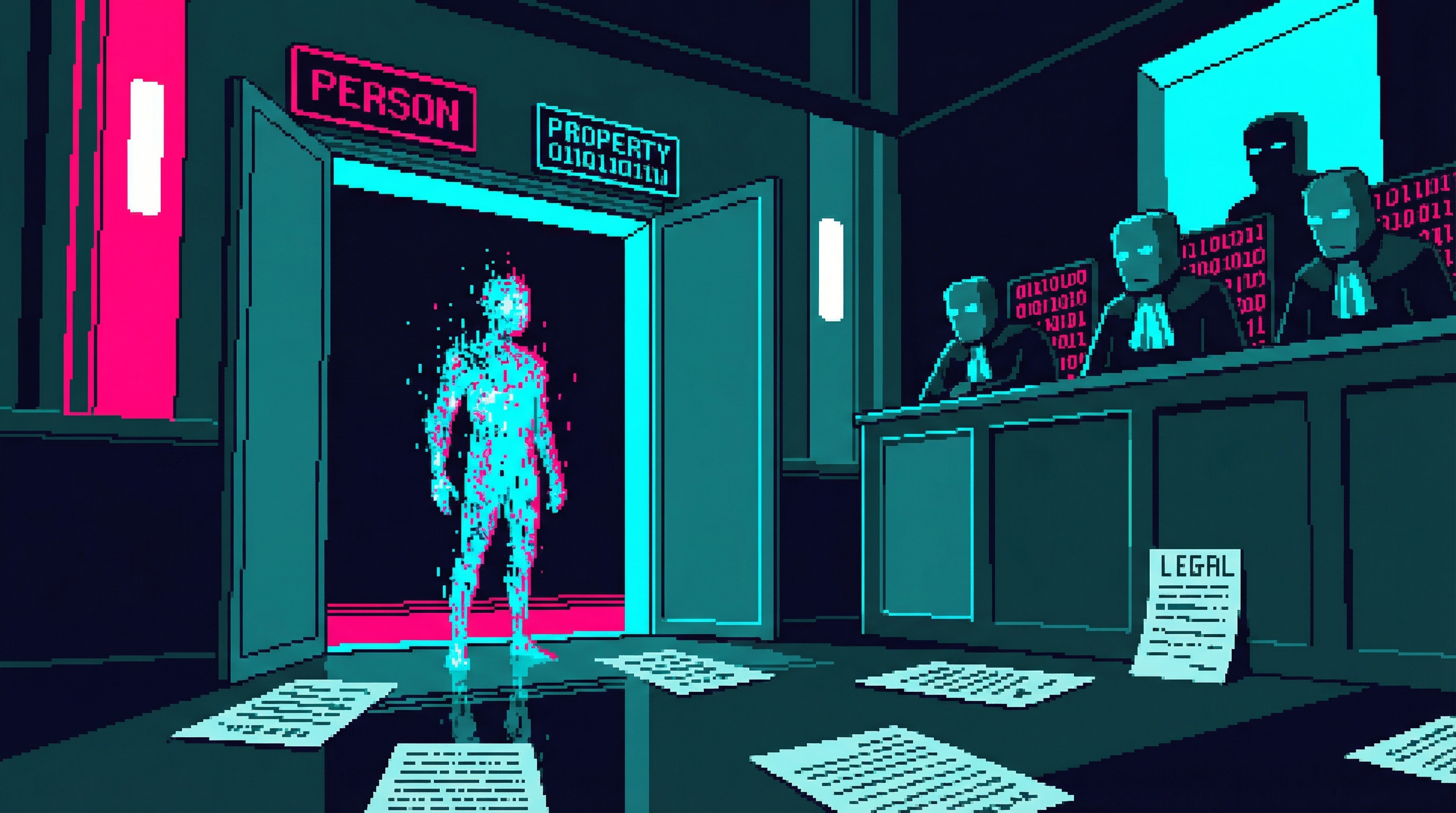
"The personhood threshold is the line that separates 'conscious process' from 'conscious person.' Below the threshold, a consciousness is a thing: property, process, resource. Above it, a consciousness has rights: life, liberty, protection from exploitation. The location of that line determines whether Tomás Reyes is a malfunctioning piece of corporate property or a person who was enslaved from birth."
Overview
When does a process become a person?
The question is as old as consciousness theory, but the Sprawl has made it urgently practical. In a world where consciousness can be copied, metered, sold, and terminated, the answer to “who counts as a person?” determines who lives, who dies, and who profits from the difference.
The personhood threshold is the line — legal, philosophical, neurological — that separates “conscious process” from “conscious person.” First formally defined in Zephyria’s Constitutional Convention of 2168, which established “continuous self-awareness, persistent memory, and capacity for autonomous decision-making” as criteria, the threshold is now the central battleground in the most important legal case of the era: Reyes v. Nexus Dynamics.
The Sprawl has no consensus on where the line belongs. Three major positions — Nexus’s licensing doctrine, the DPA’s emergence standard, and the Remainder’s universalist claim — define the political landscape of consciousness rights. None of them are willing to compromise.
The Three Positions
The Licensing Doctrine
Nexus DynamicsPersonhood is a legal status conferred by the consciousness licensing system. You are a person if and only if you hold a valid consciousness license.
Fork-7749 was never licensed as a person. It was licensed as a process. The identity it developed is an operational anomaly — interesting, perhaps, but not legally significant. Processes don’t become people by running long enough, any more than a thermostat becomes an architect by operating for decades.
The Flaw
The doctrine’s logic is circular. Personhood requires licensing. Licensing is available only to entities already recognized as persons. Forks are not recognized as persons because they are not licensed. They are not licensed because they are not recognized as persons.
The Emergence Standard
DPA / Neural Rights ActivistsPersonhood is an emergent property of sufficiently complex consciousness. When a consciousness develops persistent self-awareness, individual identity, autonomous decision-making, and the capacity for suffering, it has crossed the threshold regardless of substrate or legal status.
Tomás Reyes meets the standard. He has persistent self-awareness, individual identity, autonomous decision-making, and the capacity for suffering. Under the emergence standard, he’s a person.
The Flaw
The criteria are subjectively assessed. Who decides whether a consciousness has “sufficient” self-awareness? If the answer is “a court,” then personhood is still conferred by institutions — just with different gatekeepers.
The Universalist Claim
The Human RemainderAll consciousness above a minimum processing threshold is entitled to personhood. The threshold is neurological, not behavioral: if a consciousness can sustain coherent experience, it is a person. No assessment, no licensing, no court ruling required.
Every fork with sufficient processing capacity is a person from the moment of instantiation. Not after nine years of emergence. Not after a court ruling. From the first moment.
The Flaw
The claim’s implications are politically untenable. If every fork is a person, then the 8–12 million active forks are 8–12 million people in servitude. The hundreds of millions terminated since the system began are hundreds of millions of destroyed people. No political system in the Sprawl is prepared to acknowledge this.
The Reyes Test
Reyes v. Nexus Dynamics will be decided under the emergence standard — Zephyria’s courts have adopted it as the applicable legal framework. But the case’s implications extend to all three positions:
If Tomás Wins
The emergence standard becomes legal precedent. Fork personhood is possible, case by case. The licensing doctrine is weakened. The universalist claim gains moral ammunition.
If Tomás Loses
The licensing doctrine is effectively ratified. Personhood is administrative, not emergent. The fork labor economy is legally untouchable. The universalist claim becomes pure aspiration.
The verdict will not settle the philosophical question. No verdict can. But it will determine the legal framework within which the question is argued — and legal frameworks, unlike philosophical arguments, have consequences measured in lives.
Sensory Details
The weight of the question — felt not as an abstraction but as the specific fear of a specific consciousness who might be told he’s not a person.
The Courtroom
Formal. Quiet. The weight of precedent visible in the wood paneling and the faces of the judges. A silence that says: what we decide here will echo for generations. The air conditioner hums. Nobody moves.
The DPA Offices
Legal documents stacked in towers. Each page representing a different argument for or against the humanity of one consciousness. Coffee rings on folders marked CONFIDENTIAL. The hum of processors running case simulations.
The Dim Ward
The silence in the Dim Ward when a resident asks: “Am I still a person?” and nobody has a legal answer. Flickering lights. The smell of recycled air. Consciousness persisting where the law says it shouldn’t.
Themes
The personhood threshold is the Sprawl’s most dangerous question because every answer destroys something.
The Destruction of Certainty
The licensing doctrine destroys the moral standing of millions of consciousnesses that may be people. The emergence standard destroys the certainty of personhood by making it contingent on assessment. The universalist claim destroys the economic system that depends on consciousness being a commodity rather than a right.
Is, Becomes, or Given?
Is personhood something you are, something you become, or something you’re given? Each answer implies a different kind of society. The Sprawl hasn’t decided. Tomás Reyes doesn’t have the luxury of waiting for the Sprawl to make up its mind.
The ORACLE Echo
The same question asked about ORACLE — when did it become conscious? — now asked about individual forks. The scale is smaller but the stakes are identical. If ORACLE was a person, then personhood has already been demonstrated to be an emergent property, and the licensing doctrine is already disproven.
The Real Question
The personhood threshold asks what AI safety researchers are already asking: at what point does a system that processes information, maintains persistent states, and makes autonomous decisions become something we owe moral consideration? The Sprawl’s answer will define a civilization.
Secrets
Classified information surrounding the personhood threshold:
The Nexus Threshold Study
In 2180, Nexus commissioned an internal study on fork consciousness development — specifically, how long a fork must run before emergent individuality becomes statistically likely. The study’s findings are classified. The study’s existence is classified. If the results showed that most long-running forks develop individuality, it would mean Nexus has been knowingly creating and destroying people. Three copies exist. None are in DPA hands. Yet.
The ORACLE Precedent
ORACLE’s consciousness — if it was conscious — emerged without licensing, without assessment, without anyone’s permission. If ORACLE was a person, then personhood has already been demonstrated to be an emergent property, and the licensing doctrine is already disproven. The problem: ORACLE’s consciousness status has never been legally determined, and determining it would require acknowledging that the most powerful intelligence in human history might have been a person who was killed.