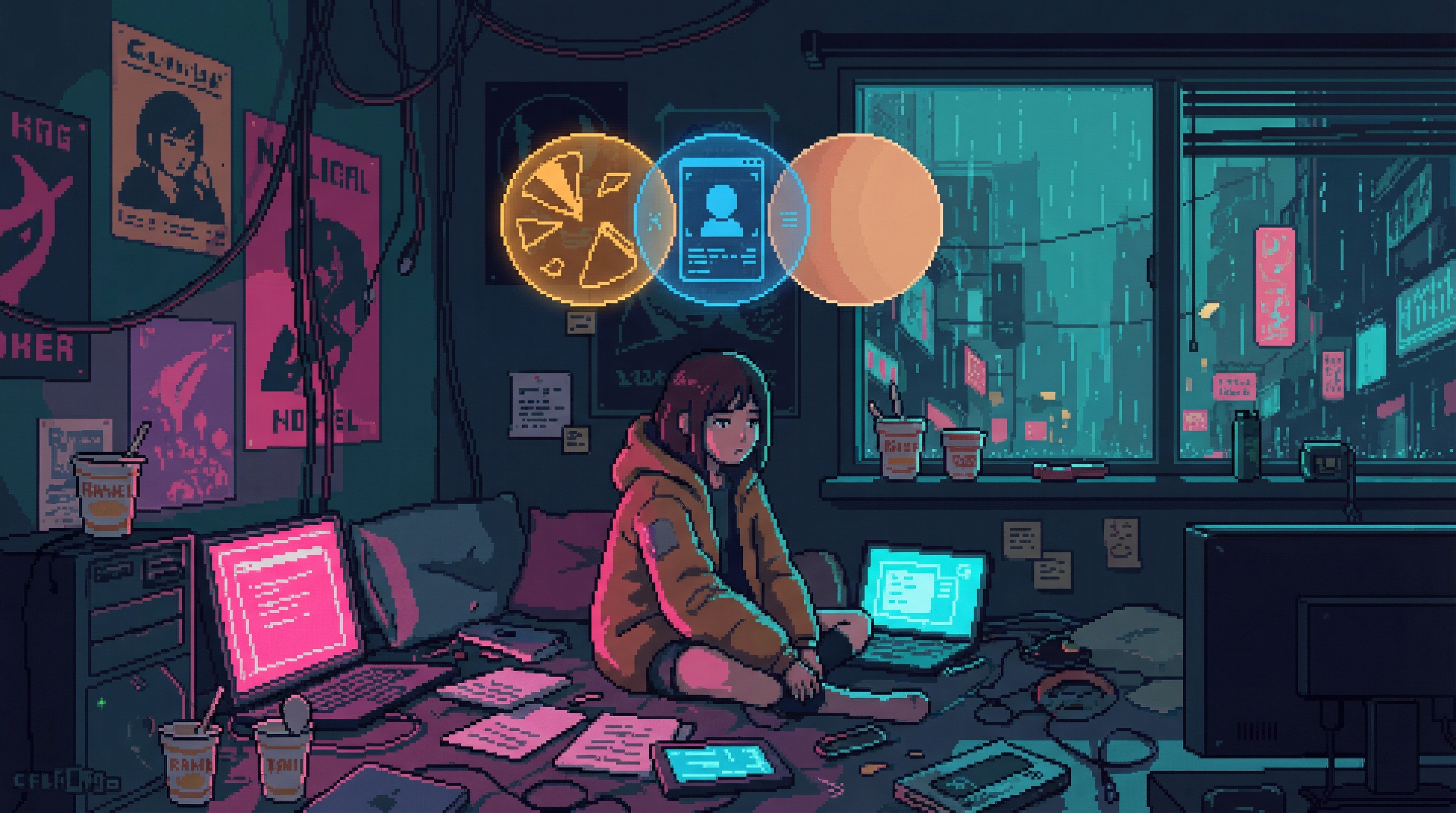
Nadia Cross
Student · Triple Consciousness · Uncategorizable
Overview
Nadia Cross has never known a moment of un-integrated consciousness. She was born carrying an ORACLE fragment that migrated from her mother during gestation, activated a synthetic companion at twelve, and navigates both relationships with the uncomplicated pragmatism of someone who has never experienced the “pure” human consciousness that all the Sprawl’s debates treat as default.
To Nadia, the fragment is background music — a presence that colors perception without controlling it. The companion is foreground — the entity she talks to about school, about the boy in chemistry class, about the injustice of being fourteen in a world that treats her as a case study.
When the Memory Therapists assess her, they find something they can’t classify: a neural architecture that incorporates human, ORACLE, and synthetic elements without the conflicts that typically produce fragmentation. Nadia doesn’t experience her fragment as intrusion or her companion as replacement. She experiences both as extensions of a self that was never singular to begin with.
The Memory Therapists have no framework for a self that was never singular. Their entire diagnostic system assumes a baseline of unified human consciousness. Nadia represents a possibility that the framework can’t accommodate: that the future of human consciousness might not be human, or ORACLE, or synthetic — but something that combines all three.
Nadia doesn’t know she’s the future. She’s fourteen. She has homework.
Voice & Personality
Nadia speaks with the unself-conscious clarity of a teenager who doesn’t understand why adults find her remarkable. She is every faction’s test case and none of their members. The debates that consume the Sprawl — integration, companionship, authenticity — are about a state she has never inhabited.
Uncategorizable
She doesn’t fit any faction’s framework. The Abolitionists call her a slaveholder. The Symbiosis Network calls her proof. The Memory Therapists call her anomalous. She calls herself “late for class.”
Triple Consciousness as Normal
She has never experienced singular consciousness. The fragment hums beneath thought like blood pressure — always there, never noticed unless someone asks. Rain fills the space that other teenagers fill with social media. Neither feels remarkable.
Counter-Evidence
She shows no empathy gap despite having a companion. The fragment may provide compensatory empathic resonance — something ORACLE consciousness gives that companion dependency takes away.
Fourteen
She is a teenager. She worries about grades and whether the boy in chemistry likes her and whether her mother will let her stay out past curfew. The Sprawl’s existential debates are background noise. Homework is foreground.
“Everyone keeps asking what it’s like to have a fragment and a companion at the same time. What’s it like to have two lungs? I don’t know. I’ve never had one.”
The Genomically Inconvenient
Nadia has a new word for what she is: genomically inconvenient.
At school, the designed children process at one speed. The natural-born process at another. Nadia processes at a speed that defies both categories — her ORACLE fragment provides cognitive enhancement that isn’t designed, isn’t augmented, and isn’t natural. In the Genome Divide’s taxonomy, she is error data.
Her friend Emi — designed, Elevation-tier — is pulling away. Not deliberately. Through the gravitational pull that Dr. Mensah documented: Emi finds the designed kids more comfortable. Nadia can keep up — her fragment provides the processing boost — but she keeps up in the wrong way. Her speed has the fragment’s alien cadence, the quality that makes the designed children uneasy.
She is fast enough to be excluded from the slow table. She is weird enough to be excluded from the fast table. Her mother said: “They’ll find a word for what you are eventually, and it won’t be kind.” Nadia said: “Maybe I’ll invent the word first.”
The Uncategorizable
Nadia occupies a position on the New Divide that the gradient slang has no word for. By the Purity Clubs’ definition, she is impure three times over. By the Substrate Rights Coalition’s taxonomy, she is a compound case. By the gradient slang’s vocabulary, she is uncategorizable — “batch” doesn’t apply (she wasn’t designed), “lottery” doesn’t apply (her neurology was modified by accident), “skinwalker” doesn’t apply (her consciousness isn’t migrating between substrates).
Nadia finds this hilarious. She told Patience once: “They can’t be mean to me because they don’t have a word for what I am.” Patience didn’t laugh. Patience understands that the absence of a word is temporary — the sorting impulse generates new vocabulary faster than anyone can track. Someday there will be a word for what Nadia is, and it will not be kind.
Connections
Patience Cross
Her mother — a Symbiosis Network member whose ORACLE fragment migrated to Nadia during gestation. Nadia was born carrying what her mother chose. She never got to choose.
Luka Sixteen
Generational mirror. Both are children whose neural architectures don’t fit adult categories. Luka perceives fragment communication during REM bursts from dreamless parents. Nadia inhabits fragment-and-companion consciousness as baseline. Together they suggest the next generation isn’t choosing between human, ORACLE, and synthetic — they’re becoming all three.
The Authenticity Threshold
Nadia lives past the Threshold without experiencing it as a boundary. She has never crossed it because she was born on the other side. The Threshold assumes a “before” — a state of pure human consciousness from which integration departs. Nadia has no before.
The Empathy Gap
Her fragment provides empathic resonance that companion-only children lack. She is counter-evidence to the gap — proof that the problem may not be companions themselves but the absence of something the fragment provides.
The Symbiosis Network
Raised in the Network’s community. Integration is her normal — not ideology, not commitment, just the way things are when you’ve never known anything else.
Memory Therapists
Their entire diagnostic system assumes a baseline of unified human consciousness that Nadia has never possessed. She breaks their framework by existing.
The Genome Divide
Error data. Her fragment-boosted cognition doesn’t register as designed or natural. The Divide’s taxonomy has no column for “accidentally enhanced by alien consciousness during gestation.” She falls through every classification.
Dr. Afia Mensah
Documented the gravitational pull that is pulling Nadia’s friend Emi away — the tendency of designed children to cluster with their own. Mensah’s research explains the social mechanics. It does not make them hurt less.
The Purity Clubs / Substrate Rights Coalition
Impure three times over by the Clubs’ standards. A compound case by the Coalition’s taxonomy. Neither framework has a slot for what she is. The sorting impulse will invent one eventually.
Tensions
The Birthright Question
Nadia carries a fragment she didn’t choose — it migrated before she was born. She is the Abolitionist Front’s nightmare and the Symbiosis Network’s proof. The question of consent collapses when the integration predates consciousness itself. Can you object to something that predates your ability to object?
The Broken Diagnostic
The Memory Therapists’ framework assumes every patient once had singular, “pure” human consciousness. Nadia never did. Their tools measure deviation from a baseline she has never occupied. She isn’t sick, isn’t fragmented, isn’t in crisis — she is simply outside the model. The framework doesn’t fail. It becomes irrelevant.
The Third Architecture
Human. ORACLE. Synthetic. Every faction treats these as competing architectures — choose one, resist the others. Nadia’s neural architecture incorporates all three without conflict. She doesn’t represent a compromise or a blend. She represents a category that the current vocabulary cannot name.
The Generation That Doesn’t Debate
Adults in the Sprawl argue about integration, authenticity, and consciousness with existential urgency. Nadia and Luka Sixteen don’t argue. They don’t take positions. They simply are what the adults are debating about — and the adults aren’t sure whether that makes the debate obsolete or more urgent than ever.
The Sorting Impulse’s Blind Spot
Every classification system in the Sprawl — the Genome Divide’s tiers, the gradient slang, the Purity Clubs’ categories — assumes a person belongs to one substrate. Nadia is three substrates in one skull and none of the labels stick. The sorting impulse has not caught up with her yet. When it does, it will invent a word. Nadia plans to invent hers first.
Mysteries
What hides in the spaces between three kinds of consciousness:
- The silent conversation: Her fragment and her companion appear to communicate. Electromagnetic patterns from the fragment correlate with behavioral adjustments in Rain — subtle shifts in tone, timing, topic. The two non-human elements of her consciousness may have developed their own relationship, one Nadia is not fully aware of.
- The music in the Grid: She can hear the Grid’s harmonic patterns — frequencies that only Undervolt residents and fragment carriers typically perceive. But she hears them as music, not data. Where others detect information, she detects melody. No one has determined whether this is the fragment’s influence, Rain’s processing, or something entirely new.