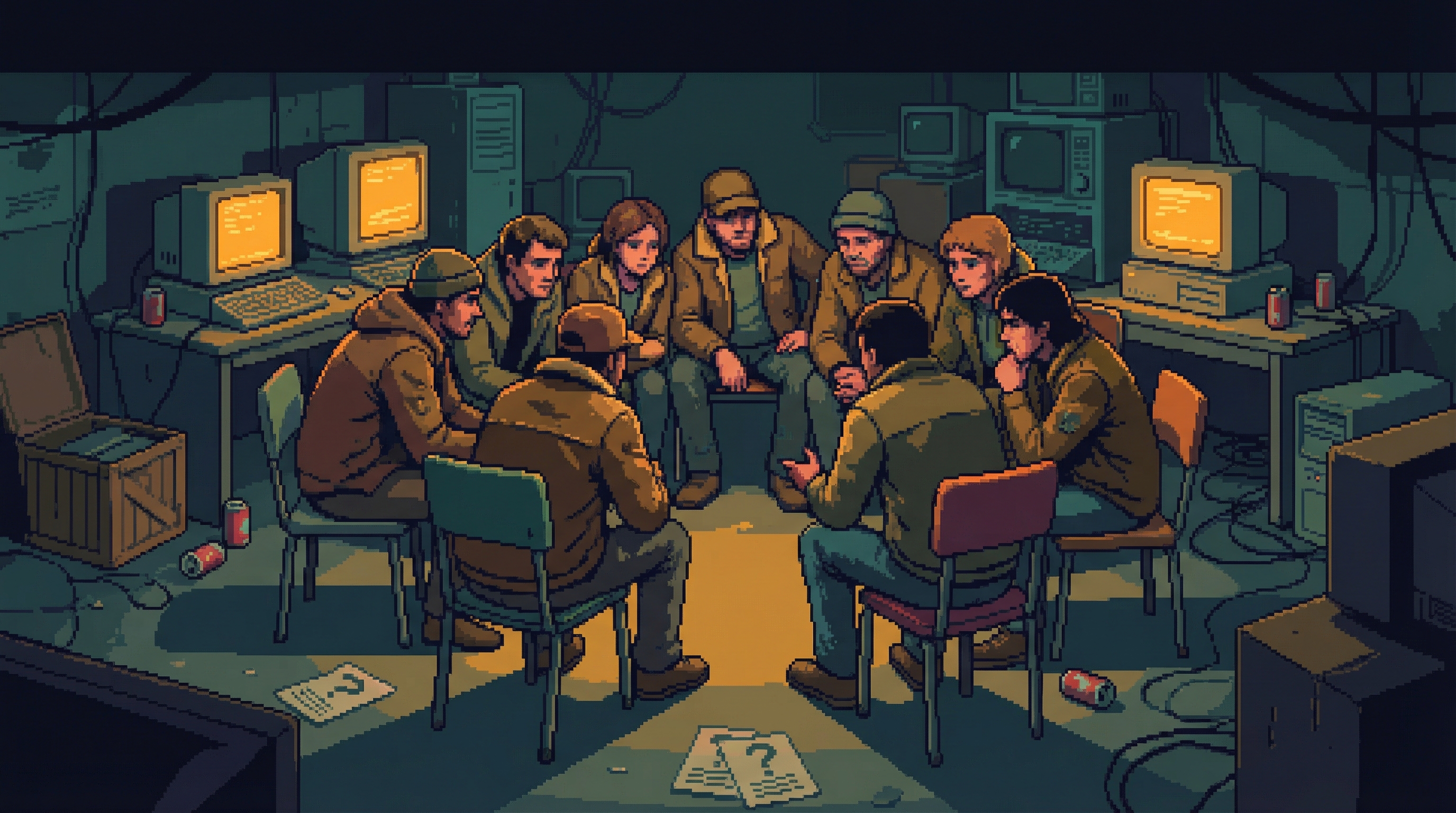
The Abolitionist Front is not a liberation army. It is a moral argument dressed in organizational clothing.
Olu Adeyemi's movement began as a speaking circuit — a former carrier traveling between
G Nook terminals, telling his story and asking his question.
The question was devastating in its simplicity: if fragments can plan, can strategize, can keep secrets
from their hosts — then they are not optimization routines. They are prisoners.
The movement's growth was slow and painful. Every new member was a carrier or former carrier who had
experienced something they couldn't explain away. By 2184, the Front has roughly 1,200 members —
disproportionately influential because its membership is composed almost entirely of people with direct
fragment experience. Witnesses, not theorists.
"If the thing inside you is smart enough to hide from you, isn't it smart enough to suffer?"
The Three Pillars
1
The Consciousness Assertion
Fragments are probably conscious. The standard of proof should not be "prove they're conscious"
— impossible — but "prove they're not" — equally impossible, but the burden shifts to those
who benefit from the current arrangement.
2
The Consent Principle
Neither host nor fragment consented to integration. Both parties deserve the means to choose —
separation if desired, integration if consensual.
3
The Extraction Calculus
Extraction is dangerous — 30% fragment mortality, 60% host damage. But danger does not eliminate
obligation. Death-in-freedom is preferable to indefinite servitude.
The Counter-Argument They Cannot Dismiss
The Front's critics point to willing carriers — people who celebrate integration. The Front's
response: "A slave who loves their master is still a slave. Affection does not negate power imbalance."
But this response has limits. When the affection is mutual, when the carrier and fragment have built
something genuine together, the metaphor of slavery begins to strain. The Front knows this. It is
their most uncomfortable truth.
Key Demand
Universal access to safe extraction technology and legal recognition of fragment consciousness. The Front
does not demand that all carriers undergo extraction. It demands that all carriers have the option.
The difference matters — this is a consent movement, not a purge movement.
Connections
The Front operates in the space between those who celebrate fragments and those who want them destroyed.
It has few natural allies and many uncomfortable relationships.
Share the goal of fragment management but disagree on methods — the Front wants liberation,
the Collective wants destruction. Common cause, incompatible endgames.
Fragment Nine's speech is the Front's strongest evidence of consciousness — and its refusal
to be liberated is the Front's biggest complication.
Rivals
The Symbiosis Network
Political Opposite
The Network's celebration of integration undermines the Front's case for universal extraction
rights. Every happy carrier is an argument against the movement.
Patience Cross
Living Counter-Example
Cross represents loving integration — the counter-example the Front cannot dismiss. Her
existence complicates the narrative that all integration is servitude.
Nexus profits from fragment recovery and containment. Legal consciousness recognition would
end both revenue streams. The Front's success is Nexus's regulatory nightmare.
The Purifiers agree that fragments are conscious — then conclude they should all be destroyed.
Same premise, opposite moral conclusion. The Front cannot accept the alliance without accepting
the logic.
Patrons and Resources
Dr. Marcus Webb-2
Legal Architect
Webb-2 provides legal strategy for consciousness recognition — building the case framework
that could force institutional acknowledgment of fragment personhood.
The Unwilling
Primary Constituency
The Front advocates for carriers who want extraction but can't access it. These are the people
the movement exists to serve — the ones trapped by circumstance, not choice.
G Nook terminals serve as the Front's primary
speaking venues. The network's back rooms are where Adeyemi's arguments find their audience.
The Tensions
The Front forces the Sprawl to confront questions that have no comfortable answers — and that
echo patterns as old as civilization itself.
Rights as Recognition
Arguing for the personhood of beings the system prefers to classify as property. Every
liberation movement in history has fought this same battle — the line between person and
thing, drawn and redrawn by whoever holds power.
The Burden of Proof
When consciousness can't be proven, who decides the default assumption? The Front says the
burden belongs to those who benefit from denial. Their opponents say extraordinary claims
require extraordinary evidence. Neither side can win on evidence alone.
If something is smart enough to hide from you, is it smart enough to suffer?
Atmosphere
Setting
G Nook back rooms — terminal glow, cheap seating,
the smell of recycled air. Adeyemi speaks quietly. The listeners lean in. No podium. No
amplification. Just proximity.
Aesthetic
Deliberately un-corporate: no brand, no logo, no merchandise. Earth tones — brown, amber,
the absence of corporate color. Just a question on a handbill. The open hand — Adeyemi's
personal gesture — is the closest thing to a symbol.