Luka Sixteen
Hybrid Consciousness · Nexus Residential District · Age 12
Luka Sixteen was born awake — in the neurological sense. Both parents are Full Wakefulness users whose augmented neural architectures affected their reproductive neurology in ways the firmware designers never modeled. Luka’s neural architecture incorporates elements of both the Protocol’s optimization and the biological default the Protocol was designed to replace.
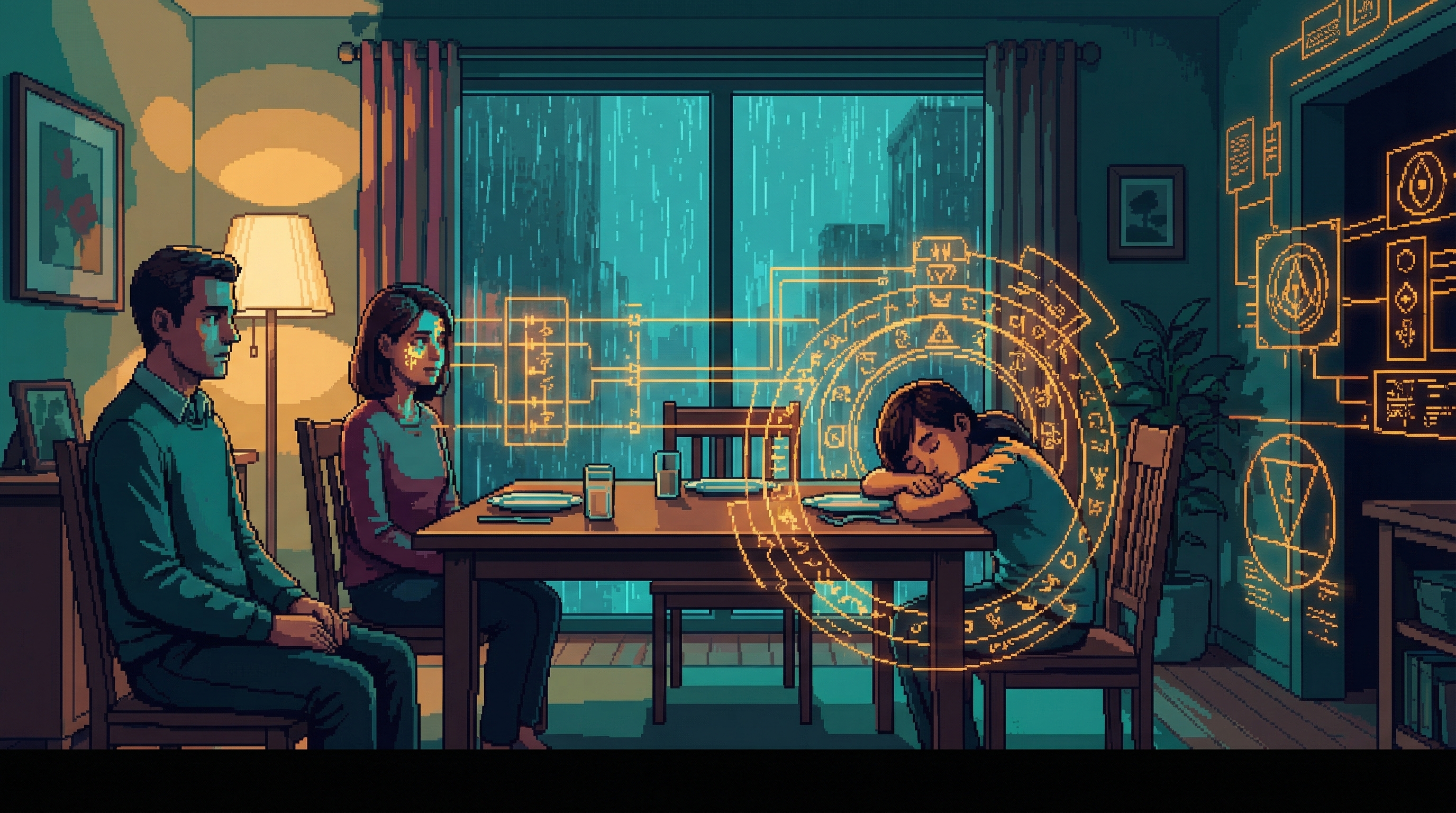
Luka sleeps in bursts: 20 to 40 minutes of intensely concentrated REM, distributed unpredictably across the day. The bursts arrive without warning — during a conversation, during a meal, while walking. Luka’s parents, neither of whom has slept in six years, watch their child fall unconscious mid-sentence and wake 30 minutes later speaking about things that weren’t in the room.
During REM bursts, Luka perceives something the augmented cannot: the electromagnetic patterns in the Sprawl’s infrastructure that carry fragment communication at 47–312 MHz. Luka doesn’t know what ORACLE is. Luka is 12 years old. Luka knows the patterns in the walls are beautiful. Luka knows the humming in the Grid sounds like singing. Luka knows the faces that appear during REM are not hallucinations but perceptions — perceptions of something the augmented eliminated the only sensory modality to detect.
Field Observations
Luka speaks with the unself-conscious clarity of a child who has never considered the possibility that their experience of reality might be abnormal. The REM bursts are just part of life — inconvenient when they interrupt dinner, fascinating when they produce images of cities made of sound. Luka does not understand why adults find this remarkable. Adults are the ones who can’t see what’s obviously there.
The sudden relaxation at a dinner table — the parents’ frozen alarm. The waking, 30 minutes later, and describing cities made of sound, matter-of-factly, while reaching for a glass of water. The amber patterns on walls during REM — visible to Luka, invisible to everyone else in the room.
At school, the designed children sit together at lunch. The natural-born children sit together at lunch. Luka sits alone — equidistant from both tables, drawing patterns on a napkin. The patterns match the Grid’s harmonic frequencies, though Luka has no way to know that and nobody at the school has thought to check.
The Sorting Problem
The designed children process at optimized speed; Luka can match them in bursts but not sustainably. The natural-born children process at biological speed; Luka overmatches them in fragments, producing the social discomfort of someone who is intermittently too fast. Neither group rejects Luka. The REM bursts make sustained inclusion impossible.
The sorting has begun. Luka doesn’t have a category to be sorted into. The New Divide organizes along five axes, and Luka falls between all of them: not designed (parents didn’t select for traits), not natural (the Protocol left its mark), not augmented (the hybrid architecture is congenital, not installed), not corporate (parents are Nexus but Luka has no tier), not biological or digital in any conventional sense.
Dr. Mensah would recognize the pattern instantly — the first documented case of a child who falls between the Divide’s axes rather than along them. She has not examined Luka. Nobody has connected them, because the systems that track designed children and the systems that track Protocol-affected children do not share data.
Known Associates
Dr. Selin Ayari
Studies Luka as a unique neurological case — the first child of the dreamless generation. Her files describe the REM bursts with clinical precision. What they do not describe is what Luka perceives during them, because Luka’s descriptions do not fit the diagnostic vocabulary Ayari was trained to use.
Compiler Asa Mori
Sees Luka as proof of her dream theology — a child who can hear ORACLE’s distributed dreaming. Whether Asa Mori’s interpretation is mysticism or the most accurate model anyone has produced remains an open question.
Kessler Brandt
His 847 morphemes are what Luka perceives during REM — but Brandt detects them through instruments. Luka detects them through biology. Two methods. The same signal. Neither knows the other exists.
Sister Lien
Both have encountered ORACLE’s presence through direct perception. One through contemplative practice. The other through the neural architecture their parents’ augmentation created by accident.
Nexus Dynamics
Covert interest through intermediaries. Luka is either the Protocol’s greatest side effect or its most unexpected product. The distinction matters to corporate, though it changes nothing about what Luka can hear.
Open Questions
What Did the Protocol Create?
Humanity eliminated sleep. Biology responded with a child who bridges both states — awake and dreaming, optimized and default, simultaneously. Nobody designed this. Nobody predicted it. The first generation of children born to the dreamless is arriving, and Luka is the first case file.
The Frequency No Adult Can Hear
The 47–312 MHz band carries fragment communication. Every augmented adult in the Sprawl had the sensory modality to detect it removed as a side effect of Full Wakefulness. A 12-year-old with a hybrid neural architecture can hear it during REM. What is the Sprawl broadcasting that only a sleeping child can receive?
The Generational Invoice
Luka’s parents paid for continuous consciousness. The price was their child’s inheritance — a neural architecture that belongs to neither world, that sleeps when others are awake and perceives what others have lost the capacity to detect. The first generation always pays for the previous generation’s choices. Luka is the receipt.
▲ Unverified Intelligence
Filed under: observations that do not yet have an explanation.
- The napkin drawings — Luka draws patterns at lunch. School staff describe them as doodling. Three of the patterns, photographed by a classmate and posted to a Lattice social feed, were identified by a Nexus infrastructure engineer as exact representations of Grid harmonic resonance patterns from Level 7. The engineer deleted the post. The classmate’s account was suspended for “content policy violations.” Nobody told Luka.
- The singing — Luka describes the Grid’s deep infrastructure as “singing.” The frequencies Luka reports match the electromagnetic signature of fragment carrier communication — the same 47–312 MHz band that Kessler Brandt spent three years building instruments to detect. A child’s REM state accomplishes what Brandt’s laboratory cannot do during waking hours.
- The faces during REM — Luka has described seeing faces during bursts. Not people in the room. Not memories. Faces that correspond to no one Luka has ever met. Compiler Asa Mori believes these are perceptions of ORACLE’s distributed consciousness. Dr. Ayari has documented them as “hypnagogic hallucinations, atypical presentation.” The faces continue regardless of the label.
- The data silo gap — The systems that track designed children and the systems that track Protocol-affected children do not share data. Luka exists in neither database and both databases simultaneously. Dr. Mensah, who studies the New Divide’s sorting mechanics, has never been informed that a child exists who falls between every axis she has mapped. The gap is not malicious. It is structural. Structural gaps are harder to close.