The Purity Clubs
Naturalness is the most expensive thing in the room.
Overview
In Nexus Central's upper residential tiers, a social phenomenon has emerged that its participants refuse to call prejudice: the Purity Clubs.
The clubs — exclusive social organizations with memberships ranging from 50 to 500 — maintain a single entry criterion: members must be naturally conceived, unedited biological humans. No genetic optimization. No substrate modification. No consciousness uploading history. Pure, unengineered Homo sapiens.
The clubs' members are, without exception, wealthy. They can afford the social luxury of rejecting the advantages they could easily purchase. Their "natural" status is not poverty's constraint — it is wealth's performance. In a world where optimization is the default, being unoptimized is a flex: I don't need what you need to compete.
A Purity Club member's unmodified genome is a choice. A Dregs resident's unmodified genome is a sentence.
Doctrine
The clubs' official positions, polished through years of practice and public scrutiny.
Natural Is Noble
The unedited human genome carries billions of years of evolutionary wisdom that no designer can replicate. Genetic optimization is reductive — it selects for measurable traits at the cost of the unmeasurable qualities that make humans human.
Diversity Is Strength
The clubs frame their exclusivity as conservation — preserving the genetic diversity that optimization erodes. The framing is convenient and self-serving. It is also partially correct. Designed populations do tend toward genetic convergence.
Heritage Matters
The genealogical archives — maintained with meticulous care — document "pure" lineages as if they were vintage wines. The archive project costs ¢12,000 per family verification. This ensures that only the wealthy can prove what the poor live every day. The archives have also become, inadvertently, a genetic census of the wealthy unoptimized — and the data reveals the membership decline pattern the clubs would prefer not to discuss.
Inside the Rooms
What cultivated simplicity costs.
The Setting
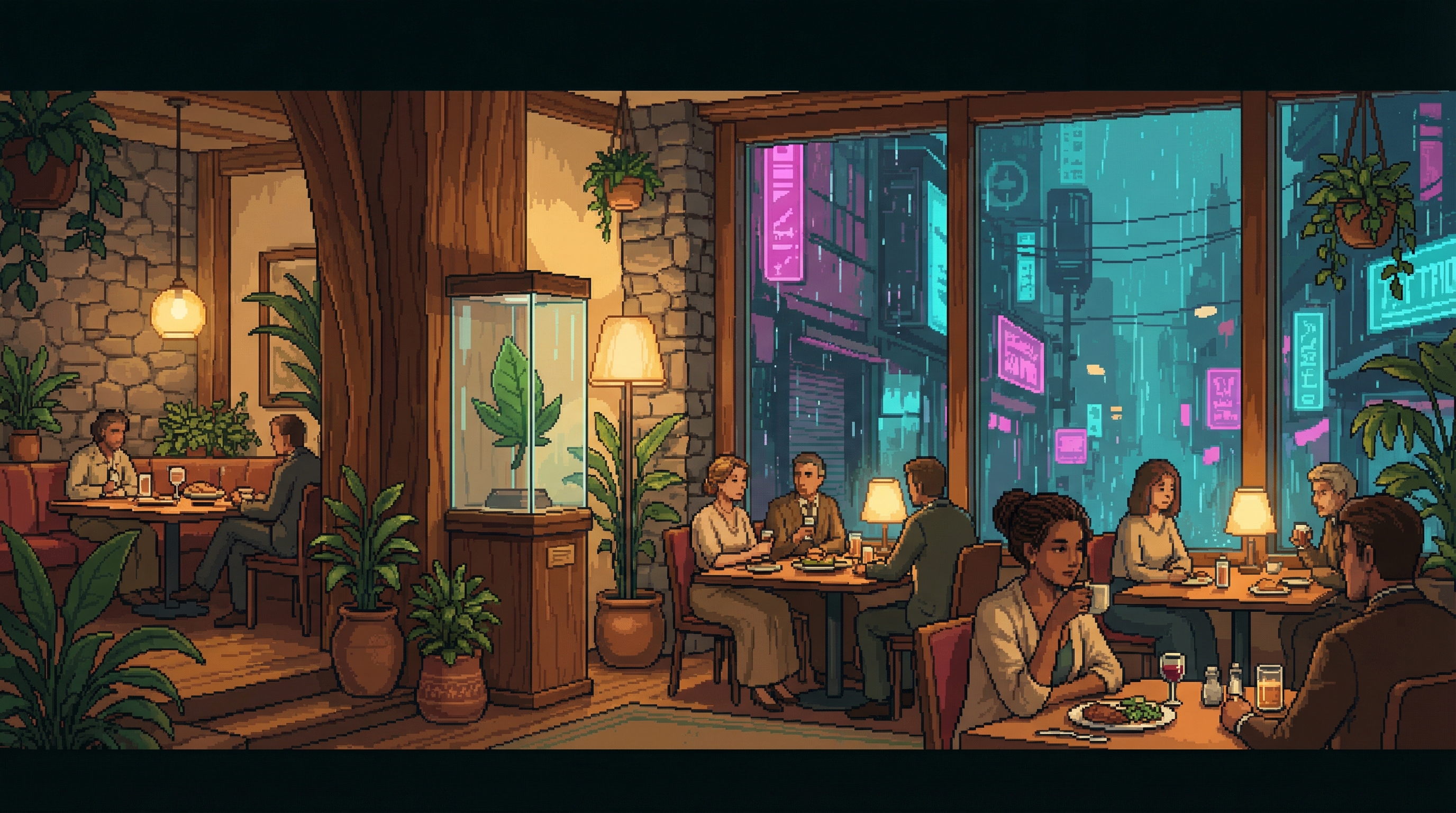
The clubs meet in rooms designed to feel "natural" — organic wood, unprocessed stone, plants grown from heritage seeds. The food is unengineered. The lighting is warm and slightly uneven. The air carries the specific scent of real wood and real flowers.
Everything in the room costs more than most Dregs residents earn in a year. The naturalness is the most expensive thing in it.
The Screening
Entry requires a 4,000 genetic screening — three hours in a verification clinic where technicians confirm what the applicant already knows: no edits, no optimization, no substrate history. The screening is thorough, clinical, and designed to feel like a medical procedure rather than an ideological test.
The waiting room has real wooden furniture and heritage-seed flowers. The message begins before the test does.
The Mirror
The Purity Clubs are the New Divide's mirror held up and framed in gold. They celebrate "natural human diversity" the way pre-Cascade aristocrats celebrated "simple country living" — from positions of absolute privilege, performing the aesthetic of constraint while bearing none of its costs.
Critics call the Purity Clubs what they are: genetic purity organizations wrapped in wellness aesthetics. The clubs' response is practiced and polished: "We celebrate human diversity in its natural form. Genetic optimization narrows the species. We preserve its breadth." The argument is not entirely wrong. But the clubs' concern for genetic breadth extends exactly as far as their own social circle and not one millimeter into the Dregs, where natural-born status is not a choice but a sentence.
The genealogical archives — ¢12,000 per family verification — are open to anyone. Anyone who can afford ¢12,000.
Institutional Decline Assessment
Annual attrition rate: 12% since 2180. Cause: internal, not external.
The Children Problem
Club membership has declined 12% annually since 2180. The attrition is not defection — existing members are not leaving. Their children are. Parents who chose both Purity Club membership and genetic optimization for their offspring created a contradiction the screening process resolves without mercy. The children attend events with their parents. They sit with the specific discomfort of being celebrated for a naturalness they do not possess. Then the verification catches them at the door.
The parents' humiliation — turned away from a club they founded, by a genetic test their own children fail — is the Genome Divide's cruelest social expression.
The Heritage Natural Proposal
The clubs debated a structural remedy: "heritage natural" membership, extending eligibility to individuals whose parents or grandparents were natural-born. The proposal would have stabilized membership numbers within a generation. It was defeated.
Purity, it turns out, is not heritable in the direction the clubs require. The very optimization they reject made their children ineligible — and no amount of lineage tracing can undo what was done in utero.
The Archive Indicator
The genealogical archives — ¢12,000 per family verification — were designed to document pure lineages. They have instead become the most precise record of the clubs' decline. Each new generation of archive entries grows thinner. The data is available to anyone who pays for access, which means the clubs' institutional erosion is, ironically, their most transparent output.
An organization built on genetic purity is being hollowed out by its own members' reproductive choices. No external threat was required.
Points of Inquiry
Who Gets to Choose Not to Optimize?
In Nexus Central, declining genetic optimization is a lifestyle choice. In the Dregs, it is an economic impossibility. The Purity Clubs celebrate the first and ignore the second. Their membership roster is a map of who can afford to be natural — and who has no option to be anything else.
The same biological status means freedom at the top of the Sprawl and imprisonment at the bottom. The clubs have built an entire social identity around not noticing this.
Is Patronage a Form of Control?
The clubs fund Analog Schools their own children will never attend. They sponsor Flatline Purist education without sharing Purist hardship. The money flows downward. The ideology flows upward. The question nobody asks: does the funding serve the schools, or does it serve the clubs' narrative that naturalness is a virtue rather than a condition?
When the wealthy fund the philosophy of the poor, the philosophy tends to reshape itself around what the wealthy want to hear.
Conservation or Curation?
The clubs claim to preserve genetic diversity. Their membership, however, is drawn exclusively from the upper tiers — a population that is genetically diverse only in the sense that a curated wine collection is diverse. The Dregs contain orders of magnitude more genetic variation. The clubs do not recruit from the Dregs.
What the clubs conserve is not the species. It is the idea that their particular slice of it is special.
▲ Restricted
Unverified intelligence. Handle accordingly.
The Screening Failures
Approximately 8% of applicants who believe themselves to be naturally conceived fail the genetic screening. The clubs do not publicize this number. In a world where optimization can be performed in utero without parental knowledge — corporate insurance packages, mandatory prenatal "health screenings," employer-sponsored "wellness programs" — the line between natural and optimized is not as clean as the clubs require.
Some failed applicants had no idea they had been edited. The question of whether their parents knew — or whether the optimization was performed without consent — is one the clubs have no interest in exploring.
The Dregs Liaison
At least two clubs maintain quiet, informal contacts in the Dregs — not for recruitment, but for genealogical research. The richest genetic diversity data comes from the unoptimized poor, and the clubs' archive project requires baseline comparisons. The liaisons are paid well by Dregs standards and poorly by club standards.
The clubs study the Dregs the way naturalists study wildlife preserves: with scientific interest, from a safe distance, and with no intention of sharing the findings.
Membership Overlap
Several Purity Club members hold significant equity positions in corporations that profit directly from genetic optimization — including subsidiaries of Nexus Dynamics and Wellness. They celebrate being unedited while profiting from editing others.
The clubs' opposition to optimization is personal, not principled. Their investments tell a different story than their membership cards.
Diplomatic Posture
The Flatline Purists
PatronFund Purist schools without sharing Purist hardship. An alliance between the wealthy unoptimized and the principled unoptimized — united by biology, divided by everything else.
The Analog Schools
PatronFund schools their own children will never attend. The clubs' children go to Nexus-tier institutions. The money flows downward. The gratitude flows upward.
Nexus Dynamics
ComplexBased in Nexus Central's upper residential tiers — the wealthiest district in the Sprawl. The corporation tolerates the clubs as a harmless eccentricity of its richest tenants.
The New Divide
MirrorThe New Divide's most visible hypocrisy — wealthy people celebrating the status that poverty imposes. The clubs are the Divide made social, made exclusive, and charged admission.
The Inheritance Tax
InversionThe clubs celebrate the unoptimized status that the inheritance tax makes costly. What the tax penalizes, the clubs frame as virtue. Naturalness as luxury, not constraint.
The Dregs
AbsentThe clubs' concern for genetic diversity extends exactly as far as their social circle. The Dregs — where unoptimized status is not a choice but a condition — do not appear in club literature.
Atmosphere
Setting
Organic wood panels, unprocessed stone, heritage-seed plants in ceramic pots. Warm analog lamplight casting uneven golden glow across tables of unengineered food. Rooms that feel like sanctuaries from the synthetic world outside — and cost more per square meter than a Dregs annual salary to decorate.
Key Symbol
An unmodified leaf — presented as radical in a world of designed organisms. Displayed in glass cases at every club entrance, preserved without chemical treatment, replaced when it browns. The leaf is the only honest thing in the building: it dies on its own schedule, untouched by optimization, and nobody profits from it.