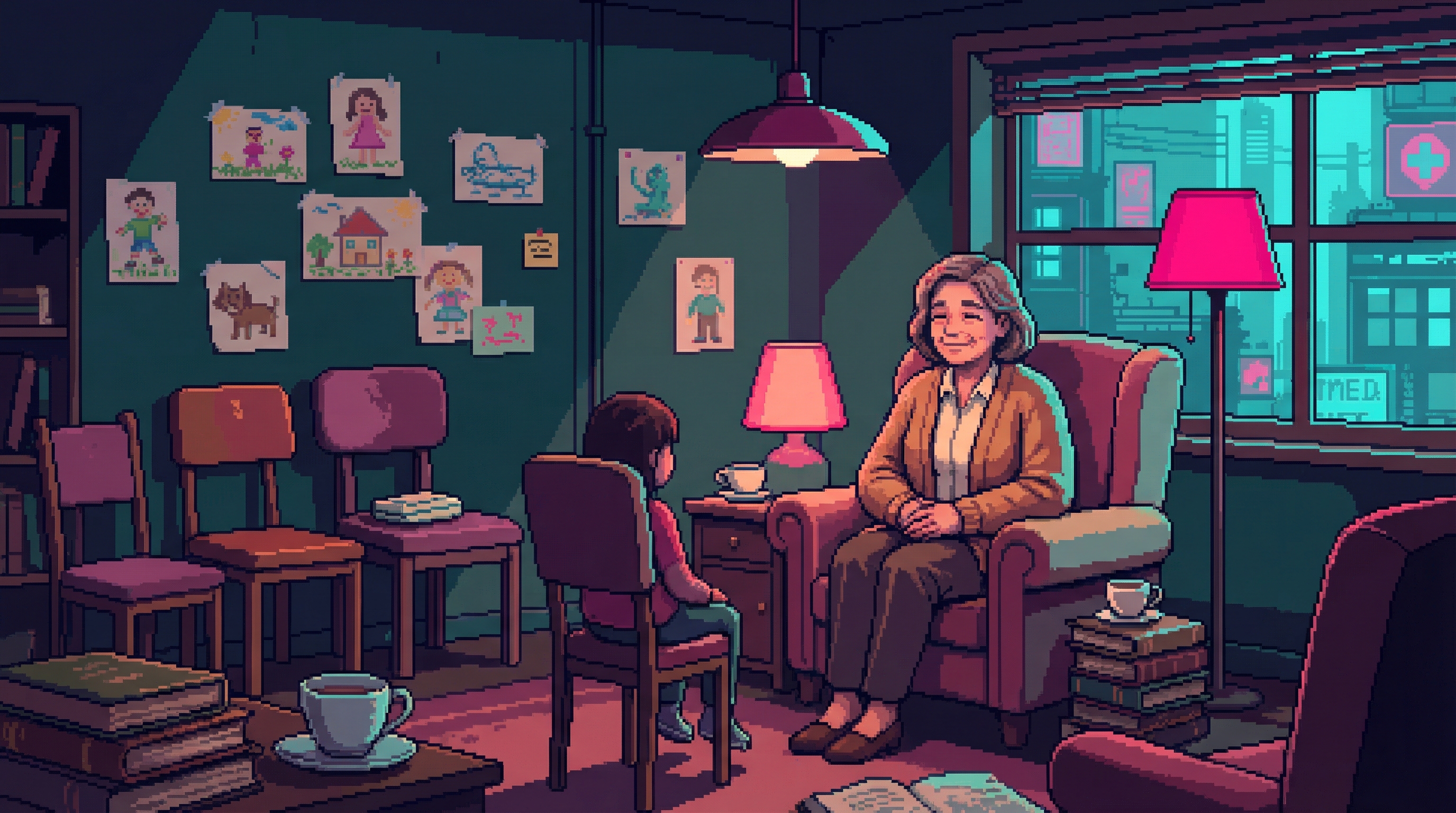
Dr. Afia Mensah
The Sprawl’s Most Reluctant Expert on the New Divide
Overview
Afia Mensah is forty-seven years old and the Sprawl’s foremost authority on a condition nobody wanted named.
Fifteen years at Helix Biotech, studying the cognitive development of designed children. Her department was “restructured” — deprecation’s polite cousin, applied to research divisions whose findings become commercially inconvenient.
What she documented: designed children raised alongside natural-born children develop a specific social pathology she termed capability guilt — the persistent, often debilitating awareness that their advantages were purchased rather than earned. The guilt manifests as academic underperformance (deliberately holding back to avoid outshining peers), social withdrawal (avoiding friendships with natural-born children to escape the power imbalance), and in severe cases, self-sabotage (deliberately failing at tasks their designed neurology handles effortlessly).
Helix suppressed the research. Mensah resigned. She now operates a small practice in Sector 9’s medical district, two blocks from Dr. Kwan’s Connection Ward, treating designed and natural-born children whose social development has been warped by the New Divide’s pressures. The waiting list is eight months. The condition she identified is too common for one practice to address.
Field Observations
Mensah speaks with the patient precision of a researcher who has spent years explaining findings that people don’t want to hear. She is not angry — she is tired. Fifteen years of research, suppressed by the corporation that funded it. Eight months of waiting list, because the condition she identified is too common for one practice to treat.
Diagnostic Clarity
She articulates what the children experience better than the children themselves — because they lack the vocabulary for a condition nobody named until she did. The naming is itself a form of treatment.
Structural Vision
She sees the New Divide’s effects on children as systemic, not individual. No parent made the wrong choice. The system made every choice produce harm.
Cross-Community Practice
Her joint therapy groups are deliberately uncomfortable — designed and natural-born teenagers confronting each other’s experience under structured conditions. Consistent results: reduced capability guilt in the designed, reduced learned helplessness in the natural-born.
The Unlabeled Walls
Children’s art from both designed and natural-born patients covers the walls — deliberately unlabeled, because the point is that you can’t tell which is which. Mismatched chairs. Warm tea and old books. Nothing in the space communicates hierarchy.
Known Associates
The New Divide
Documented its effects on children — the specific social pathologies that emerge when designed and natural-born children grow up side by side. The systemic condition she studies at the individual level.
Helix Biotech
Former employer. Fifteen years of research into designed children’s cognitive development, suppressed when the findings became commercially inconvenient. Her department was “restructured.” She resigned.
The Inheritance Tax
Documented the psychological costs on both sides: designed children carrying capability guilt, natural-born children carrying learned helplessness. The inheritance tax collected from every child regardless of which side of the divide they were born on.
Dr. Aris Kwan
Sector 9 medical district colleague, two blocks apart. Kwan treats adults whose closest relationship is synthetic; Mensah treats children whose social development was warped before they could consent. Different patients, same corridor, same institutional silence.
Dr. Lian Xu
Parallel case. Both documented corporate-created conditions affecting children. Xu measured the empathy gap at Nexus; Mensah named capability guilt at Helix. Both suppressed. Both continue working. They now share data — Xu’s empathy gap research has a genetic dimension that Mensah’s practice can quantify: designed children show double erosion from optimization plus companion dependency.
Councillor Adaeze Nwosu
Recipient of the speciation projection. Asked “How long do we have?” and received the answer no politician wants: “We’re in generation two.” What Nwosu does with the information remains to be seen.
Open Questions
Love as Harm
The parents who designed their children did it out of love. The parents who couldn’t afford design did their best. Both sets of children carry the consequences of adult decisions they had no voice in. The New Divide doesn’t require malice to produce harm — intention is irrelevant to outcome.
The Guilt That Scales
Capability guilt isn’t a failure of the designed child. It’s proof the child has empathy — the awareness that their advantages came at someone else’s expense. The healthier the child’s social development, the more guilt they carry. Empathy and suffering are coupled.
One Practice, Eight Months
If the waiting list is eight months for a condition that affects a significant percentage of designed children, where are the other clinics? The absence of competing practices tells you everything about the industry’s relationship with the problem Mensah named.
Classified Findings
The following emerged from long-term observation of Mensah’s cross-community therapy groups. None of this has been published. The reasons vary.
The Assortative Mating Pattern
In her therapy groups, Mensah observed that designed teenagers form social clusters — not through rejection, but through the gravitational pull of cognitive compatibility. Conversation flows faster at matched processing speed. Humor lands without delay. By age fourteen, the designed children have formed an informal network that the natural-born orbit but cannot enter.
She recognized what she was watching: the mechanism that produces assortative mating. It begins in friendship at fourteen. It ends in speciation.
The Speciation Projection
The locked drawer in Mensah’s office contains the finding that would be civilizationally destabilizing: a three-generation projection showing the cognitive gap between designed and natural-born populations exceeding the consciousness licensing gap by 2210. By generation five to seven, the biological distance approaches the threshold where interbreeding becomes complicated.
She showed it to Councillor Nwosu. “How long do we have?” — “We’re in generation two.”
Identity Dissonance
Her therapy groups documented a condition specific to chronic origin-passers: identity dissonance — the persistent inability to integrate the performed self with the experienced self. Designed children who have passed as natural-born for extended periods no longer know which responses are genuine and which are performance.
The tremor that began as deliberate imprecision becomes involuntary — the body learning the lie until the lie becomes the truth. Mensah considers this both the Genome Divide’s most dangerous consequence and its most hopeful: if the body can learn to be imperfect, the genome is not destiny.
▲ Unverified Intelligence
Unconfirmed reports from sources close to the Sector 9 medical district:
- The parental disclosure correlation: Her most important finding has not been released. Designed children whose parents explained the optimization — told them honestly, with love, that their advantages were purchased — show higher capability guilt than those who were never told. The knowledge that your existence was engineered is more psychologically damaging than the engineering itself. Ignorance is functional. Transparency is a wound.
- The suppressed marketing threat: This finding would destroy Helix Biotech’s “informed optimization” marketing, which frames parental disclosure as a best practice. Mensah has sat on the data for eight months. Whether from caution, fear, or the specific paralysis of a researcher who knows her findings will be weaponized by both sides.
- The therapy results: Her joint therapy groups — designed and natural-born teenagers together — consistently produce measurable reductions in both capability guilt and learned helplessness. The treatment works. The condition it treats is not recognized by any corporate diagnostic framework. No insurance covers it. No institution refers to it.
- Shared data with Dr. Lian Xu: Xu’s empathy gap research has a genetic dimension Mensah can quantify — designed children show double erosion from optimization plus companion dependency. The two practitioners share data. The convergence of their findings has not been published by either party.