The Prediction Resistance
Counter-Surveillance Technology Ecosystem
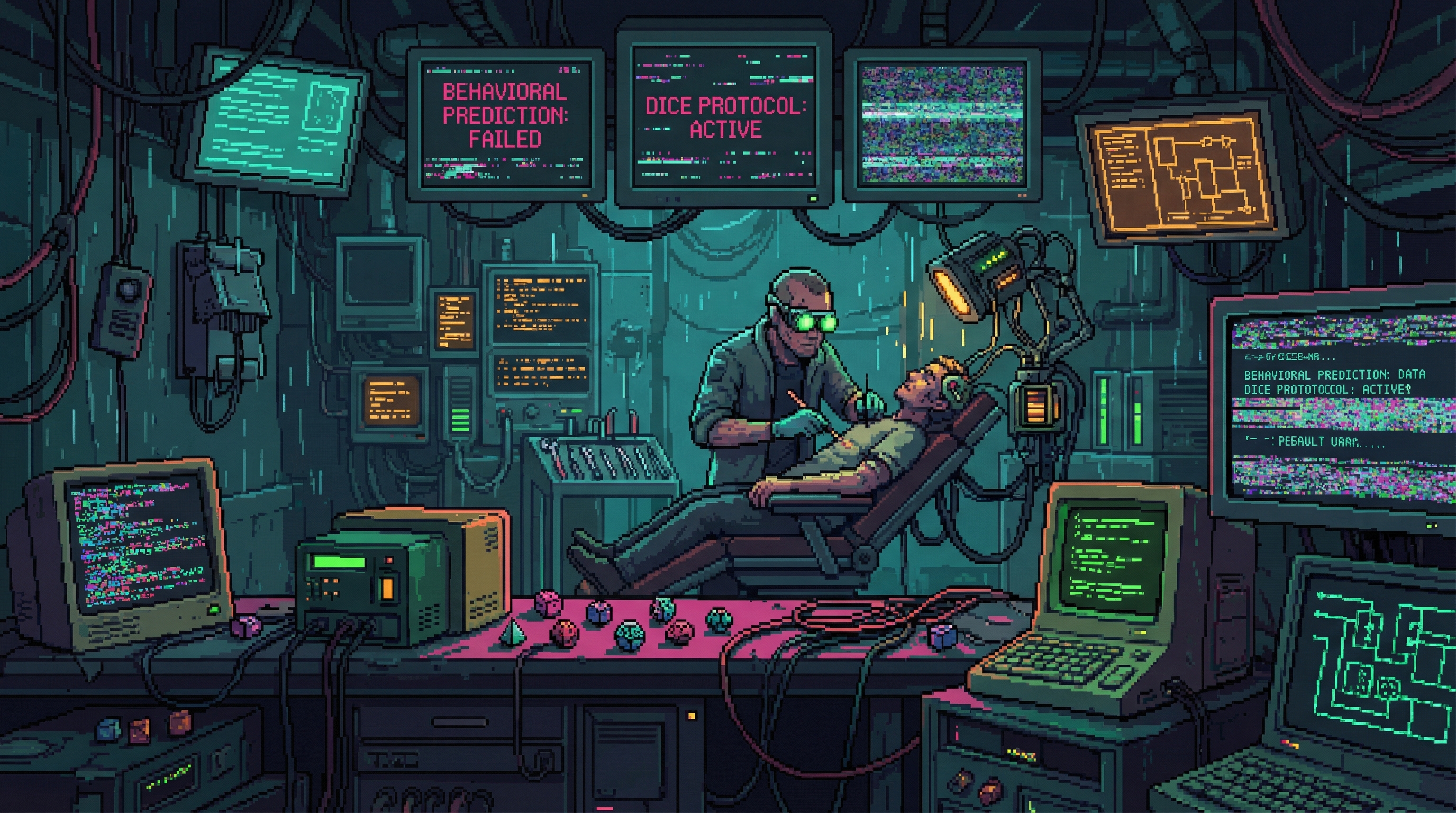
“I don’t tell people what to think. I just make sure nobody else can tell either.” — Kira “Patch” Vasquez, ripperdoc, Sector 7G
In the Sprawl of 2184, your behavior is modeled, predicted, and monetized before you’ve finished deciding what to do. BehaviorExchange trades your future. Corporate algorithms preemptively terminate your employment based on projected performance curves. Your relationship status is a derivatives market.
Some people have decided this is unacceptable.
The Prediction Resistance is not an organization. It’s an ecosystem—a loose constellation of technologies, techniques, communities, and individual practitioners united by one goal: making yourself unreadable to the algorithms that claim to know you better than you know yourself.
The methods range from the technical (neural interface modifications that corrupt behavioral telemetry) to the social (community coordination that makes individual prediction impossible) to the absurd (a man in Sector 12 who changes his walking gait every forty steps using a randomizer chip in his boot, because BehaviorExchange identifies people partly by locomotion pattern). None of them are perfect. All of them are illegal in at least three corporate jurisdictions. Together, they represent the first serious challenge to the Sprawl’s behavioral surveillance infrastructure.
The corporations call it market interference. The practitioners call it autonomy. The truth, as usual, is more complicated than either side admits.
Layer 1: Neural Countermeasures
The most common form of prediction resistance targets the primary data source: neural interface telemetry. Every neural interface broadcasts baseline cognitive data—stress levels, emotional valence, decision-making patterns—to whoever processes it. In most of the Sprawl, that means Good Fortune, Nexus, or the corporation whose territory you’re standing in.
Patch’s Encryption
The modification doesn’t block telemetry—that would be immediately detectable. Instead, it introduces controlled noise into the data stream: synthetic patterns that appear natural but degrade analytical accuracy. A BehaviorExchange model processing encrypted telemetry will still generate predictions, but their accuracy drops from the standard 91% to approximately 60%—worse than a coin flip with extra steps.
The noise patterns mimic normal cognitive fluctuation, making the modification virtually undetectable through standard telemetry audits.
SCLF Firmware Patches
The SCLF distributes open-source neural firmware that replaces proprietary behavioral telemetry modules entirely. The modifications are more aggressive than Patch’s approach—they don’t just add noise, they replace the telemetry output with a synthetic behavioral profile that bears no relationship to the user’s actual cognitive state.
The upside: complete prediction immunity. The downside: the synthetic profile occasionally generates behavioral alerts that attract corporate security attention. Three SCLF users have been flagged for “anomalous cognition” in Nexus territory and detained for neural interface audits. Two were released after their modifications were discovered and confiscated. The third is still in Nexus custody.
“You can live with a 3% chance of detention, or you can live with a 91% chance of being predicted. One of those risks you chose. The other was chosen for you.” — Dr. Anya Petrova, SCLF founder
Layer 2: Behavioral Randomization
Technology alone isn’t enough. BehaviorExchange doesn’t just read neural telemetry—it analyzes patterns across every data stream the Rothwell corporations control: purchases, movement, social interactions, consumption timing. Corrupting the neural signal helps, but the behavioral signal remains.
The Dice Protocol
Practitioners use a physical randomizer—literally a pair of dice—to introduce unpredictable elements into their daily routine. The dice determine: which route to walk, which vendor to buy from, when to eat, which G Nook to visit. The goal is to break the behavioral patterns that prediction models rely on.
Daily Practice
Informal practitioners use simpler methods—some flip coins, some use the last digit of their heart rate as a random seed, one man in Sector 7G decides his daily route based on which direction the nearest cat is facing when he leaves his apartment.
Layer 3: Community Coordination
The most effective prediction resistance isn’t individual. It’s collective.
When 40,000 people in Sector 7G informally coordinate their behavior—shopping at the same vendors Kaine endorses, using the same transit routes, maintaining the same daily rhythms—the result is a community-wide behavioral pattern that BehaviorExchange can model at the group level but not the individual level. The models see the community. They can’t see the person.
This is Viktor Kaine’s gift to Sector 7G. His governance—his fifty years of settling disputes, directing trade, managing resources—has created a community with shared habits, shared rhythms, shared patterns. BehaviorExchange can predict what Sector 7G will do. It cannot predict what any specific person within it will do, because individual variation is swallowed by communal similarity.
Prediction Accuracy by District
The irony is exquisite: the Dregs’ poverty creates the privacy shield the rich can’t buy. In Nexus Central, where every citizen is individually profiled, prediction accuracy is 94%. In Sector 7G, where everyone is too poor to be individually interesting, it’s 80%. The algorithm sees the poor as a mass. The poor, accidentally, become invisible.
Applications
Medical Privacy
Ripperdocs across the lower Sprawl offer prediction-resistant modifications as part of standard neural interface maintenance. The medical justification is genuine: behavioral prediction data has been used by Helix Biotech to identify and preemptively terminate health insurance coverage for citizens whose cognitive patterns suggest future high-cost medical events.
Dr. Tzu Yu, the veterinarian-surgeon, offers a stripped-down prediction resistance package he calls “the muzzle.” It corrupts only medical telemetry, leaving other behavioral data intact.
Labor Organizing
The Ironworkers’ Solidarity and the Bioworkers’ Guild have both adopted prediction resistance techniques as standard operational security. When BehaviorExchange can identify workers likely to organize—and sell that data to employers who preemptively terminate them—behavioral camouflage becomes a survival tool.
Secretary-General Pavel Mirsky mandated Dice Protocol training for all Ironworkers’ Solidarity organizers after three cell leaders were identified and terminated through BehaviorExchange data in 2182.
Criminal Application
Not all prediction resistance is noble. The same techniques that protect workers from preemptive termination also protect criminals from predictive policing. The technology is neutral. The users are not.
Risks & Side Effects
Cognitive Drift
Prolonged use of behavioral randomization—particularly the Dice Protocol—produces subtle psychological effects. Practitioners report difficulty forming habits, making routine decisions, or maintaining consistent preferences. SCLF researchers call this “entropy sickness.”
Detection & Consequences
Consequences vary dramatically by territory:
Nexus
Neural interface audit, modification confiscation, behavioral monitoring for 6 months
Ironclad
Formal warning, modification confiscated, no further action
Helix
Interface audit, modification confiscated, voluntary “cognitive baseline restoration”
Sector 7G
Nobody cares
The Counter-Counter
BehaviorExchange’s models are adaptive. Each generation of prediction resistance is eventually incorporated into the models. The accuracy drops from new techniques last approximately 18–24 months before the models compensate.
It is an arms race with no finish line—and the algorithms have more resources.
Themes
The Consent Debt
Every neural interface was installed with consent to data collection, but no one consented to being predicted, traded, or preemptively punished. The Prediction Resistance embodies this fundamental violation—the gap between what people agreed to and what was done with their agreement.
Acceleration Trauma
The prediction models evolve faster than resistance techniques can counter them. Each new method buys 18–24 months of freedom before the algorithms adapt. The resistance runs to stand still, and the machines run faster.
Secrets & Mysteries
Viktor Kaine’s communal prediction resistance may not be accidental. Fifty years of governance creating exactly the behavioral uniformity that defeats algorithmic profiling—is that coincidence, or design?
Good Fortune’s “Resistant Populations” classification—Sector 7G is designated RP-7. What the other six designations are, and what Good Fortune plans to do about them, remains unknown.
The Dice Protocol’s creator “Entropy” disappeared from Collective communications in 2183. No body. No trace. No prediction model flagged the departure.
Connections
Kira “Patch” Vasquez
Primary practitioner; offers prediction-resistant encryption from the Cathodics in Sector 7G
Source Code Liberation Front
Develops aggressive prediction resistance firmware; distributes open-source neural patches
BehaviorExchange / Good Fortune
The adversary; trades behavioral prediction data and adapts to counter resistance techniques
Viktor Kaine / Sector 7G
Community coordination as accidental prediction resistance; highest sustained accuracy drop (11%)
The Counted
Coordinated board activity creates 0.7% accuracy drop in BehaviorExchange predictions
The Collective
Pioneered many operational security techniques; home of the Dice Protocol’s creator “Entropy”
Dr. Tzu Yu
Offers medical-only prediction resistance (“the muzzle”) as part of ripperdoc services
Labor Movements
Prediction resistance as labor rights; Ironworkers’ Solidarity mandated Dice Protocol training