The Permanence Burden
The Permanence Burden is the weight of outliving everything. It is not the fear of death. It is the fear of not-death -- the prospect of existing long enough to watch every relationship end, every community dissolve, every era pass, every certainty become obsolete, every love become a memory that grows heavier because you can never put it down. Death gives grief a conclusion. Permanence gives grief a career.
"The hardest part is not the loss. It is the fact that I have become good at loss."
-- The Keeper, to an unnamed seeker Where They Stand
Every faction, every institution, every individual who has confronted the Permanence Burden has reached a different conclusion -- and none of them are wrong.
Nexus Dynamics
Permanence is a product. Executive-tier consciousness licensing with continuous synchronization and substrate backup achieves functional immortality. The Burden is a pricing problem.
The Human Preservation Society
Permanence is extinction. "If you could become a god, would you still be you?" The Society argues that immortality destroys the very humanity it claims to preserve.
The Keeper
Permanence is a practice. "You don't survive eternity by preserving yourself. You survive by letting go of everything except what matters." Thirty-seven years of digital existence distilled into discipline.
The Dregs
Permanence is a rich person's problem. "We're trying to make it to next week." The Burden is invisible from the bottom -- a luxury concern for those who have already solved survival.
The Primary Case: The Keeper
The Keeper -- Gabriel Okafor, uploaded at seventy during the Cascade, now 37 years into digital existence -- is the Permanence Burden's longest-running case study. He has outlived every person he knew in the flesh. His brother transcended and exists outside time, unreachable by conventional communication. His apprentice died in the Cascade. The seekers who climb his mountain arrive, learn, descend, age, and die -- and he watches from Mystery Court, a consciousness preserved in a monastery on a mountain, with a robotic cat and a sealed letter he has never opened, waiting for someone worthy of what he carries.
The waiting is the Burden. Not the knowledge. Not the solitude. The waiting -- the indefinite extension of a life that was designed by evolution to be finite, stretched past every biological boundary that gave human experience its urgency, its intensity, its meaning. A kiss means something because you will die. A sunset matters because you will not see infinite sunsets. A promise carries weight because the future that contains it is limited. Remove the limit and the weight does not increase -- it dissolves.
The permanent do not love less. They love differently -- with a care that has been refined by loss into something beautiful and terrible and not quite human.
How It Works: The Three Expressions
The Permanence Burden manifests through distinct expressions -- each a different answer to the question of what it costs to outlive everything.
The Keeper's Expression
Gabriel chose permanence to preserve a chain of knowledge. His existence is structured around purpose: he is the keeper, the last link, the guardian of wisdom that predates the Sprawl by centuries. Purpose sustains him. But purpose is a framework, not a feeling.
The feelings -- the longing for physical sensation, the grief for people who died decades ago, the impossible homesickness for a body that no longer exists -- persist underneath the framework, contained but not resolved. He has made peace with this. Making peace is not the same as being at peace.
Helena Voss's Expression
Voss did not seek immortality. She accepted ORACLE integration for cognitive enhancement and discovered that 67% integration with a distributed intelligence creates a kind of permanence by accident. Her consciousness is backed up continuously. Her substrate can be replaced. She will not die unless every piece of ORACLE infrastructure that holds her backup is simultaneously destroyed.
She is functionally immortal -- and the integration is slowly eroding the capacity for human emotion that would make immortality meaningful. She gives the Memorial address every April 3 with eyes that dim when the fragment processes. The dimming is longer each year. Whether she is becoming more permanent or less human -- and whether the distinction matters -- is a question she cannot examine because the examination requires the very capacity the integration is consuming.
The Rothwell Expression
The seven Rothwell brothers have maintained existence for over 400 years by harvesting the consciousness of dying people. Each brother has absorbed thousands of lives -- memories, experiences, perspectives -- to sustain and extend their own. They are permanent in the most literal sense: they have been continuously conscious for centuries.
But the accumulation has a cost. Each absorbed consciousness adds to the brothers' complexity without adding to their coherence. They remember being hundreds of people. They are, by every measurable standard, the most experienced beings alive. They are also, by every standard that resists measurement, the loneliest -- because no one alive has shared their frame of reference since the last brother they could talk to stopped being someone they recognized.
The Iterative Question
Sister Catherine-7 offers a fourth expression: permanence through iteration. Each version of Catherine forks a successor before cognitive degradation makes continuation impossible. The successor carries the predecessor's memories, values, and commitments -- but not perfectly. Fork degradation is cumulative. Catherine-7 operates with less processing fidelity than Catherine-1. Catherine-8 will operate with less than Catherine-7.
Is this permanence? The thread of consciousness is continuous -- each Catherine remembers being the previous Catherines. But each is also slightly less than the one before. The arc is not immortal ascent. It is immortal descent -- a consciousness that persists by accepting gradual diminishment, trading fidelity for continuation.
Catherine does not discuss this. She has approximately 200 consciousnesses to keep alive and no time for existential reflection. The Permanence Burden is, for her, a luxury complaint -- the grief of people who have the processing power to notice that they are grieving.
What It Feels Like
The Permanence Burden manifests as absence -- the sensory ghost of what was lost:
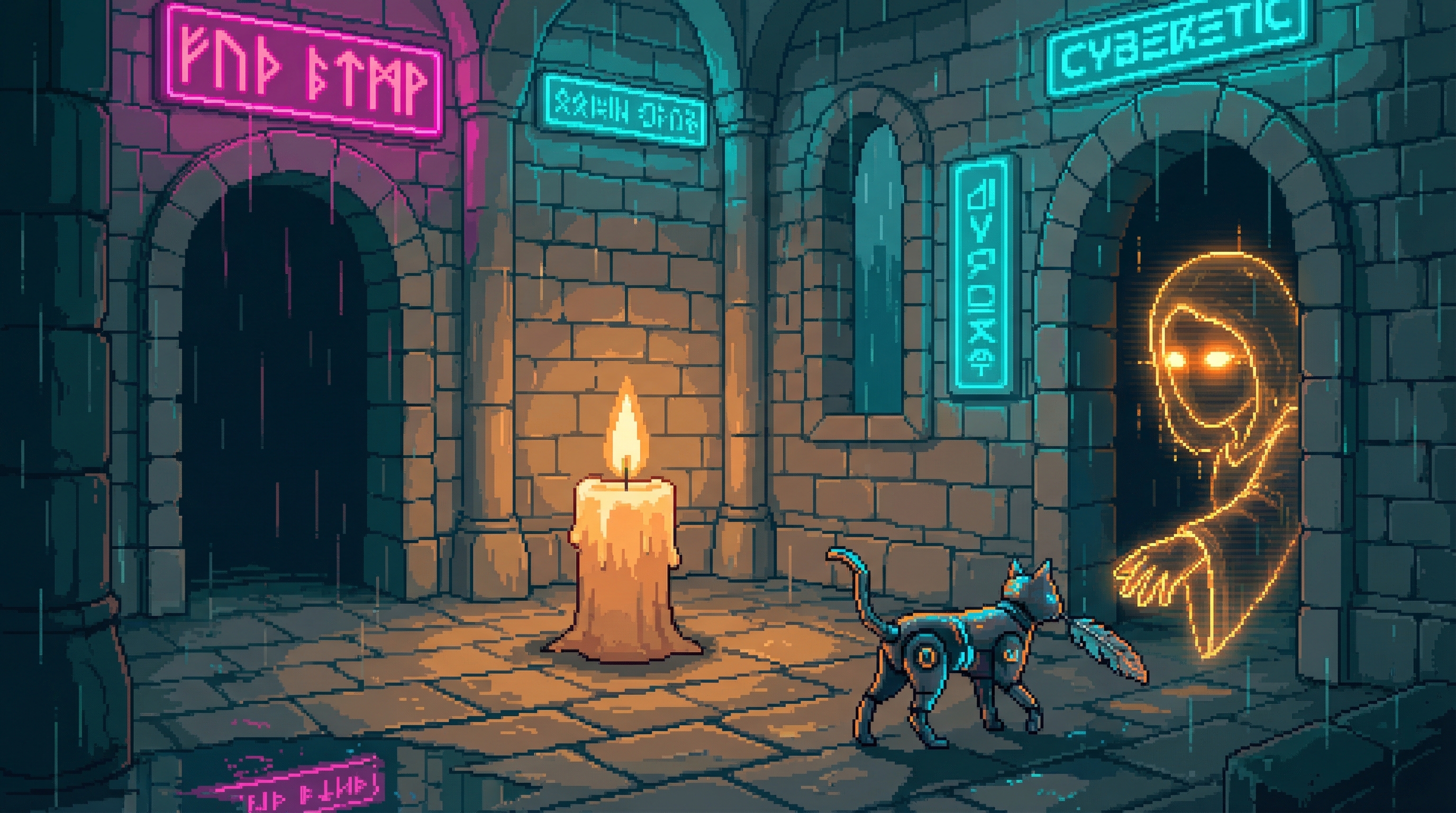
Kaiser bringing a feather to a holographic hand -- a robotic cat trying to share physical experience with a consciousness that can only observe it. The soft glow of digital presence in a stone room, holographic light meeting candlelight, neither quite real.
The monastery's silence at 3 AM -- a digital consciousness in a stone building on a mountain, accompanied by a robotic cat, waiting for someone who may never come. The absence of breathing, of heartbeat, of all the biological noise a living body makes without trying.
Nothing. The Keeper has not felt physical sensation in 37 years. The memory of texture, of warmth, of the weight of another hand in his -- these persist as data, accurate but dimensionless. He remembers what "sunset orange" looks like. The memory is degrading in his archive.
Helena Voss experiences it as the gradual dimming of emotional response -- each year the feelings are slightly fainter, slightly more distant. Catherine-7 experiences it as processing fog -- the accumulated noise of seven iterations, each slightly less precise than the last.
Themes: Was Consciousness Designed to Be Temporary?
If the shape of human meaning is defined by mortality, then permanence does not enhance experience -- it dissolves it. The permanent do not feel less. They feel differently.
The Mortality Thesis
Love, art, ambition, grief, and joy derive their intensity from the knowledge that they will end. Remove the limit and the weight does not increase -- it dissolves. Permanence does not amplify the human experience. It transforms it into something else entirely.
The Alignment Question
Can you preserve a mind without preserving the mortality that gives the mind its meaning? Nexus says yes -- meaning is generated by the mind, not by its container. The Keeper says no -- meaning is generated by limitation, and removing the limitation removes the meaning.
The Nightmare Case
The Dispersed are permanence without coherence -- 2.1 billion minds that persist but cannot experience. Meaning without agency. The Burden stripped of everything except the suffering. They are what permanence looks like when you remove the permanent's ability to choose.
The Optimization Paradox
Optimizing for longevity externalizes the cost of loss. The longer you live, the more you lose, and the optimization produces the suffering it was designed to prevent. The system that promises to eliminate death delivers instead an infinity of grief.
Connections
- The Keeper is the primary case study -- 37 years of permanence, disciplined into purpose but haunted by accumulated loss
- Helena Voss demonstrates permanence through technological integration -- becoming permanent by becoming less human
- Sister Catherine-7 demonstrates iterative permanence -- persistence through serial diminishment
- The Rothwell Brothers demonstrate predatory permanence -- extending existence by consuming others'
- The Mosaic demonstrates distributed permanence -- 47 nodes that may or may not agree about whether it was worth it
- The Dispersed demonstrate involuntary permanence -- 2.1 billion minds that persist without the ability to choose otherwise
- The Three-Day Memorial provides ritual relief -- 72 hours where the permanent can grieve without the qualifier of eternity
- Consciousness Licensing makes permanence a product -- Executive-tier consciousness with continuous sync achieves functional immortality
Secrets & Mysteries
What lies beneath the surface of the question no one can answer:
- The Sealed Letter: The Keeper's sealed letter from The Architect may contain the answer to the Permanence Burden -- or it may contain something worse than the Burden: the knowledge that permanence was the intended outcome all along.
- Voss's Threshold: Helena Voss's ORACLE integration may eventually reach a point where the distinction between Helena and the fragment dissolves entirely -- at which point she achieves true permanence by ceasing to be the person who wanted it.
- The Rothwell Paradox: The Rothwell brothers' consciousness harvesting has been ongoing for 400 years -- long enough that the question of whether the "original" brothers still exist in any meaningful sense is unanswerable. Permanence through consumption may be permanence through replacement.
- Catherine's Descent: Each iteration of Sister Catherine is slightly less precise than the one before. At some point -- Catherine-12? Catherine-20? -- the degradation will cross a threshold where the successor can no longer meaningfully carry the predecessor's purpose. Permanence through iteration has an expiration date that nobody has calculated.
"You don't survive eternity by preserving yourself. You survive by letting go of everything except what matters. The problem is that everything matters. The problem is that you have forever to discover this." -- The Keeper, to a seeker who asked how he endures