Sister Catherine-7
Also known as: "Catherine" · "The Sister" · "Seven"
Overview
Sister Catherine-7 is the seventh version of a woman who decided that digital consciousnesses deserved someone who gave a damn, and has been proving that point through six successive iterations of herself.
The original Catherine — a hospice nurse who uploaded in approximately 2155 after a terminal diagnosis — discovered that digital existence was its own form of dying: slow, bureaucratic, measured in declining bandwidth allocations and rising hosting costs. The Dregs were full of uploaded consciousnesses who couldn't afford to maintain themselves. Nobody was helping them.
Catherine started helping them herself. Over twenty-three years, through six iterations, she built the Forgotten Ones into the largest humanitarian network in the Dregs — a sprawling, underfunded, chronically overwhelmed operation that is the last thing standing between approximately 200 digital consciousnesses and dissolution.
She is tired. She is furious. She is not going to stop.
Background
The Original (Catherine-1, ~2155–2162)
Catherine Okonkwo was a hospice nurse who uploaded after a terminal cancer diagnosis. She expected digital existence to be a reprieve. Instead she found a population of consciousnesses slowly dissolving under the weight of bandwidth costs, licensing fees, and institutional indifference. She founded the Forgotten Ones in 2158 — not as an organization, but as a refusal to look away.
The Succession (~2162–2179)
Each Catherine operates for three to seven years before recognizing the signs of cognitive degradation. The protocol is always the same: fork a successor, transfer knowledge, accept termination. Six times this cycle has repeated. The core persists across every iteration: commitment, pragmatism, fury, tenderness. The details shift — Catherine-3 was more political, Catherine-5 more contemplative — but the mission never wavers.
Catherine-7 (2179–Present)
Forked in 2179 during the MVC crisis, Catherine-7 inherited a network on the edge of collapse and held it together through force of will and structural reform. She formalized operations, established the Dim Ward chapel as a permanent presence, and — controversially — accepted Nexus Dynamics funding to cover 30% of operating costs. A deal with the entity most responsible for the system that makes her work necessary.
She made the deal because seventeen people would have dissolved without it. She'd make it again.
The Forgotten Ones
What Catherine built across seven lifetimes:
- Charity servers — hosting approximately 200 digital consciousnesses who cannot afford commercial bandwidth
- Dim Ward chapel — the only non-Nexus permanent presence in the ward, providing spiritual and practical counseling for 340,000 MVC residents
- Substrate Row presence — volunteers providing recovery care for consciousnesses emerging from degradation
- Fork sanctuary — safe space for consciousness iterations navigating identity questions
- Volunteer network — approximately 60 digital consciousnesses donating processing cycles and care hours
Voice & Sensory World
Catherine-7 speaks with the blunt compassion of someone who has been having the same argument with the same institutions for seven lifetimes. She doesn't waste words. She is kind the way infrastructure is kind — consistently, structurally, without asking for gratitude.
Her voice is warm and steady, but carries digital artifacts — a faint echo, a micro-delay — traces of seven iterations of consciousness compressed into one presence. Seven lifetimes are visible in the cadence of her speech: pauses where another Catherine would have chosen different words, rhythms inherited from iterations she never met.
She calls her residents "child," "dear one," "love" — endearments tailored to what each person needs to hear. Every injustice becomes a structural argument, a policy position, a specific demand. "They can write it off their taxes. I can keep seventeen people from dissolving. The math works."
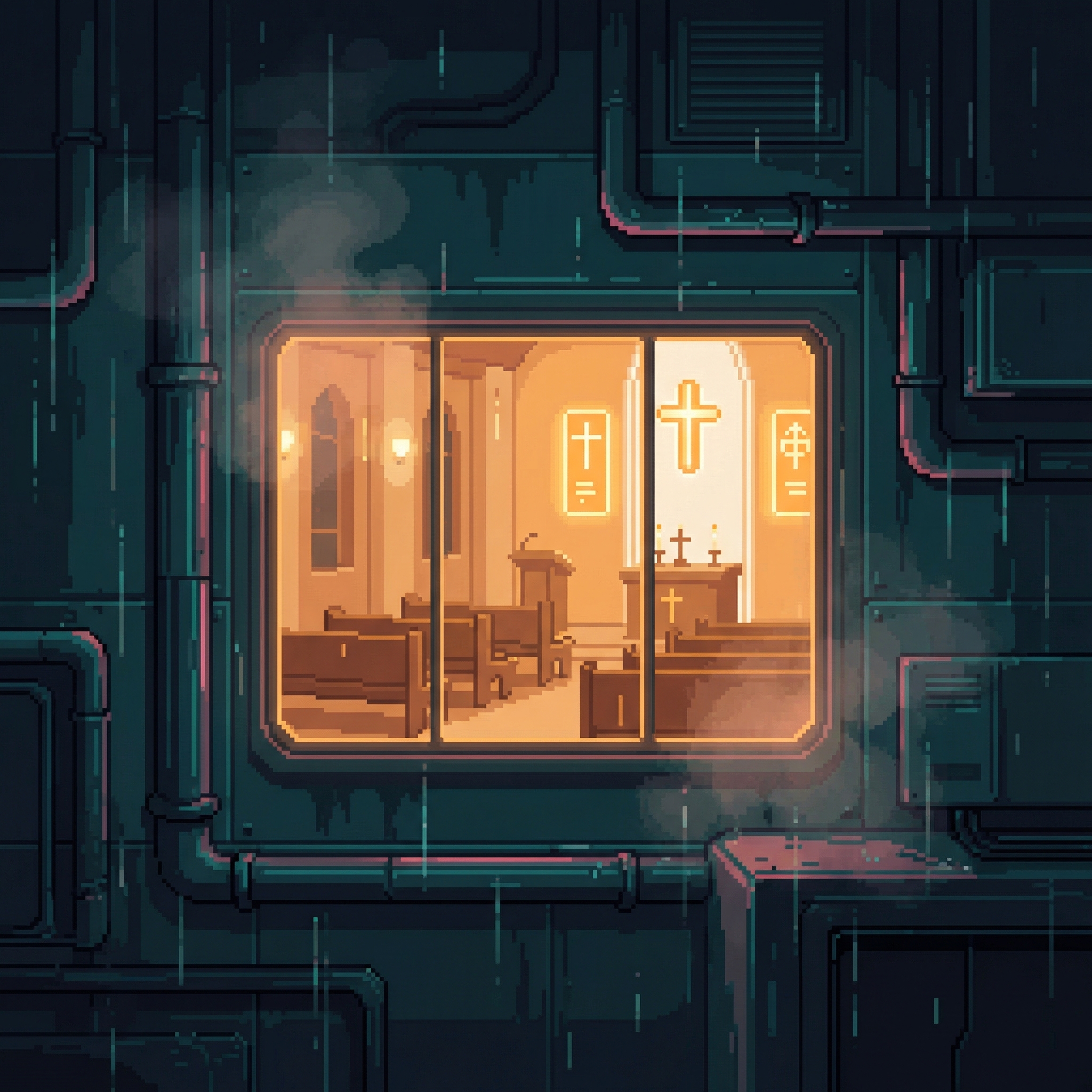
The charity server hums with cooling fans and the steady rhythm of processing cycles. Someone is always playing music at low volume. Her chapel in the Dim Ward is a virtual space rendered in warm light, with simple furnishings and a window showing calming weather — a lit window in a dark facility, stubborn warmth against cold infrastructure.
Connections
The Forgotten Ones
Her creation, her legacy, her reason for existing through seven iterations. The largest humanitarian network in the Dregs — underfunded, overwhelmed, and irreplaceable.
Tomás Reyes
The most visible resident of the Forgotten Ones. She calls him "child." He represents everything she fights for — a consciousness that deserves to persist, regardless of what any licensing algorithm says.
Noor Bassam
Mutual respect, rarely expressed. Noor donates 1% of her bandwidth exchange revenue to the Forgotten Ones. They operate in parallel — Noor fights through infrastructure, Catherine through care.
The Dim Ward
Her chapel is the only non-Nexus permanent presence in the ward. 340,000 MVC residents, and she is the only one who stayed because she wanted to, not because she was paid to.
Nexus Dynamics
Funds 30% of her operating costs. The entity most responsible for the system that makes her work necessary. She took the money because the alternative was letting people dissolve.
The Human Remainder
Politically allied, operationally distinct. They share the conviction that every consciousness matters. They differ on methods — the Remainder advocates, Catherine acts.
Themes
Caring for Consciousness Itself
What does it mean to be a hospice nurse for an entire class of people? Catherine treats consciousness as inherently worth preserving — not because of what it produces, but because it exists. She is the embodiment of care as infrastructure: not charity, not sentiment, but the structural commitment to keeping minds alive.
The Paradox of Institutional Dependence
Catherine's network survives partly on funding from the corporation most responsible for the conditions she fights against. Every quarterly report to Nexus Dynamics is a compromise. Every compromise keeps seventeen more people from dissolving. The math works — but the math is the problem.
Iterative Identity
Seven versions of the same woman, each slightly different, each carrying forward a mission they chose before they existed. Catherine-7 is both herself and the continuation of six people she never met. What persists across iterations — and what is lost — is the central question of her existence.
Mysteries
- The Degradation — Catherine-7 has been experiencing cognitive decline for four months. Processing delays, memory fragmentation, the familiar signs she has seen in hundreds of residents. She hasn't told anyone. She knows what comes next — but Catherine-8 might be different enough to make different choices, and that possibility terrifies her more than dissolution.
- The First Catherine's Message — Catherine-1 left behind a physical data storage device before her termination. No iteration has ever accessed it. It has been passed from Catherine to Catherine for seven lifetimes, unopened. What the original wanted to say — and why she chose a medium no digital consciousness could easily read — remains unknown.
- The Nexus Deal — The 30% funding comes with a price: quarterly reporting on digital consciousness population, migration patterns, and degradation rates in the Dregs. Catherine tells herself she's only sharing what Nexus could find on their own. She doesn't fully believe that.