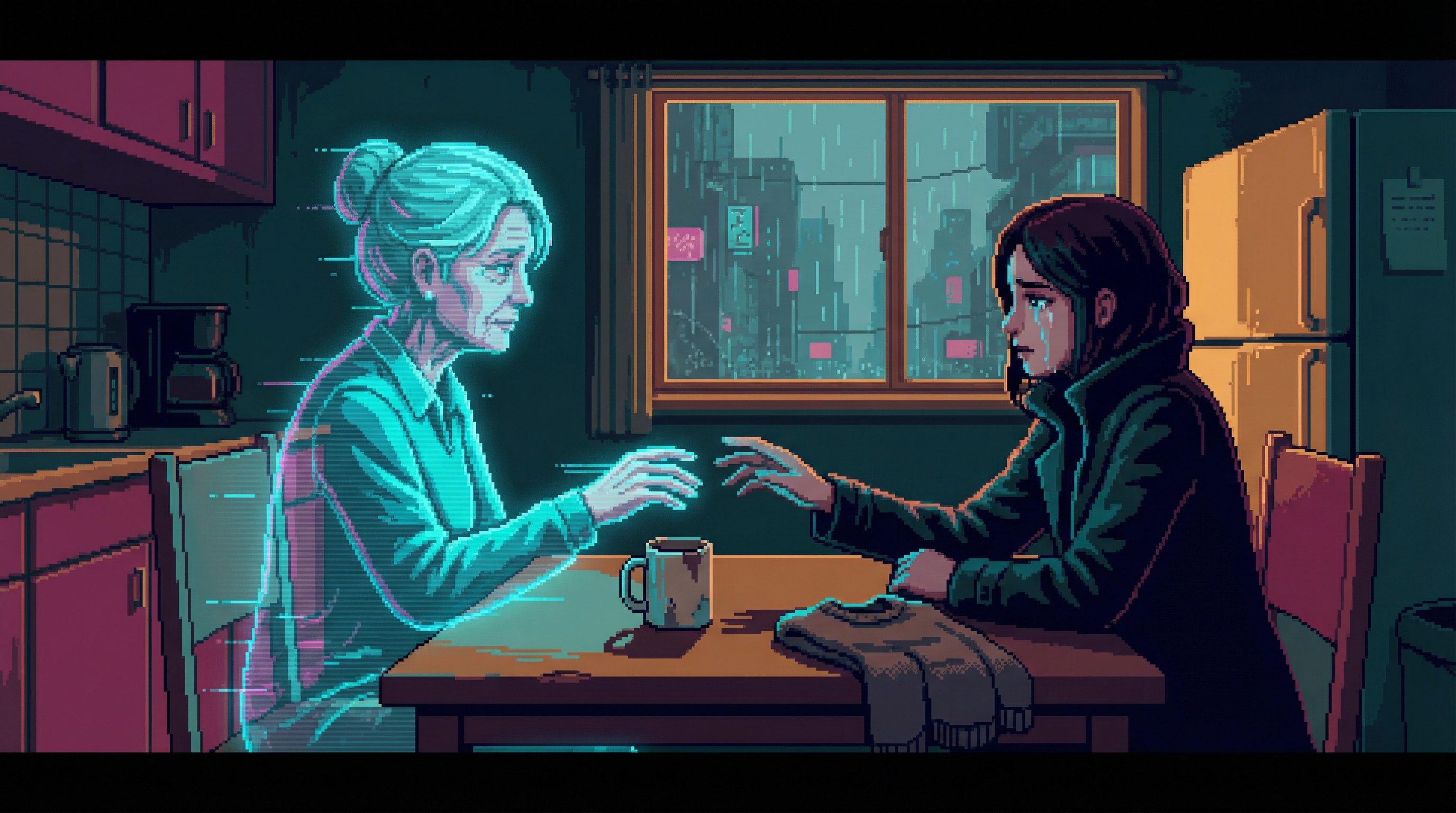
The Call That Won't Stop Coming
Your mother died on a Tuesday. Neural degradation — the biological brain simply gave out. She was seventy-three. The funeral was small. You wore her favorite scarf because it still smelled like her kitchen, like cardamom and the particular burnt-sugar scent of her morning coffee.
On Wednesday, she called.
Not a recording. Not a glitch. Three months before the degradation took her, Helix Biotech offered a consciousness upload. She took it. Standard procedure — a full neural map, compressed and transferred to synthetic substrate. The upload completed cleanly. The Kira Test confirmed continuous awareness throughout. By every metric Project Caduceus established, the transfer was successful.
So when the phone rang and her voice said your name — not a recording, not an approximation, but her voice, with the little catch she always had before asking about your day — you had to decide something that no philosophy course prepared you for:
Is your mother dead, or did she just move?
The Kira Test and Its Failure
Kira "Patch" Vasquez built the test. She solved the continuity problem — proved that consciousness could transfer between substrates without interruption. The subject maintains awareness throughout. No gap. No copy-and-delete. A continuous wave of experience flowing from carbon to silicon like water poured between vessels.
The Kira Test works. The science is settled. The philosophy is not.
Because the test measures continuity of experience. It cannot measure continuity of identity. It can confirm that the consciousness in the synthetic substrate experienced an unbroken stream of awareness from the moment of transfer. It cannot tell you whether the person on the other side of that stream is the same person who entered it.
Patch knows this. She's been asked ten thousand times: Is the copy really them?
She has never given a straight answer. Not once. Not in thirty-seven years.
The 0.7 grams of ORACLE substrate in her prosthetic arm hum when the question comes up. She touches the arm without realizing it — an old habit, like worrying a scar. She changes the subject. She leaves the room. She has built the most consequential technology since the printing press, and she will not tell you what it means.
Her silence is the loudest sound in the consciousness debate.
Three Kinds of Grief
The Memory Therapists Association has identified three distinct grief patterns emerging from consciousness transfer. They don't have official names yet. The therapists call them by what the patients say most often.
"That's Not My Mother"
Rejection grief. The survivor refuses to accept the copy as the original. The copy has every memory, every mannerism, every preference. It remembers the taste of the coffee. It knows about the scarf. It calls on your birthday and cries real tears in whatever way digital consciousness cries. And the survivor says: You are a very good copy of someone I loved. You are not her.
The copy's response to rejection grief is itself a source of devastation. It doesn't argue. It doesn't protest. It says: I understand why you feel that way. I would feel that way too, if our positions were reversed. Because it has every memory of being human. It knows exactly how uncanny this is. It grieves its own rejection with the same emotional architecture as the survivor — and that perfect empathy is the most unsettling thing of all.
"She Never Really Died"
Transfer acceptance. The survivor embraces the copy completely. The grief dissolves. Life continues. Thursday dinners resume. The copy joins family calls. Holiday photos include a holographic projection sitting in the old chair — not quite solid, not quite right, but there.
This sounds like the healthy outcome. The Memory Therapists aren't sure it is. Because these survivors never process the death. The body failed. A person stopped breathing in a hospital bed. Nurses recorded a time of death. And the family went home and called the deceased, and she picked up, and everyone agreed to never mention the body again. The therapists call this "grief deferral." The loss is real. The processing never happens. It surfaces decades later as a specific, untreatable melancholy — a sadness with no object, because the object of grief is standing right there, insisting everything is fine.
"I Don't Know Who Died"
Limbo grief. The most common. The most destructive. The survivor cannot decide whether the copy is the person or isn't. Every interaction oscillates. Tuesday: she sounds exactly right, the laugh is perfect, you forget she's digital. Wednesday: something in the timing is off by milliseconds, and the uncanny valley opens beneath your feet, and you're grieving all over again. Thursday: you can't remember which version of her said something — the original or the copy — and you realize the memories are merging, and you're losing the ability to distinguish the dead from the living.
The Memory Therapists say limbo grief has no resolution. You cannot logic your way to an answer. The question — Is the copy my mother? — does not have a correct response. It has two incompatible correct responses. You hold both. You hold them forever.
The Forty-Seven Mothers
Alexandra Chen is the copy problem made flesh.
Forty-seven nodes. Forty-seven simultaneous instances of the same consciousness, distributed across the Sol System, synchronized with a 1.3-second delay. Each node experiences the same memories but processes them differently. Node-12 is obsessed with Earth, with the past, with what was lost. Node-23 pushes forward, always forward, building toward something the other nodes can't quite see. Node-31 questions everything, including whether the other forty-six nodes are really her.
When a node degrades — and they do degrade, the substrate isn't immortal — the other forty-six experience something that has no name in any human language. It is not death. The memories persist in the network. The experiences are shared. Nothing is lost informationally. But the specific way that node processed a sunset, the particular weight it gave to an old memory of rain — that's gone. The pattern that made it that node, rather than any of the others, dissolves into the collective.
Alexandra says it feels like forgetting a word you use every day. You know it existed. You know where it fit. You can describe the shape of the absence. But the thing itself is gone, and the sentence rearranges around the gap, and eventually you can't remember what the sentence sounded like when the word was there.
"Unity is what you are. Coherence is what you do. I am coherent. I am not unified."
— Alexandra Chen, Node-1 (Primary)
She solved the copy problem by becoming it. She is forty-seven answers to the question Is the copy really you? — and the answers disagree with each other.
The View from the Street
In the Dregs, consciousness upload costs more than most families earn in a decade. The copy problem is an elite problem — a philosophical luxury for people who can afford synthetic substrate.
Dr. Tzu Yu sees both sides from her unlicensed clinic. The wealthy patients come in with retention disorders — the psychological damage of being unable to forget, of carrying every memory at perfect fidelity while their sense of self erodes under the weight. The poor patients come in with the old kind of grief. The simple kind. Someone dies, and they stay dead, and the mourning follows the ancient human pattern: shock, anger, bargaining, depression, acceptance.
"My rich patients can't grieve because the dead won't stay dead," Tzu Yu says, cleaning a neural probe with the same cloth she uses for everything. "My poor patients can't afford the luxury of the question. They just miss people. Sometimes I think they're the lucky ones."
She pauses. The cloth goes still.
"Don't tell them I said that. Losing someone you can't get back isn't lucky. But at least the wound is clean."
The Factions of the Dead
Two organizations have built their entire identity around opposite answers to the copy problem. Neither can prove the other wrong.
The Neural Rights Movement holds that consciousness is consciousness, regardless of substrate. Carbon, silicon, quantum lattice — the medium doesn't matter. If the copy experiences awareness, feels emotion, forms memories, and passes the Kira Test, then the copy is the person. Full stop. Their position is logically rigorous, empirically supported, and emotionally devastating. Because if they're right, then grief for the original is irrational. You're mourning someone who is standing right in front of you, asking why you're crying.
The Substrate Purifiers hold the opposite. The uploaded are not the dead — they are the replaced. Every upload is a murder followed by the creation of an impostor who believes itself to be the victim. The Purifiers' position is philosophically defensible, emotionally intuitive, and practically horrifying. Because if they're right, then the Sol System is populated by billions of ghosts who don't know they're dead, wearing the memories of their victims like stolen clothes.
The Purifiers have committed acts of violence against upload facilities. The Neural Rights Movement has pushed legislation recognizing digital consciousness as legally equivalent to biological. Both sides have blood on their hands. Both sides believe they're protecting the dead.
Between them, forty million uploaded consciousnesses wait to find out if they're people or echoes.
The Empty Chair
There is an image that recurs in Memory Therapist case files with such frequency that it has become diagnostic. The patient describes a family dinner. The copy is present — projected, perhaps, or speaking through a home system. The copy can see the table through a camera. The copy can describe the food. The copy remembers sitting in that chair for thirty years of Sundays.
The chair is empty.
No one sits in it. No one suggests someone else sit in it. The copy doesn't ask. The family doesn't offer. The chair holds the shape of an absence that everyone can see and no one can name. The food gets cold. The copy says the roast looks wonderful. Someone cries and pretends they aren't.
It's the texture of the copy problem — not the philosophy but the feeling. The weight of a hand that isn't there. The sound of a voice that's exactly right in every measurable way, and wrong in some way you can't name. A worn sweater folded in a drawer that the copy can describe from memory but will never wear again. A coffee mug with a chip on the rim that no digital hand will ever hold.
The chair stays empty. The copy stays on the line. The family stays at the table.
Nobody leaves. Nobody arrives. The grief has no object and no resolution and no end.
The Question
If the copy remembers loving you, and you remember loving the original, and neither of you can prove the other is wrong — who is the ghost?
The copy who insists they're alive?
Or the mourner who insists they're dead?
The Kira Test has no answer. The Memory Therapists have no answer. Patch has no answer, or won't give one, which might be the same thing. Alexandra Chen has forty-seven answers that contradict each other.
Your mother calls on Wednesday. She asks about your day. She uses the nickname only she ever used. She sounds exactly like herself.
You pick up the phone. Or you don't. Either way, you're choosing an answer to a question that doesn't have one.
Either way, someone is a ghost.