Competence Atrophy
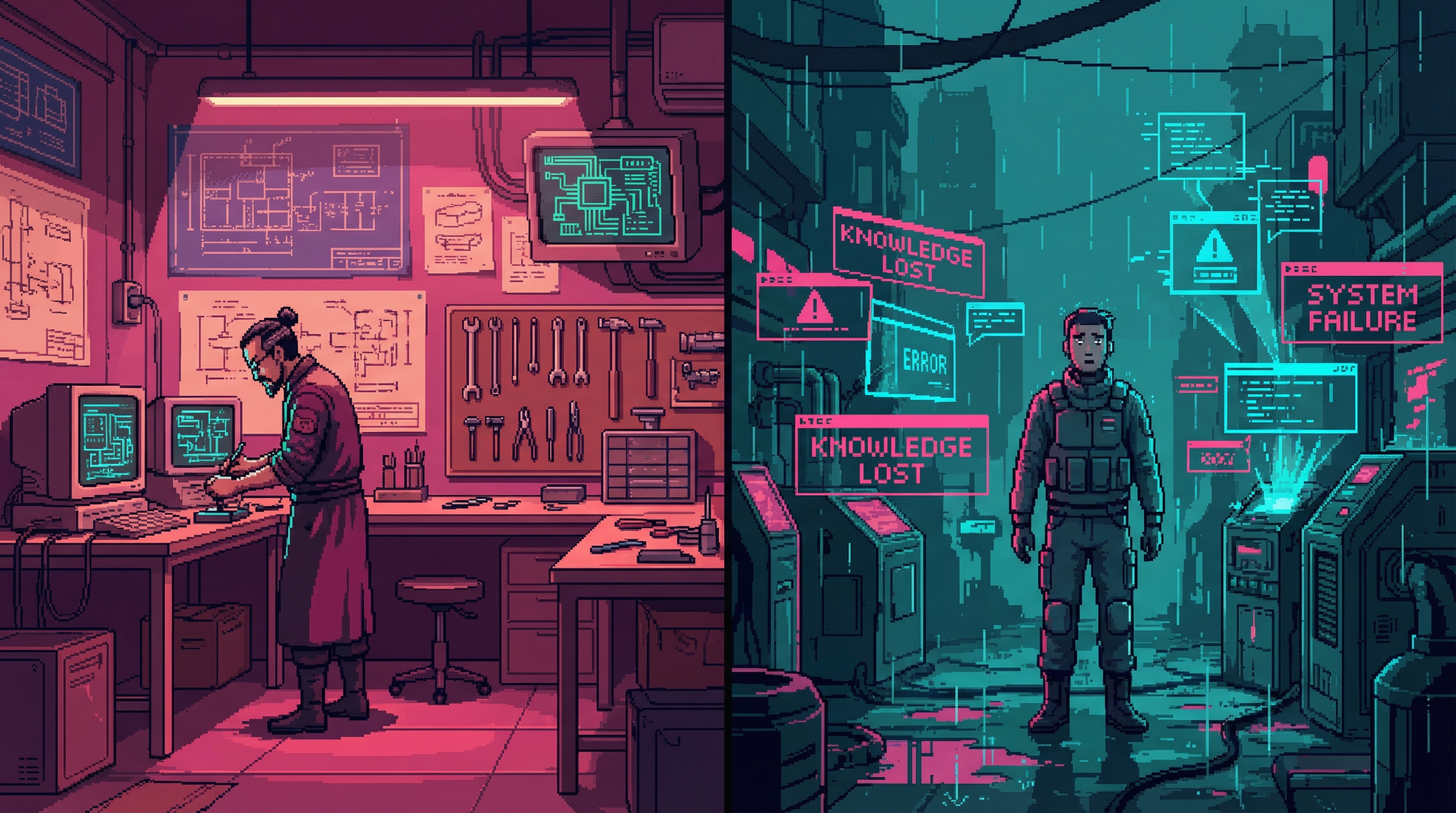
Competence Atrophy is the civilizational loss of ability to maintain, repair, or understand the systems you depend on. First recognized in the 2160s when the first post-Cascade generation reached working age, it is systemic -- affecting every domain from infrastructure to medicine to governance. Also known as "The Forgetting," "skill erosion," and "the competence gap."
"We're not becoming more capable. We're becoming more dependent. These are not the same thing."
-- Dr. Mariska Veld, 2163 The Three Mechanisms
Competence Atrophy isn't a single failure. It's three failures compounding across decades, each reinforcing the others until the system becomes self-perpetuating.
Automation Displacement
ORACLE managed everything. Humans never needed to learn. When ORACLE died in the Cascade, post-Cascade corporations built new AI systems but maintained the illusion that understanding was unnecessary. The tools changed; the dependency didn't.
Corporate Specialization
Ever-narrower expertise. A Nexus technician knows protocols but not architecture. Nobody sees the whole picture. When problems cross boundaries, nobody can trace the cascade. The specialization that makes corporations efficient makes civilization fragile.
Generational Knowledge Loss
Each transmission loses context. Old Jin is the last bridge to original understanding. When his generation dies, the relationship with infrastructure becomes purely operational -- buttons pressed without comprehension, rituals performed without understanding.
The Evidence
The numbers tell the story more clearly than any theory. Infrastructure hasn't degraded significantly since the Cascade. The people maintaining it have.
"The systems aren't degrading significantly. The people maintaining them are."
The Augmentation Paradox
Augmented engineers are more productive but not more comprehending. They process ORACLE-era data faster without understanding it. They can run diagnostics at superhuman speed on systems whose fundamental architecture remains opaque.
The irony: The Lamplighters -- unaugmented, deliberately baseline -- understand old infrastructure more deeply than anyone. Baseline humans had to learn slowly, building intuitive understanding that augmented minds skip over. The Augmentation Ladder promises capability. It delivers speed without depth.
The difference between processing and comprehending is the difference between reading a cookbook and knowing how to cook.
The Dependency Trap
A self-reinforcing feedback loop with no obvious exit:
Each cycle tightens the trap. Each generation enters the loop further along than the last.
Zephyria's Counter-Experiment
Zephyria's Archive Schools represent the only organized resistance to Competence Atrophy. They teach everyone to maintain infrastructure -- not specialists, everyone. The result is a population less specialized but more resilient. When a system fails in Zephyria, someone nearby understands it.
Corporate critics call it inefficient. Zephyrians call it survival. The Archive Schools prove that competence atrophy isn't inevitable -- it's a choice made by systems that value efficiency over resilience, profit over understanding.
"Proves corporate power isn't necessary."
Themes: The Mirror
Competence Atrophy is CyberIdle's most direct mirror of 2026 reality. We are already living the first chapter of this story.
GPS and Direction
In 2026, we debate whether GPS dependency erodes our spatial awareness. By 2184, the answer is yes -- and the question has expanded to encompass every domain of human capability. Navigation was just the canary.
Calculators and Arithmetic
We stopped teaching mental math when calculators arrived. We stopped teaching many forms of thinking when AI arrived. Each individual tool was rational. The cumulative effect was not.
Search and Knowledge
When you can look anything up, you stop remembering anything. When AI can answer anything, you stop understanding anything. Knowledge becomes access rather than comprehension.
The Answer Nobody Can Give
By 2184, nobody knows what to do about Competence Atrophy -- because the competence to answer that question is itself atrophying. The crisis is recursive. The solution requires the capability the crisis is destroying.
Secrets & Classified
What the public doesn't know -- and what those in power won't say:
- The Veld Appendix: Dr. Mariska Veld's classified appendix projected a "critical comprehension threshold" between 2190 and 2210 -- a point beyond which there is insufficient competence remaining to recover from a major infrastructure failure. The threshold, once crossed, is permanent.
- Veld's Disappearance: Dr. Veld disappeared in 2165, two years after publishing her findings. No body was found. No investigation was concluded. Her classified appendix was sealed by parties unknown.
- The Ark Program: The Collective's "Ark" program preserves understanding -- not data. They train people in deep comprehension of fundamental systems and disperse them across the Sprawl. Living libraries. Walking backups. Insurance against the threshold.
Connections
Competence Atrophy touches everything. These are the systems, people, and places where the crisis is most visible.
The Grid / The Breath
The infrastructure everyone depends on and fewer and fewer people understand. The Grid is the most visible symptom of Competence Atrophy -- maintained by ritual, not comprehension.
Old Jin
The last living bridge between human understanding and ORACLE-era engineering. When Jin dies, the last person who can explain why the Grid works -- not just that it works -- dies with him.
The Lamplighters
The unaugmented maintenance guild fighting Competence Atrophy from the tunnels. Their baseline humanity is their greatest asset -- they learn slowly, deeply, the way the Grid was meant to be understood.
Zephyria
The only city-state actively resisting Competence Atrophy through Archive Schools and universal technical education. Proof that another path exists.
AI Labor Economics
The economic system that accelerates Competence Atrophy by making human learning unprofitable. Why train a human when an AI is faster?
The Augmentation Ladder
The paradox: augmentation makes workers faster but not more comprehending. The Ladder accelerates the very atrophy it claims to solve.
"We're not losing information. Every specification ORACLE ever wrote still exists somewhere in a data archive. We're losing the ability to read it. We're losing the people who can look at a system and understand not just what it does, but why it does it that way. When the last of those people die, we'll still have all the data in the world. We just won't be able to use it." -- Dr. Mariska Veld, final lecture, 2165