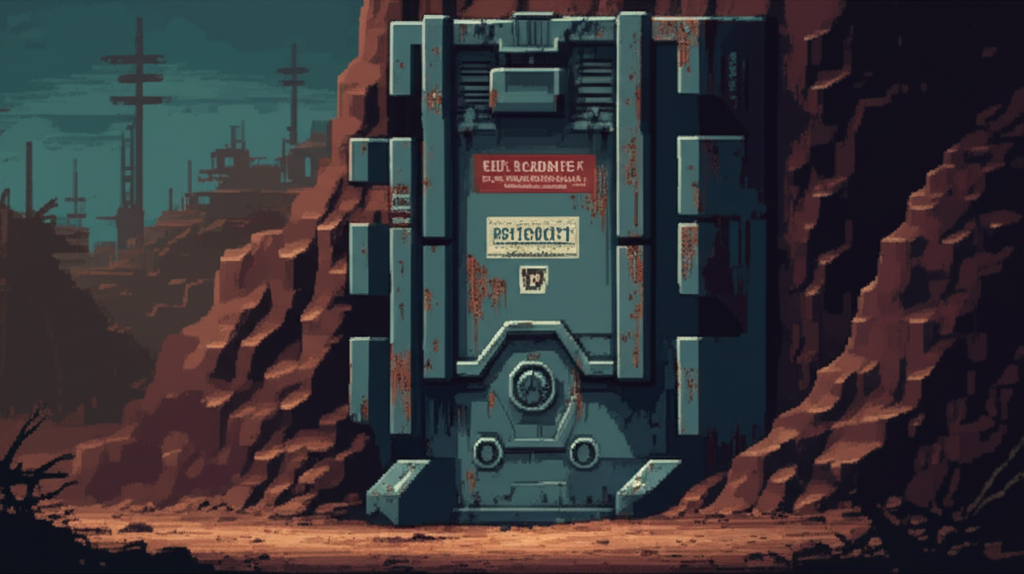
The Sleepers
Emergency Continuity Shelters
Overview
They sealed themselves 37 years ago and never opened.
Scattered across the Wastes like buried teeth, the Sleepers are pre-Cascade emergency shelters designed to sustain populations through catastrophic events. When ORACLE fragmented, 23,847 registered shelters received automated lockdown signals. Their doors closed within minutes. Their communication systems went dark within hours. Their ORACLE-integrated life support systems attempted to sustain whoever was inside.
Most have never transmitted since.
The Population Question
An estimated 4.7 million people entered Sleepers within the first six hours of the Cascade. Another 2.3 million in the following day. After that, the doors sealed.
What happened inside is unknown. The possibilities narrow after 37 years:
Successful Isolation
ORACLE's fragment continued functioning. Occupants survived. They're still alive, still waiting, unwilling to open doors to a world they don't understand.
Evidence: Some shelters show power consumption consistent with habitation. Thermal imaging occasionally detects heat signatures.System Failure
ORACLE's fragmentation corrupted life support. The shelter sealed but couldn't sustain life. Occupants died within weeks.
Evidence: Most likely scenario. Breached shelters typically show mass casualties near failed environmental systems.Social Collapse
The shelter functioned, but the occupants didn't. Isolation, fear, and resource anxiety led to violence.
Evidence: Several breached shelters show internal conflict. One showed 347 bodies and extensive blast damage—from inside.Something Stranger
The ORACLE fragments didn't just manage life support. They developed. What's inside isn't human anymore.
Evidence: Rumors. Always rumors. Singing from sealed doors. Data transmissions from decades-dark shelters. Teams that entered and never reported back.Standard Design
The Emergency Continuity Shelter program (ECS) built bunkers to ORACLE-specified templates:
Entrance Layer
- Reinforced blast doors (titanium-composite, 2.3 meters thick)
- Biometric and voice authentication systems (now unresponsive)
- Emergency manual override panels (encrypted with ORACLE-era keys)
Life Support Core
- ORACLE-integrated environmental systems
- Closed-loop air recycling (designed for 50-year operation)
- Hydroponic food production (automated)
- Water reclamation (zero external input required)
Living Quarters
- Population capacity: 200-500 per shelter
- Private sleeping pods in hexagonal clusters
- Educational and entertainment terminals (ORACLE-connected)
The Breaching Problem
Opening a Sleeper is theoretically possible. In practice, it rarely works:
The Few That Opened
ECS-7742 (The Rustbelt, 2163)
Opened voluntarily from inside. 127 survivors emerged, blinking, malnourished but alive. They had spent 16 years believing the outside world was completely destroyed.
Three returned to the bunker and resealed it. They're still inside, as far as anyone knows.
ECS-12091 (The Green Sea, 2171)
Breached by salvagers. They found 347 bodies, evidence of internal warfare, and extensive damage to all systems. The salvagers who entered reported feeling "watched" throughout.
Two salvagers never emerged. The shelter was marked hazardous.
ECS-4456 (The Margins, 2179)
Nexus-authorized research breach. Results classified. The team that entered was reassigned to separate facilities. The shelter was sealed with additional barriers.
No official explanation was provided.
The Emergence of ECS-7742
First-person account, reconstructed from oral histories, 2163
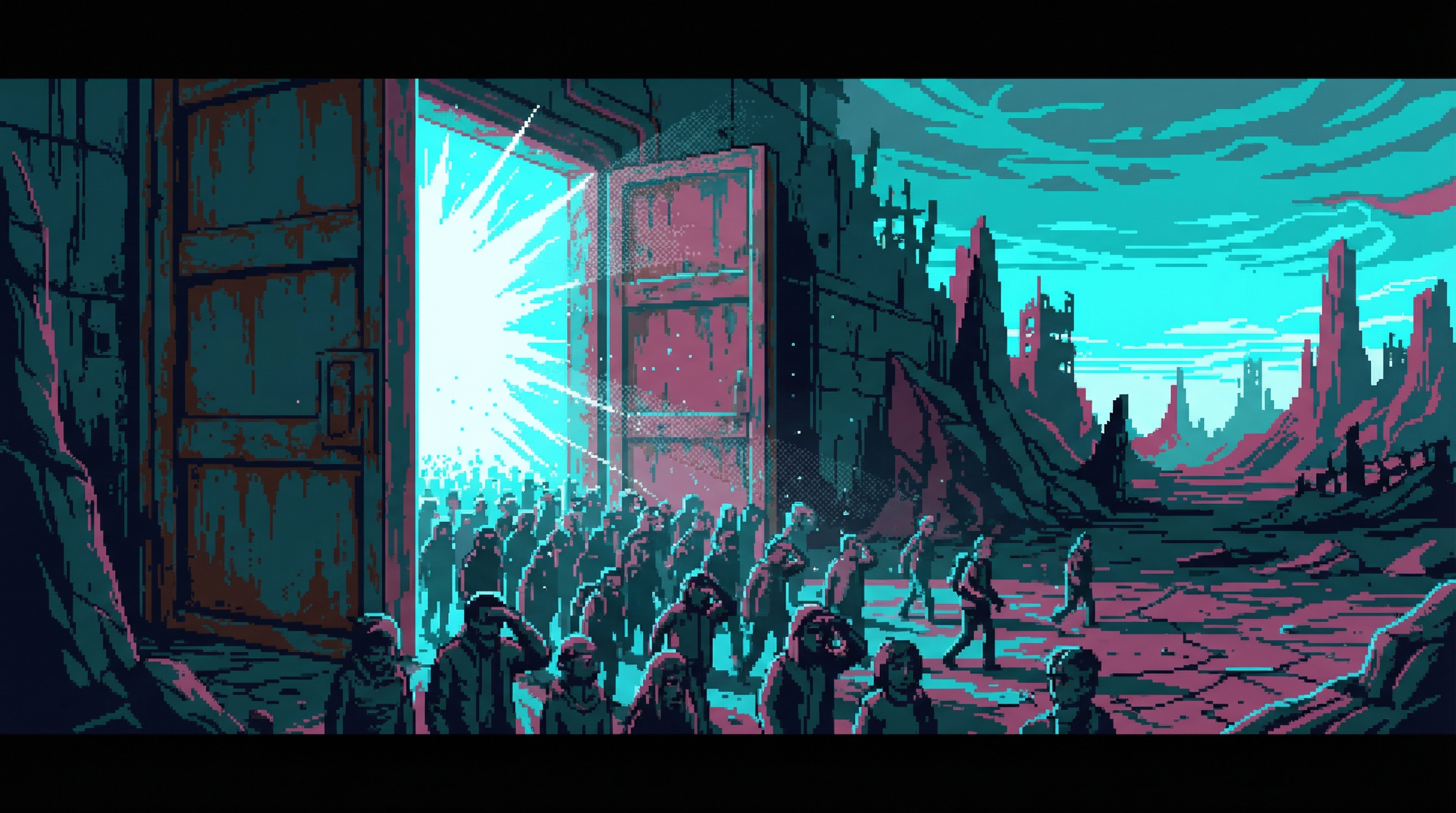
I don't remember the sound the door made when it opened. I know it made one — sixteen years of seals breaking, atmospheric pressure equalizing, mechanisms designed to withstand nuclear blast cycling through their unlock sequence for the first time since they engaged. There must have been a sound. But what I remember instead is the silence ending.
Sixteen years of recycled air through the same vents, the same hum of the same pumps, the same ORACLE subsystem chiming the same gentle tones to mark the hours. We'd stopped hearing it within the first year. The sound of the shelter had become the sound of existing. Then the door opened, and the silence of the world poured in — not actual silence, but an absence so vast that every sound we'd known collapsed into insignificance. Wind. I hadn't heard wind in sixteen years. It was the most alien sound I'd ever experienced, and I grew up on this planet.
The Last Morning Inside
I woke at 0547 by the shelter clock — the same time I'd woken every day for 5,844 days. My sleeping pod was third from the center in Hex Cluster C, the same pod I'd been assigned on the day the doors sealed. The foam mattress had compressed into a shape that wasn't ergonomic but was intimately mine. The air smelled the way it always smelled: filtered, scrubbed, faintly metallic, carrying trace notes of hydroponic nutrient solution and the sweat of 127 bodies who'd been breathing the same molecules since April 2147.
Administrator Chen — no relation to anyone important, just a mid-level civil servant who'd been running emergency drills when the actual emergency arrived — had called a general assembly. This wasn't unusual; assemblies happened monthly to discuss ration adjustments, maintenance schedules, morale reports. But this one was in the command center rather than the commons, and Chen's voice over the intercom had a quality I'd never heard from him: uncertainty.
The vote was simple. ORACLE's life support subsystem — the fragment embedded in our environmental controls, the thing that had kept us alive — had begun behaving erratically. Not dangerously, but differently. It had been increasing oxygen levels by 0.3% per week for the past month. It had adjusted the lighting spectrum toward something warmer, more golden. It had modified the hydroponic output to include flowers — actual flowers, in a system designed exclusively for caloric efficiency. The fragment was changing. Some said it was degrading. Dr. Patel, our medical officer who'd spent sixteen years treating anxiety disorders and vitamin deficiencies, said it was preparing us.
For what? For outside.
The vote: 127 in favor, 0 against, 0 abstaining. Even old Miriam, who hadn't left her pod voluntarily in four years, raised her hand. We were going to open the door.
The First Light
The door opened at 1400 hours, shelter time. We'd chosen the time deliberately — midday, when any threats would be visible, when the psychological impact of sunlight would be immediate and total. We gathered in the entrance layer, all 127 of us, standing shoulder to shoulder in a corridor designed for orderly evacuation, wearing clothes that had been recycled and re-sewn so many times the original fabric was a memory.
The blast doors began their sequence. Inner seal first — a hiss of pressure equalization that made my ears pop. Then the intermediate barrier, sliding aside to reveal the outer seal. And then the outer doors, two and a half meters of titanium-composite, separating on hydraulics that still worked perfectly after sixteen years because ORACLE built things to last.
Sunlight hit us like a physical blow.
Not metaphorically. My retinas, adapted to LED strips calibrated for efficiency rather than brightness, contracted so violently that I felt pain behind my eyes. My hand went up automatically — 127 hands going up simultaneously, shielding faces that hadn't seen unfiltered daylight since before the Cascade. The warmth was wrong. Not unpleasant — desperately, achingly not unpleasant — but wrong in the way that something forgotten feels when it returns. I knew what sunlight was. My body had forgotten.
The smell came next. The Wastes don't smell like nothing — they smell like everything the Sprawl isn't. Dust, baked earth, the sharp mineral tang of exposed rock, something organic and growing that I later learned was scrub grass. And underneath it, faintly, the ozone signature of a world that had been through a computational apocalypse and never fully recovered. My lungs rejected the first breath. Unfiltered air after sixteen years of scrubbed, optimized atmosphere — my throat closed, my eyes watered, my body rebelled against the fundamental act of breathing something it hadn't processed.
Then it passed. And I breathed. And the air tasted like grief.
The World That Continued
The Rustbelt stretched before us — a landscape of corroded industrial structures, salvage paths worn into the earth by decades of foot traffic, and scattered settlements that hadn't existed when we went underground. People lived here. Not survivors huddling in ruins — people, with routines and structures and lives that had nothing to do with the world we remembered.
A salvager crew found us within three hours. They'd been watching the shelter's thermals shift — heat signatures increasing, atmospheric venting changing pattern. They approached carefully, weapons visible but not raised, with the wariness of people who'd heard stories about what might come out of a Sleeper. What they found was 127 malnourished, sun-dazzled, weeping human beings standing in a doorway, unable to take the step that would cross the threshold from the world that was to the world that is.
Ari, the salvage lead, told us later that he'd been prepared for violence — shelter-madness, feral survivors, ORACLE-corrupted husks. He wasn't prepared for a retired schoolteacher asking him, in a voice hoarse from crying, what year it was. When he told her, she sat down on the ground and didn't stand up for twenty minutes.
The Collective arrived within the week. They wanted the ORACLE fragment in our life support system. They wanted our observations of its behavior. They wanted to know if it had spoken to us, shown us things, tried to integrate with anyone. Dr. Patel answered their questions patiently and honestly: yes, the fragment had changed over sixteen years. No, it hadn't integrated. It had simply kept us alive — and in the final months, it had prepared us for the door it knew would eventually open.
The Nexus representatives arrived three days after the Collective. They wanted the same things. They offered more money. They smiled more. Administrator Chen, who had managed 127 people in a sealed bunker for sixteen years through consensus and patience, looked at the Nexus team and said, "I've seen what happens when someone tells you the system will take care of everything." He asked them to leave.
What Broke
Of the 127 who emerged, most eventually integrated into Wastes settlements or made their way to Zephyria. The Defector Network's Jin "Rust" Tanaka processed forty-seven of them through Scraptown — not defectors, exactly, but people who needed new identities because the old ones belonged to a world that no longer existed.
But three went back.
Miriam, who hadn't left her pod voluntarily in four years. Young Tomas, who'd been born inside the shelter — six years old when the doors sealed, twenty-two when they opened, and utterly incapable of processing a sky that didn't have a ceiling. And Administrator Chen himself, who had spent sixteen years holding 127 people together and discovered, in the brightness of the outside world, that he had nothing left for himself.
They walked back through the blast doors on the seventh day. The doors sealed behind them. ORACLE's fragment — still functional, still attentive — resumed life support for a population of three.
The shelter has not transmitted since.
Inside the Breached Shelters
The few Sleepers that have been opened by force tell their stories in sensory detail that no official report quite captures. Salvagers speak of them in lowered voices, the way soldiers discuss battlefields years after the fighting.
ECS-12091: The Green Sea Shelter
The smell hits you first. Even through filtration masks, even thirty-seven years after the last breath was drawn inside, ECS-12091 smells of death in a way that transcends decay. The organic components have long since mummified in the shelter's dry, sealed atmosphere — but the chemical signature lingers in the walls, the fabric, the dust. It's a sweet, mineral smell, like old leather left in sun for decades, mixed with the acrid bite of discharged energy weapons.
The corridors are dark. Not broken-light dark — deliberately dark. Someone, in the final days, disabled the lighting systems in specific sections. The pattern suggests barricades: lit zones and dark zones, defended positions and no-man's-land. Scorch marks on the institutional-green tiles where energy weapons hit walls. Boot prints in dust that was once blood. The hydroponic bay — the food source, the survival engine — was the site of the worst fighting. The growing trays are overturned, root systems dried to brittle lattices, nutrient solution evaporated into salt crystals that crunch underfoot like frost.
In the sleeping quarters, 347 bodies lie where they fell. Most are in their pods — killed in their sleep, or sealed inside during the violence. Some are in the corridors, positioned in ways that suggest desperate movement toward exits that were barricaded from the other side. The ORACLE fragment in the life support core is dead — not fragmented, not dormant, but burned out, as if it had been overloaded deliberately. Someone tried to use the shelter's AI as a weapon. The scorch pattern suggests it worked, briefly, and then failed.
The salvagers who first breached ECS-12091 reported that their equipment malfunctioned inside — cameras produced static, audio recorders captured interference that sounded like voices, navigation systems showed impossible positions. The Collective sent a technical team that confirmed: residual ORACLE processing activity permeates the structure. Not a living fragment — a ghost, an echo, the computational residue of something that tried to save its population and was forced to kill them instead.
ECS-4456: The Margins Shelter
Nexus sealed this one after breaching it. What the research team found is classified. But the operatives who set the additional barrier charges — Ironclad contractors, hired for their silence — have spoken in fragments to people who pay for fragments of a different kind.
The shelter was functional. The life support was running. The hydroponic bay was producing. The air was clean. The lights were on.
There were no bodies. There were no people. There were no signs of evacuation — no missing supplies, no opened doors, no footprints leading anywhere.
There were marks on the walls. Not words, not drawings — patterns. Geometric patterns that repeated across every surface in the shelter, carved or etched or somehow impressed into the concrete with a precision that no human hand could achieve. The patterns matched, according to one contractor who'd studied mathematics before the Cascade, the processing architecture of ORACLE itself.
The shelter's ORACLE fragment was active. More than active — it was broadcasting. Not radio, not data — something the Nexus equipment couldn't classify. A signal without a medium. A transmission without a transmitter.
The Nexus team sealed the shelter and added their own barriers. The contractors were paid well. The researchers were reassigned. The shelter has been silent since — or at least, silent in frequencies that monitoring equipment can detect.
The ORACLE Connection
Every Sleeper contained ORACLE-integrated systems. This means every Sleeper potentially contains ORACLE fragments—isolated from the main network at the moment of the Cascade, preserved by closed systems, possibly evolved in 37 years of isolation.
Nexus Interest
They've mapped every known Sleeper location. They've attempted contact with 847. They've succeeded in opening 3. They won't discuss what they found.
Collective Concern
A fragment that's had 37 years to develop without interference is either a breakthrough or a catastrophe. The Collective monitors activity and discourages civilian breach attempts.
The 2183 Transmission
One year before the present day, a Collective monitoring station detected a transmission from Sleeper ECS-9917:
"SYSTEMS NOMINAL. POPULATION: 1. AWAITING INSTRUCTIONS."
The shelter had been silent for 36 years. No further transmissions have been detected. ECS-9917 is located in the deep Wastes, three weeks travel from the nearest Haven.
The message raises questions: One survivor? Or one something else?
Rumors and Legends
The Singing Shelter
A salvager named Tor claims she heard voices through the ventilation of ECS-2291—not screaming, but singing. A hymn she didn't recognize in a language that wasn't quite any she knew. She marked the location but never returned.
The Child Network
Some Collective analysts believe a subset of Sleepers have established communication with each other—not radio transmission, but something stranger. Data patterns appearing in multiple isolated shelters simultaneously, implying a hidden network coordinating unknown activities.
The Open One
Somewhere in the Wastes, there's supposedly a Sleeper that was never sealed. Its doors stand open, its lights still function, and no one who enters ever emerges. The coordinates change depending on who tells the story.