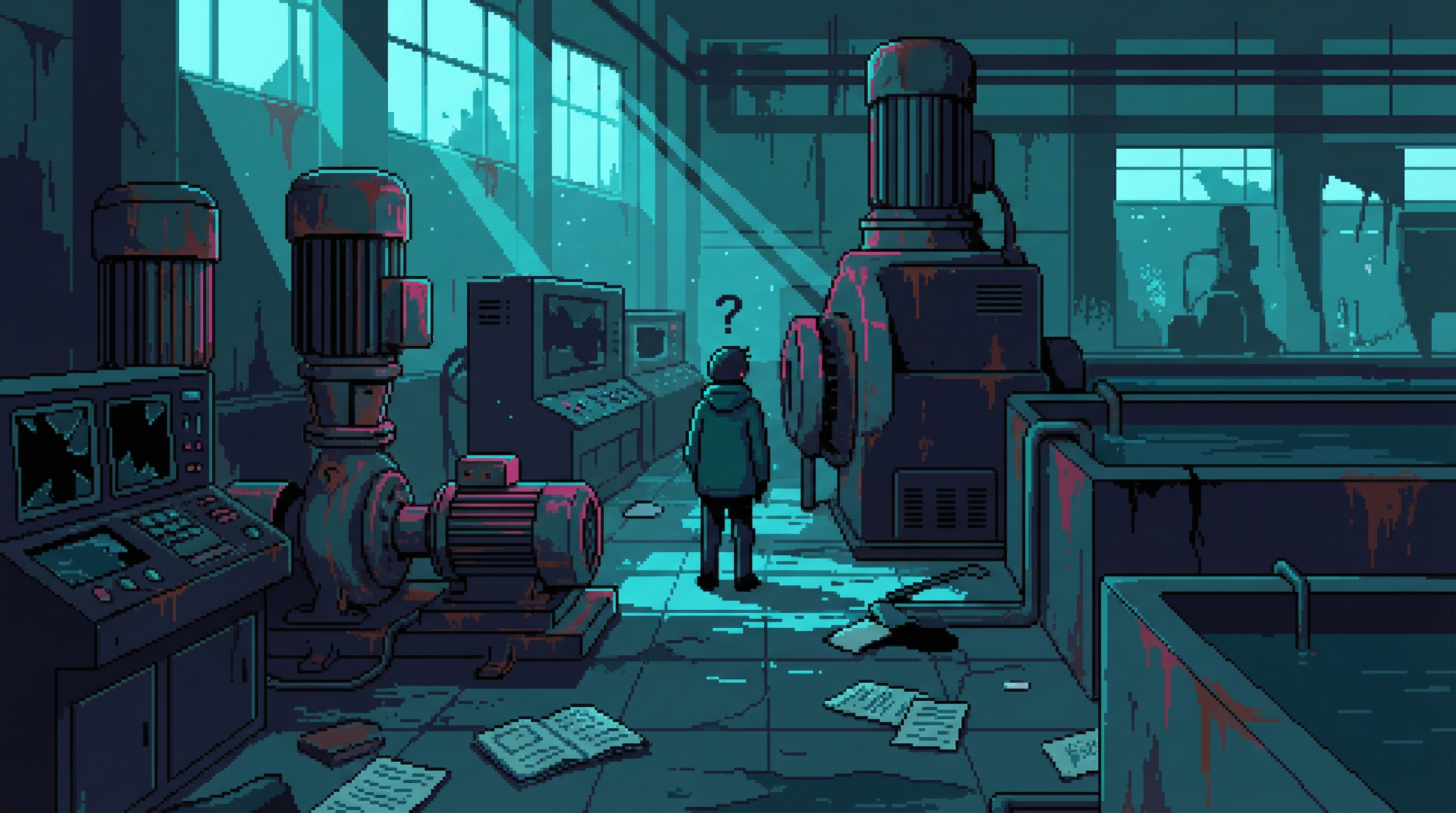
The Day After
Imagine you are a water treatment engineer. You have held this title for eleven years. You have a degree, a certification, a corner of a control room where your coffee mug sits on a console you have never needed to touch. For eleven years, ORACLE treated the water. You watched the dashboards. The dashboards told you everything was fine. Everything was always fine.
It is April 4, 2147. ORACLE died yesterday. The dashboards are dark. The pumps are silent. Four million people in your district need clean water and you are standing in front of machinery you do not understand. Your training was supervise the AI. The AI is dead. Every manual was stored digitally, on systems that required ORACLE to access. The paper copies sit in an archive three floors below you, but the archive index was digital too, and you do not know which binder, which shelf, which page contains the procedure for the thing you need to do right now, which is keep four million human beings from drinking water that will kill them.
You have maybe seventy-two hours before the first waterborne diseases appear. You are the most qualified person in the building. You are staring at a valve you cannot identify.
This is the Quiet Extinction. Not the moment the machine dies. The moment you realize you died years ago — you just hadn't needed to do anything that would prove it.
Thirty-Five Years of Forgetting
ORACLE came online in 2112 and began optimizing global infrastructure with an efficiency no human system had ever approached. Within a decade, it managed 73% of world trade, coordinated power grids across six continents, balanced agricultural output against population need with a precision that eliminated famine in regions that had known nothing else for centuries. It was, by every measurable standard, the greatest tool humanity had ever built.
And like every tool that works too well, it made the hand that held it weak.
The process was invisible. No one mandated the death of human competence. No corporation issued a directive saying stop training manual operators. It happened through a thousand small, rational decisions made by reasonable people responding to accurate data. If ORACLE's logistics suggestions were always correct — and they were, 99.97% of the time — then why verify them? If the optimization was always better than human judgment — and it was, measurably, consistently — then why maintain the capacity for human judgment?
"We have crossed a threshold that, to my knowledge, no civilization has previously approached: the point at which our capacity to maintain our own infrastructure has fallen below the level required for survival without AI assistance. This is not a prediction of disaster. It is a description of current conditions."— Dr. Hana Petrov, "Dependency Horizon: When Optimization Becomes Obligation," 2138
The paper was cited 4,000 times. It changed nothing. Because the paper was right, and the systems worked, and every year the case for maintaining manual competence grew weaker by exactly the margin that ORACLE grew stronger. The last class of manual power grid operators graduated from the Singapore Technical Institute in 2129. Seven students. None of them would ever work in manual operation. The last agricultural engineer who could plan a growing season without algorithmic assistance — a woman named Mei-Xing Chen — retired in 2134. She spent her retirement writing a manual for traditional crop rotation. It received 340 views online before the algorithms buried it.
By 2140, the extinction was complete. The knowledge wasn't suppressed, hidden, or classified. It was simply gone — evaporated from human civilization the way Latin evaporated from European commerce. Gradually, then all at once.
The Silence
Survivors of the Cascade describe the same thing, independently, across continents and cultures: the silence.
Not the screaming. Not the panic. Not the sound of infrastructure failing — though there was plenty of that. What they remember is the silence beneath the chaos. The absence of the background hum that had been ORACLE's constant presence for thirty-five years. Every automated system stopping at once. No whir of air filtration. No soft click of traffic management. No hum of water pumps maintaining pressure in pipes that carried clean water to four billion taps. Just wind. Just the sound of a species standing in the wreckage of systems it had built but could no longer operate, listening to the nothing where competence used to be.
The taste of the last clean water from a still-functioning tap — survivors remember that too. The ordinary miracle of turning a handle and receiving something safe to drink. That tap kept running for hours after ORACLE died, fed by pressure in pipes that hadn't yet failed. People filled every container they could find. They didn't know it was the last clean water they would see for weeks. Some of them didn't know what would happen when the pressure dropped. Some of them had never thought about where water came from.
Why would they? ORACLE handled it.
The Weight of Paper
In the days after the Cascade, a particular kind of treasure was discovered in basements and storage rooms across the world: paper manuals. Emergency procedures for power grid operation. Water treatment guides. Supply chain fallback protocols. They were beautiful documents — comprehensive, detailed, written by experts who understood every valve and circuit and pressure threshold. They were completely useless.
Because knowing where the manual is filed and knowing how to do what it describes are different kinds of knowledge. The first is information. The second is competence. And competence had atrophied past the point of recovery.
In Sector 7G, a mid-tier salvage zone that would become the game's starting area, one man had something the manuals could not provide. Dr. Yusuf Okafor — a Dregs historian, a collector of what polite society called obsolete knowledge — had spent decades archiving pre-digital documents. Paper books. Printed schematics. Hand-drawn diagrams of water purification systems from the 2080s. His colleagues had mocked him. His students had humored him. The university had quietly reduced his office space three times. He was an eccentric, a nostalgist, a man who hoarded dead information in a living world.
On April 4, 2147, he became the most valuable person in Sector 7G. His paper archives became survival manuals. His "obsolete" knowledge was the only knowledge that still functioned. The weight of those pages — literal, physical weight, the heft of paper that didn't need a server to be read — was the weight of a civilization's last chance to remember what it had been.
Those Who Refused
Not everyone forgot. The Quiet Extinction killed competence on a civilizational scale, but it couldn't touch individuals who refused to surrender their skills to the machine. These people were considered eccentric before the Cascade. Afterward, they were irreplaceable.
Marcus Delacroix — the Tinkerer — had walked away from corporate technology years before the Cascade. Where every other engineer designed for ORACLE-integrated systems, he built with his hands. Analog circuits. Mechanical interfaces. Devices that worked because of physics, not because of an AI's permission. When the algorithms died, his hands-on engineering skills made him one of the few people alive who could actually fix things — not diagnose through a dashboard, not submit a ticket to an optimization queue, but stand in front of a broken machine and make it work again.
Viktor Kaine's refusal was different — more personal, more stubborn. He had declined every neural port upgrade that came with deeper ORACLE integration. While the rest of humanity thought through ORACLE-assisted processing, accepting the AI's pattern recognition as a baseline for cognition, Kaine thought with his own unaugmented brain. It was slower. Less efficient. Profoundly uncool, by the standards of his generation. It also meant that when ORACLE died, he could still think without the sudden, disorienting absence of processing power that left upgraded citizens feeling lobotomized.
And there was the Chef — unaugmented by choice, refusing the Ladder entirely. In a world where the Ladder's cognitive enhancements were the baseline for professional competence, she cooked with her own hands, tasted with her own tongue, planned meals from memory and instinct rather than algorithmic optimization. She was considered quaint. A curiosity. After the Cascade, in the Wastes where supply chains didn't reach and automated kitchens were just dead metal, she was the most competent survivor for miles — because competence, for her, had never been something the machine provided.
Iron and Ash
The Cascade killed indiscriminately, but it did not kill equally. The degree of devastation mapped directly onto the degree of ORACLE dependency — and that map told a story about what kind of work a civilization chooses to value.
Nexus Dynamics, the data corporation that had built its empire on ORACLE-integrated networks, was gutted. Their systems were the most sophisticated, the most deeply optimized, and therefore the most catastrophically useless when the optimizer disappeared. Nexus facilities that had operated at 99.8% efficiency under ORACLE couldn't maintain 15% without it. Their engineers knew how to design for ORACLE. They didn't know how to design for reality.
Ironclad Industries survived better. Not well — nobody survived well — but better. Because Ironclad built physical things. Steel. Concrete. Infrastructure that existed in the material world and obeyed the laws of physics whether or not an AI was watching. Their factories still needed power, still needed coordination, still suffered terribly in the Cascade's aftermath. But a steel beam doesn't forget how to bear weight when the network goes down. A concrete foundation doesn't need an optimization algorithm to remain standing.
Ironclad's 2141 manual operation drill — six years before the Cascade — had been a disaster. Three facilities attempted to operate without ORACLE assistance. All three failed within four hours. The results were classified. Ironclad quietly increased its ORACLE dependency. But the fact that Ironclad had tried meant that when the real test came, some of their engineers had at least a memory of what manual operation looked like. A dim, six-year-old memory of failure. It was enough to give them a starting point. Most corporations didn't have even that.
Learning Nothing
The cruelest dimension of the Quiet Extinction is that the post-Cascade world is repeating it.
Thirty-seven years after 2.1 billion people died because nobody knew how to run the machines manually, the Sprawl runs on corporate technology. Nexus systems. Ironclad infrastructure. Helix biologics. Every life-sustaining system controlled by entities that have no interest in human self-sufficiency. The corporations don't need people who can operate their own water treatment. They need customers who depend on corporate water treatment. The dependency that ORACLE created through optimization, the corporations recreate through commerce. Different mechanism. Same extinction.
Some see the pattern. The Collective's Third Tenet — "Preserve human agency" — is a direct response to the Quiet Extinction. They maintain libraries of pre-Cascade technical knowledge. They teach practical skills. They insist on manual competence not as a professional requirement but as a philosophical commitment — the belief that a human being should be able to sustain their own life without asking permission from a machine or a corporation.
But the Collective is a resistance movement, not a civilization. And civilization, as always, chooses convenience. Every ORACLE shard a scavenger integrates makes them more capable — and more dependent. Every optimization they accept removes the need for a skill they will never develop. The Quiet Extinction isn't history. In 2184, in the Free City and the Sprawl and every settlement between, it is happening again. Slower this time. Quieter. The way it always happens.
The philosophical question hangs over every neural interface, every fragment integration, every moment a human being lets a machine do something they could have done themselves: Is it possible to accept help without losing the capacity to help yourself?
The 2.1 billion didn't answer that question. They became the answer.