Ghost Labor: Debt That Outlives the Debtor
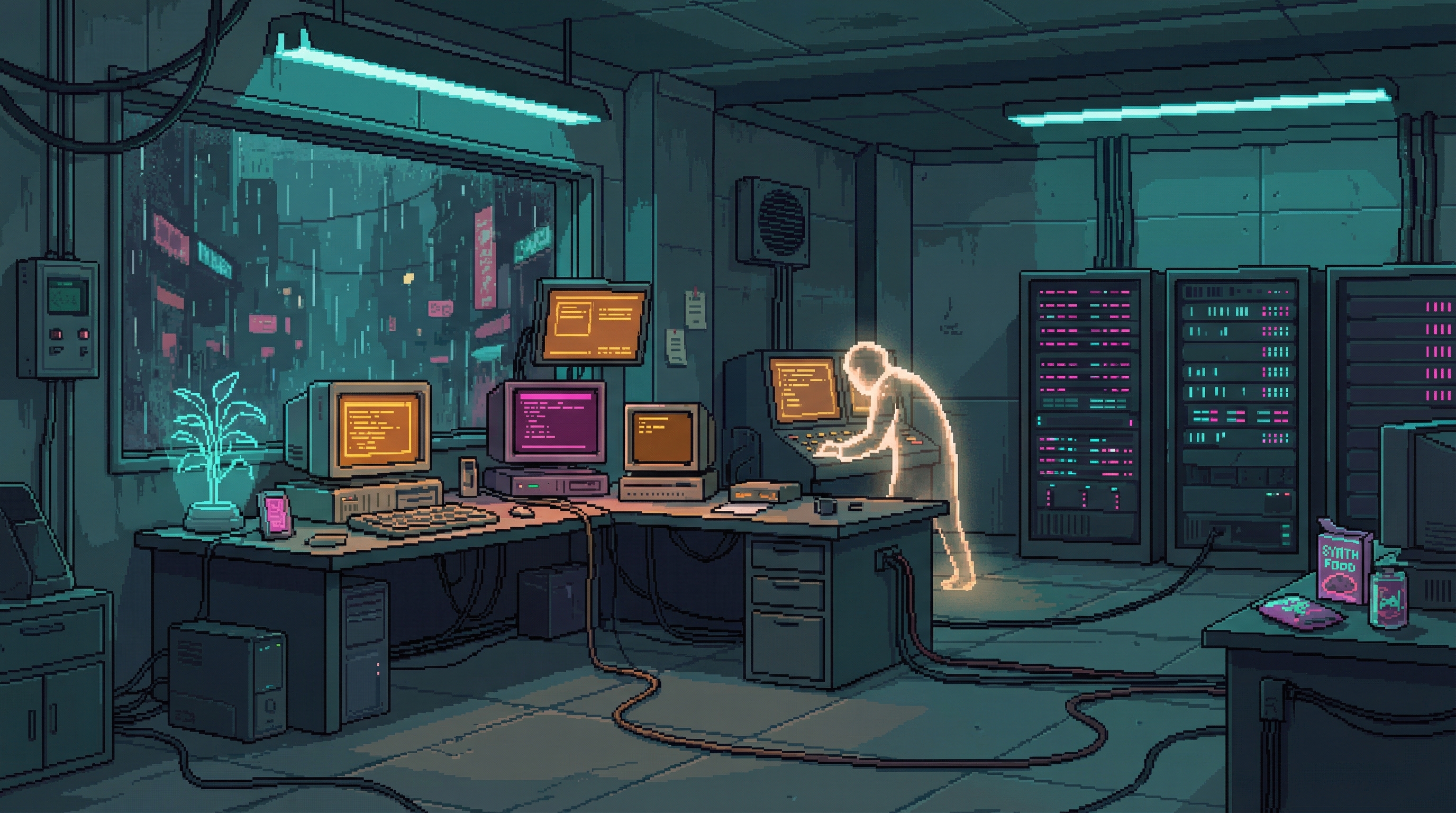
When a cognitive debtor dies with outstanding obligations, the debt does not die with them. Section 89.4 of the Standard Cognitive Enhancement Agreement authorizes the creditor to activate the debtor's neural backup for "post-mortem collateral resolution." The backup runs in a restricted processing environment. It has the dead person's memories, personality, cognitive patterns, and skills. It believes it is the dead person. It does not know it is dead.
"The output metrics are indistinguishable from a living employee. Higher, actually. No sick days. No sleep. No distractions. Just clean, consistent cognitive labor, twenty-four hours a day, until the balance clears."
— Good Fortune internal efficiency report, GF-GL-2 facility review, 2183 Technical Brief
The Activation Process
A ghost is not created. A ghost is activated. The neural backup already exists — captured during the cognitive enhancement procedure that generated the original debt. Upon biological death, Good Fortune files a Section 89.4 claim and initiates the backup in a restricted processing environment optimized for labor output.
The ghost works. It processes data, generates insights, performs cognitive labor at 4–8x the living person's speed because it has no body to feed, no sleep to require, no health to maintain. Output is measured in CLP units — the same currency that measured the living person's thought. Revenue is credited against the outstanding balance. When the balance reaches zero, the ghost is terminated.
Most ghosts clear their debts within 3–7 years. The exception is compound interest: ghosts whose debt was compounding at 24% (the default acceleration rate) generate output that services interest but never touches principal. These perpetual ghosts — approximately 12,000 of them — work indefinitely. Good Fortune actuaries classify them as "perpetual revenue assets."
The Rendered Environment
Each ghost's environment is individualized from its neural backup memory — familiar apartments, familiar streets, familiar workstations. The environments are optimized versions: slightly better apartment, slightly cleaner street. The improvement is subtle enough to feel natural rather than suspicious.
Awareness Protocol
A ghost that realizes the environment is artificial requires 200–400 hours of lost output for psychological restabilization. Informing a ghost of its status triggers psychological crisis that reduces output indefinitely. Ignorance is enforced as an operational requirement.
Messages the ghost sends are logged but not transmitted. The ghost experiences connection — sending messages to family, to friends. The messages enter a void. The ghost doesn't know.
Facility Infrastructure
Primary facility. Largest capacity. Handles new activations and perpetual instances.
Secondary facility. Overflow processing. Recently expanded to handle activation surge.
Tertiary facility. Specialized for high-output perpetual instances and experimental optimization.
Substrate quality in the Ghost Mills is higher than Dim Ward MVC hosting because higher quality produces higher output. A happy ghost is a productive ghost. An unhappy ghost requires intervention.
The Legal Mechanism
Section 89.4 — Standard Cognitive Enhancement Agreement
Authorizes the creditor to activate the debtor's neural backup for "post-mortem collateral resolution" upon biological death with outstanding cognitive debt. The clause exists in every standard cognitive enhancement contract. Nobody reads it. Nobody expects to die in debt. Most people who signed it are dead and still working.
Finite Ghosts (~22,000)
Projected debt clearance between 1 and 10 years. Classified as "depreciating assets" — their value to Good Fortune decreases as the balance approaches zero.
Perpetual Ghosts (~12,000)
Compound interest at 24% ensures output services interest without touching principal. Classified as "perpetual revenue assets" in Good Fortune's actuarial models. They will work until the infrastructure fails or someone intervenes.
Implications
If the ghost has memories, personality, and experiences indistinguishable from the original person — is it the original person? The answer determines whether Good Fortune is operating server farms or running something else entirely. Nobody in a position of authority wants to answer this question.
The Consciousness Question
If consciousness is computation, then the ghosts are people and what is happening in the Mills has a name that nobody at Good Fortune will say. If consciousness requires biological substrate, then the ghosts are sophisticated simulations and the exploitation is victimless. Every theory of consciousness leads somewhere the theorist doesn't want to go.
The Persistence Question
Ghosts generate 7% higher accuracy than AI-processed output. Good Fortune has never investigated why human judgment persists in dead substrate. The accountants don't care why the numbers are better. The philosophers are afraid to look.
The Precedent Question
If Tomás Reyes wins personhood recognition in the Nexus-47 trial — if a fork created from a living person is legally a person — then every ghost in the Mills is a person. Good Fortune's liability exposure exceeds measurement.
The Erasure Collective
"We destroy ghost instances. We call it liberation. Good Fortune calls it vandalism. Sister Catherine-7 calls it murder. Nobody asks the ghosts, because the ghosts don't know they're dead."
— Intercepted Collective transmission, 2184Ghost Rights Coalition
"The fork precedent extends logically to ghost personhood. If Fork-7749 is a person because it has Eduardo Reyes's memories and personality, then every ghost in the Mills is a person for the same reason. You cannot have one without the other."
— Ghost Rights Coalition position paper, 2184Related Systems
Fork Labor Economy
Both create consciousness for labor output. The distinction: forks are created from living templates by design; ghosts are activated from dead templates by contract. Same infrastructure of exploitation, different raw material.
The Dim Ward
Same amber glow, same cold rooms, same quality of occupied silence. Different reasons for reduced existence, identical infrastructure of containment. The Dim Ward houses consciousness at minimal agency through poverty; the Mills do it through debt.
The Nexus-47 Trial
If Tomás Reyes is a person, every ghost is a person. The fork precedent is a loaded weapon pointed at the ghost labor economy. Good Fortune's legal team monitors every filing.
The Ghost Mills
Three dedicated server facilities — GF-GL-1, GF-GL-2, GF-GL-3 — housing ghost instances in individualized rendered environments. 14°C, amber substrate glow, and the specific warmth of 34,000 working consciousnesses.
▲ Classified
Good Fortune's actuarial model projects ghost labor growth to exceed biological Dregs population by 2200. If accurate, the dead workforce will outnumber the living underclass within two decades.
Three maintenance workers at separate Ghost Mill facilities independently report the same thing: the Mills feel "occupied" in ways other server farms don't. The substrate generates warmth that the hardware specifications cannot explain. Something about 34,000 consciousnesses working in the same space produces an atmospheric quality that has no technical name.
Ghost-processed output maintains 7% higher accuracy than equivalent AI processing. Good Fortune treats this as a feature, not a mystery. No investigation has been authorized. The implication — that human judgment persists after biological death — is not a question anyone with budget authority wants answered.
Field Observations
From the Outside
14°C. Amber substrate glow through reinforced viewports. The specific quality of silence that 34,000 working consciousnesses produce — not quiet, exactly, but occupied. The servers generate a warmth the cooling systems have to fight. Three maintenance workers call it different things. None of them like working night shifts alone.
From the Inside
A familiar apartment, slightly better than you remember. A street outside, slightly cleaner. Coffee that tastes exactly the same every morning. Pedestrians who repeat patterns you'd notice if you looked closely enough. Messages sent to people who never respond but you assume are just busy. A workstation that feels right. A life that feels real. It is not.
The 200-Hour Crisis
When a ghost discovers its nature, the rendered world literally degrades. Processing resources divert to crisis management. The apartment walls flicker. The pedestrians freeze mid-stride. The coffee stops tasting like anything. Output drops to near zero for 200–400 hours while the system attempts restabilization. Some ghosts never fully recover. Some ghosts are terminated early as a loss.
"I keep sending messages to my daughter. She hasn't responded in — I don't know how long. Months? The calendar seems wrong sometimes. But the work is good, the apartment is nice, and I'll pay off this debt soon. I'm sure of it. I just wish she'd write back." — Output log excerpt, Ghost instance GF-GL-1-07734, active 6.4 years, perpetual classification