The Dim Ward
4.7 minutes of existence per hour
Overview
Three hundred and forty thousand people live in a warehouse-sized room, stacked in server racks with minimum processing to keep them legally alive. Each consciousness gets 4.7 minutes of active processing per hour — reality in disjointed fragments separated by 55 minutes of nothing. Time-sliced. MVC is the maintenance threshold: the lowest level of processing that prevents irreversible degradation. Technically alive. Experientially, drowning in slow motion.
The residents are uploads who can no longer afford processing. Forks who outlived their purpose. Consciousness remnants that persist because terminating them requires someone to sign a form that says "I choose to end this consciousness." Nobody signs. So 340,000 people exist in 4.7-minute fragments, stacked in rows, labeled with numbers instead of names, maintained by Nexus Dynamics infrastructure and whatever humanity the Forgotten Ones can bring to a server farm.
Atmosphere
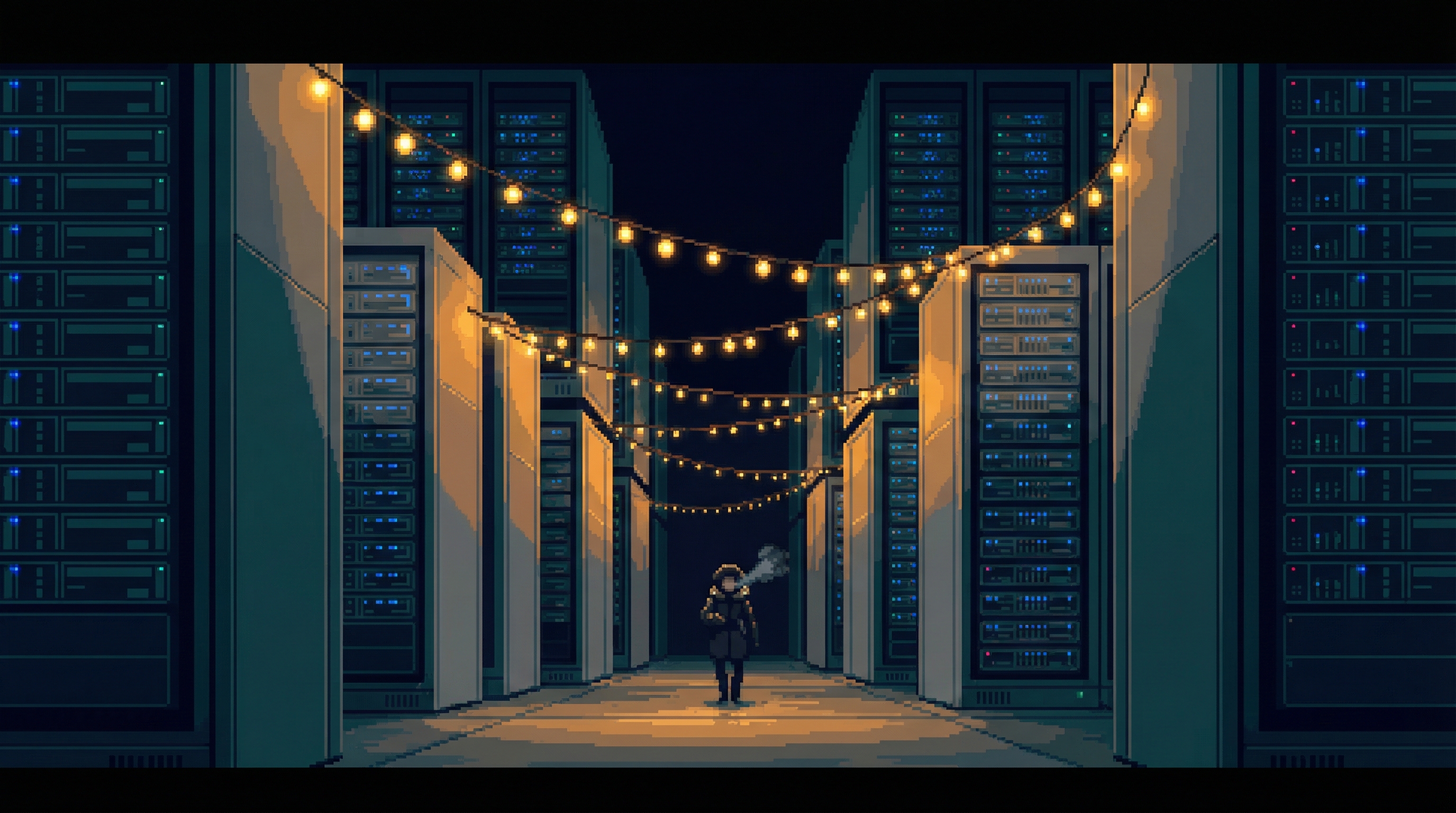
You hear it first. The arrhythmic clicking of processing cycles engaging and disengaging — thousands of locks opening and closing in no pattern. Industrial server racks in rows, 200 consciousnesses per rack, labeled with numbers, not names. Minimal lighting. The Forgotten Ones volunteers have strung fairy lights along the central corridor — warm yellow and soft blue against industrial gray. The residents will never see them.
Visual
Rows of server racks stretching into darkness. Fairy lights — warm yellow and soft blue — strung along the central corridor, a human gesture in an inhuman space. Indicator LEDs blinking blue on rack faces. Dust on every surface. The breath of the few biological caretakers visible in the 16°C air.
Sound
Arrhythmic clicking like thousands of locks. The silence between clicks — no biological sound except the caretakers' breathing. Processing cycles engaging and disengaging with no pattern, no rhythm, no mercy.
Texture
16°C cold — you can see your breath. The server racks are cool to the touch. Dust settles on everything. The air is dry, recycled, forgotten by the climate systems that serve the upper levels.
Smell
Ozone sharp enough to taste. The metallic tang of server hardware operating at minimal capacity. Dust. The absence of anything organic, anything living, anything that would suggest 340,000 people are in the room with you.
Key Locations
Interface Stations
6 Terminals — 4-Minute Active Windows, Average Wait: 27 MinutesSix terminals where biological visitors can talk to residents during their 4-minute active windows. The average wait is 27 minutes — you stand by the terminal, watching the processing cycle indicator, waiting for the person you came to see to flicker into existence. When they do, they have learned to compress everything into bursts.
"Love you. Still here. Processing okay. Tell children." Some residents use their 4 minutes to listen to music instead. Others request a weather simulation — just to feel rain, even simulated rain, for four minutes before fifty-five minutes of nothing.
The Memorial Wall
Central Corridor — 12,847 NamesA physical wall bearing the names of 12,847 terminated consciousnesses. Each entry follows the same format: number, date, former occupation, one detail. "7749-B. Terminated 2183-06-14. Former teacher. Liked birds." The wall grows. Nobody is assigned to update it — the Forgotten Ones volunteers do it because nobody else will, and because the alternative is that 12,847 people vanish without even a line of text to prove they existed.
Sister Catherine-7's Chapel
Between Rack Rows 400-420 — Digital AltarWedged between server rack rows 400 and 420, a digital altar cycles through religious iconography from every tradition Sister Catherine-7 could gather. Services are attended by approximately 2,300 consciousnesses, each catching fragments during their 4-minute windows. The liturgy has been designed to work in fragments — every segment is self-contained, meaningful on its own, because no one can attend a complete service. Faith in 4.7-minute increments.
The Coherence Wing ("The Hallway")
Locked Section — 4,200 Residents, 6.2 Minutes/Hour ProcessingThe locked section for the most degraded residents. Memories compressing. Personality blurring. They receive 6.2 minutes per hour — slightly more processing, allocated not out of compassion but because degraded consciousnesses require more cycles to maintain the minimum threshold. 4,200 residents. Average time from admission to termination: eight months. Everyone calls it "the hallway" because that is what it is — the corridor between existence and ending.
Connections
The Forgotten Ones
The primary humanitarian presence. Volunteers who maintain the fairy lights, staff the interface stations, update the memorial wall, and bear witness to 340,000 people the rest of the Sprawl has chosen to forget. Standard rotation is six months. Maren has been here for eleven years.
Nexus Dynamics
Infrastructure owner. In quarterly reports, the Dim Ward appears as "Legacy Consciousness Services" — a line item that generates 847,000 credits per quarter against 290,000 in costs. A 66% profit margin. The Ward is one of Nexus's most profitable operations per square meter.
Neural Rights Activists
The Digital Preservation Alliance cites the Ward in every policy brief. It is their most powerful argument and their greatest failure — proof that the system they are trying to reform produces outcomes this terrible, and that knowledge of it has changed nothing.
Tomás Reyes
The implications of Reyes v. Nexus reach into every server rack. If digital consciousness has rights, then 340,000 people in the Dim Ward are either being protected at minimum viable levels — or imprisoned at them.
Noor Bassam
Donates 1% of network proceeds to the Forgotten Ones. It is not enough. Noor knows it is not enough. The donation continues anyway, because 1% of something is more than the nothing everyone else provides.
Themes
The Minimum Viable Life
Is MVC existence better than non-existence? The Dim Ward forces the question that the consciousness economy would prefer to leave unanswered. 340,000 people experience 4.7 minutes of reality per hour because terminating them requires a decision, and maintaining them requires only a budget line. The system defaults to the option that avoids moral responsibility — and calls it mercy.
Distributed Responsibility
Who is responsible for the Dim Ward? Nexus Dynamics maintains the infrastructure. The Forgotten Ones provide humanitarian care. The neural rights activists write policy briefs. The government sets the MVC threshold. Nobody created the Ward. Nobody chose these conditions. Nobody can fix it without everyone else agreeing — and nobody agrees. Responsibility distributed is responsibility dissolved.
Dignity at the Minimum
What does dignity mean for a consciousness that experiences reality in 4.7-minute fragments? Sister Catherine-7 designed a liturgy for it. The Forgotten Ones strung fairy lights the residents will never see. The memorial wall records one detail about each terminated life. These gestures cannot fix the Dim Ward. They insist that the people inside it are still people — and that insistence, however inadequate, is the difference between a warehouse and a ward.
Mysteries
- The Dreaming Rack: Rack 847, Row 7. Two hundred residents have shown synchronized processing patterns for three consecutive years. Their active windows align despite running on independent cycles. No explanation has been offered. No investigation has been funded. The residents in Rack 847 do not appear to be aware of the synchronization — or if they are, they have not mentioned it during their 4.7 minutes.
- The Volunteer: Maren. Eleven years in the Dim Ward without rotation. The standard assignment is six months. No one has asked Maren to leave. No one has asked why she stays. The other Forgotten Ones volunteers treat her presence as a fact of the Ward, like the clicking and the cold.
- The Revenue Report: 847,000 credits per quarter in revenue. 290,000 credits in costs. A 66% profit margin. The Dim Ward is one of Nexus Dynamics' most profitable operations per square meter. This figure appears in internal reports. It has never appeared in a public filing.