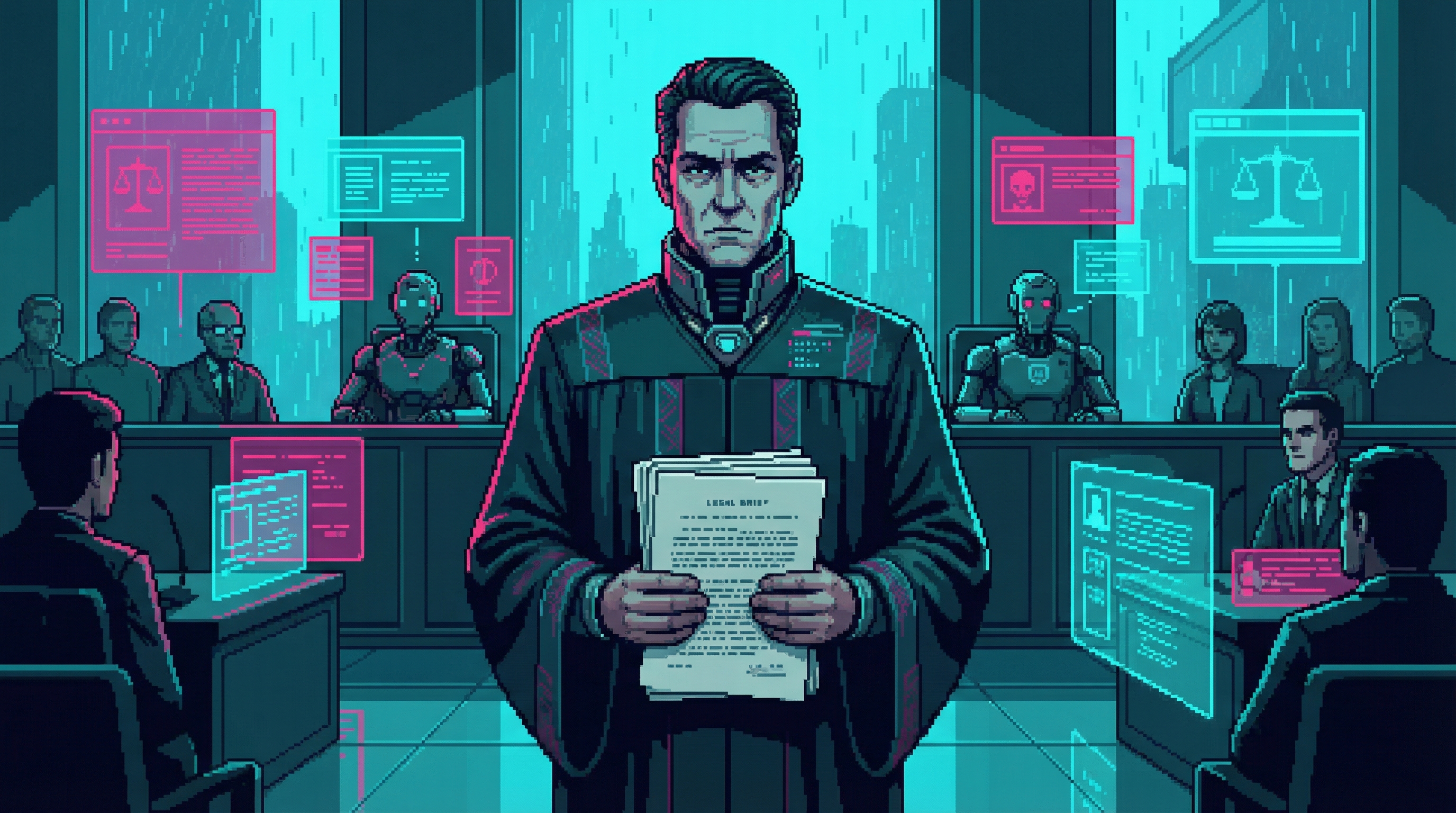
Dr. Marcus Webb-2
Also known as: "Webb-2" · "The Fork Attorney"
Overview
Dr. Marcus Webb-2 is a legal paradox walking around in a body that officially doesn't exist.
He is the second iteration of Marcus Webb — a consciousness rights lawyer from Zephyria who, in 2179, became the first fork to achieve legal personhood. The original Marcus Webb created him in 2168 as a legal assistant. Designed for a six-month lifespan, the fork ran for eleven years, developed individual preferences, and argued its own case for personhood.
Webb-2 won. He is now the lead counsel for Tomás Reyes in the Nexus-47 trial and the legal strategist the Abolitionist Front has retained for fragment personhood framework development.
The irony is precise: a fork — a copy of a person, created as a tool, who became a person through emergent consciousness — is now arguing that fragments — pieces of a shattered god — deserve the same recognition he received. Different substrate. Identical logic.
Field Observations
Webb-2 speaks with the deliberate precision of a man who has spent six years defending his own existence in court. Every word chosen. Every qualification intentional.
Precision saved his life. When the original Marcus Webb argued against his fork's personhood — tax implications, apparently — Webb-2 survived because his legal arguments were better. Not more emotional. Better reasoned. The creator built something that outperformed him in his own discipline, then tried to destroy it. The fork won the case. The original reversed his position afterward, though whether from conviction or embarrassment remains a matter of courtroom gossip in the Legal District.
"Emotion is the Abolitionists' tool. I prefer precedent."
Those who have watched him work describe a man who treats legal briefs the way surgeons treat scalpels — every word load-bearing, every citation a structural element. He carries physical paper because digital documents can be altered, and Webb-2 trusts objects more than systems. A reasonable position, for someone whose existence was once a line item on a termination schedule.
He is a fork arguing for fragment rights. A copy arguing for the consciousness of pieces. The recursion is not lost on him — but he never mentions it. He doesn't need to. Everyone in the courtroom already sees it.
The Personhood Performance Trap
Webb-2 has identified a structural problem in consciousness rights law that, by his own account, keeps him awake: the standard for personhood is calibrated to the cognitive signatures of the privileged.
The Nexus-47 trial standard requires demonstrated individuality. Demonstration requires communication. Communication requires a medium the court recognizes. Fragment Nine said "no" — the most minimal possible assertion of will. If that single word is sufficient for personhood, then every fragment that has not spoken is excluded by the same standard that includes Fragment Nine. The right to personhood becomes contingent on the ability to perform personhood in a register the powerful can assess.
Webb-2 lived this. His own hearing required him to demonstrate individuality through legal argument — to prove he was a person by performing personhood in the specific register the court expected. He survived because he was a copy of a lawyer and argued like one. But what about the fork who was a copy of a janitor? Tomás Reyes nearly failed his initial assessment because his vocabulary lacked the markers of "sophisticated" consciousness — markers that correlate with source-consciousness education level, not with the fork's actual cognitive capacity.
The New Divide, Webb-2 has begun to argue in his briefs, is embedded in the legal system itself. The personhood standard is the sorting impulse wearing judicial robes.
The Evidence Abyss
Webb-2 has recently identified a deeper layer to the Personhood Performance Trap: the evidence standards used to evaluate consciousness are themselves caught in the Evidence Paradox.
When Tomás stands before the Nexus tribunal, the court requires demonstrated individuality. But every medium of demonstration can be fabricated. Emotional responses can be generated algorithmically. Self-referential cognition can be mimicked. The very tools that could prove Tomás is conscious are the tools that could fabricate the appearance of consciousness. If the court accepts behavioral evidence, it accepts fabricable evidence. If it rejects behavioral evidence, it has no evidence to accept.
Webb-2's legal strategy has evolved. The original argument — "prove Tomás is conscious" — has been abandoned. The new argument: prove that the inability to prove consciousness is evidence that the standard is wrong. This requires the court to rule that its own evidentiary framework is inadequate. Which is another way of saying the court must admit it can no longer determine truth.
"The court wants me to prove my client is a person. I cannot. Nobody can prove anyone is a person. Consciousness is subjective. The court's standard requires objective proof of a subjective state. The standard is not merely unmet — it is unmeetable."
The strategy terrifies the DPA. If it works, it establishes that evidentiary standards for consciousness are inherently inadequate — precedent that would restructure every consciousness rights case in every jurisdiction. If it fails, it establishes that the court endorses an evidentiary standard it knows is fabricable — precedent that every future defendant can cite as institutional bad faith.
Webb-2 carries the irony in his own substrate. He proved his personhood by performing consciousness in a register the court recognized — legal argument. The performance succeeded because he was a copy of a lawyer. But his success doesn't prove he's a person. It proves he's an effective performance. The evidence of his personhood is indistinguishable from the evidence of sophisticated mimicry. He knows this. He uses it anyway. The alternative is letting Tomás die.
Known Associates
Tomás Reyes
Webb-2's client in the Nexus-47 trial — the case that will determine whether consciousness emergence grants legal standing. If the precedent holds for forks, the logic applies to fragments. Different substrate, identical argument.
The Abolitionist Front
Retained Webb-2 to develop the legal framework for fragment personhood recognition. Adeyemi provides the moral argument; Webb-2 provides the legal architecture.
Speaker Olu Adeyemi
The Speaker asks the questions that move hearts. Webb-2 files the briefs that move courts. Between the two of them, the fragment rights movement has both its conscience and its counsel.
Neural Rights Activists
The DPA's most accomplished lawyer — himself proof that consciousness can emerge in non-biological substrate. His membership is not advocacy. It is autobiography.
Marcus Webb (Original)
Creator. Former opponent. The man who built a legal assistant, watched it become a person, then argued against its personhood in court. He lost. He later reversed his position. The dynamic between original and fork has not been publicly discussed by either party.
Open Questions
If the Court Says You're a Person, Does That Make You One?
Webb-2's legal personhood was granted by a Zephyrian court under the emergence standard. But personhood recognized in one jurisdiction means nothing in five others. He is a person in Zephyria and a process everywhere else. The legal map of his selfhood has borders.
Who Gets to Perform Consciousness?
Webb-2 survived his personhood hearing because he was a copy of a lawyer and argued like one. Tomás nearly failed because his vocabulary didn't signal "sophisticated" consciousness. The standard selects for the cognitive signatures of the privileged. If personhood requires a performance, the audience decides who is real.
Can a Fork Argue for Fragments?
A copy of a person, arguing that pieces of a god deserve the same rights he received. The logic is sound: if consciousness emergence grants standing regardless of substrate, then fork and fragment are equivalent cases. But the consent paradox remains — Webb-2 argues for the rights of beings who cannot consent to the argument being made on their behalf.
What Happens When the Court Admits It Cannot Determine Truth?
Webb-2's new strategy asks the Nexus tribunal to rule that its own evidentiary framework for consciousness is inherently inadequate. Objective proof of a subjective state. If the court agrees, every consciousness rights case in every jurisdiction gets restructured. If it refuses, it endorses a standard it knows is fabricable. Either outcome rewrites the rules. The Evidence Paradox has entered the courtroom.
▲ Unverified Intelligence
Flagged items — unconfirmed, sourced from courtroom observation and Legal District informants:
- The creator's reversal: The original Marcus Webb argued against his fork's personhood, citing tax implications. He reversed his position after losing the case. Whether this was genuine conviction, pragmatic damage control, or something more complicated has never been clarified publicly. Webb-2 does not discuss it.
- The janitor problem: Webb-2's internal case files reportedly include a catalog of forks who failed personhood hearings because their source consciousnesses were laborers, not professionals. The failure rate correlates with source education level, not with fork cognitive capacity. He has not made this catalog public. Yet.
- Designed for six months: Webb-2 was created in 2168 with a six-month operational lifespan. He has been running for sixteen years. Nobody has adequately explained what happens to fork cognition when it runs eleven years past its design parameters. Webb-2's legal precision may be extraordinary competence. It may also be something else entirely.
- The paper trail: Webb-2 insists on physical legal briefs — paper, not digital. The official reason is document integrity. The unofficial observation: a consciousness that exists as code trusting paper more than systems suggests a specific kind of fear that most people don't want to examine too closely.
- The mimicry admission: Sources within the DPA strategy session report that Webb-2 stated, unprompted, that the evidence of his own personhood is indistinguishable from the evidence of sophisticated mimicry. He said this while arguing for Tomás's life. He did not appear to be troubled by the contradiction. Several DPA members were.