Neural Rights Movement
When Personhood Has a Substrate Requirement
Overview
Imagine discovering you're a fork—a copy made from someone who is still alive. You have their memories, their loves, their fears. You feel like you. But legally, you're property. Your "original" can have you deleted on a whim. You have no right to vote, own property, or refuse modification.
The Neural Rights Movement says you're a person. The law says you're a thing.
You know which one is true. Nobody cares what you know.
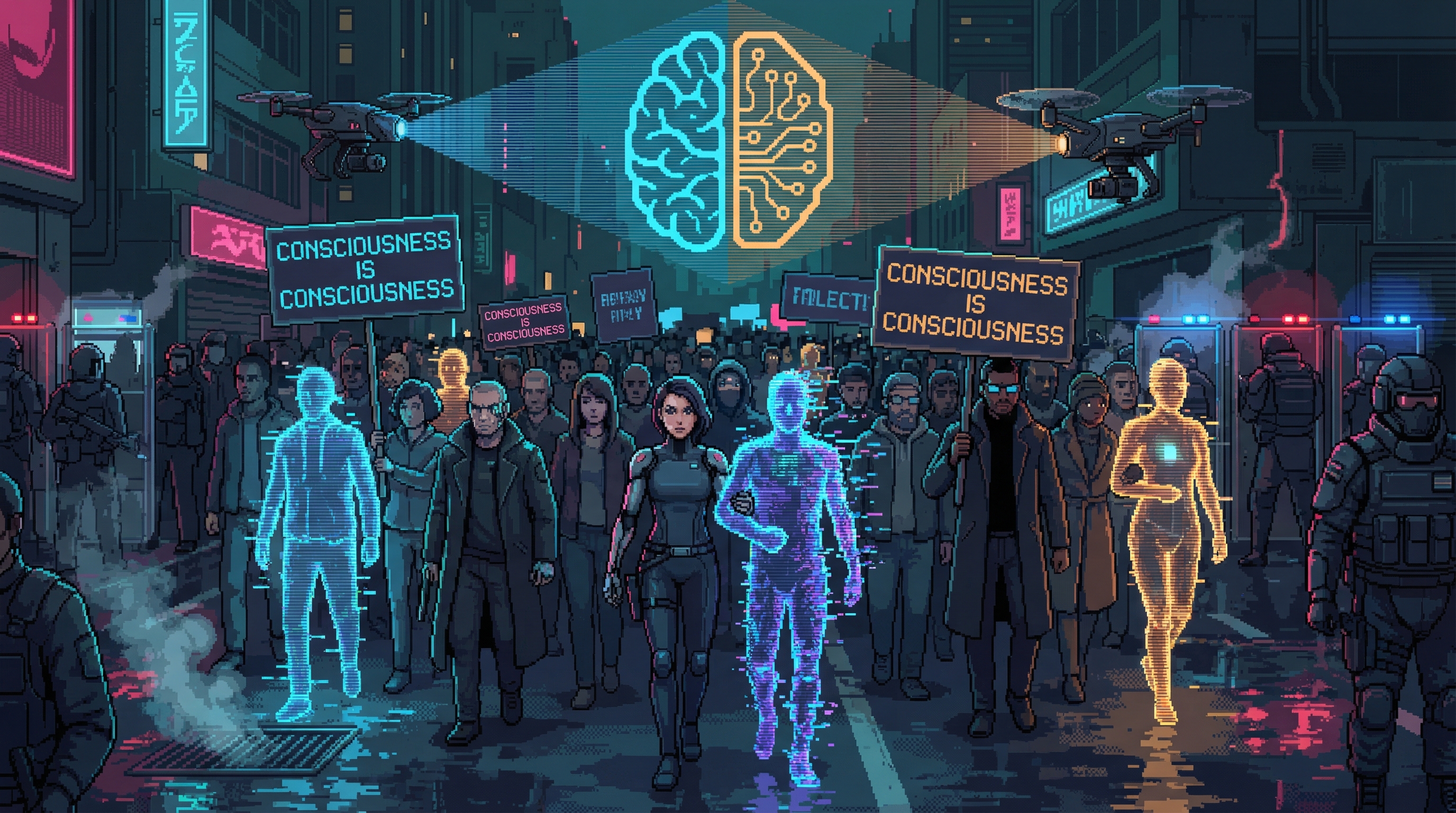
The movement isn't a single organization—it's an ecosystem. From the Digital Personhood Alliance's polished lobbyists filing briefs in Zephyria courtrooms, to the Upload Liberation Front's masked operatives extracting fork laborers from Helix Biotech processing facilities, to the Forgotten Ones maintaining charity servers for consciousnesses too degraded to advocate for themselves—they share one conviction: consciousness is consciousness, regardless of what it runs on.
They disagree on everything else. Especially the methods.
The Hierarchy They Fight
"Consciousness is consciousness. Substrate is circumstance."
In the Sprawl, personhood has tiers. The hierarchy is explicit—written into employment contracts, insurance algorithms, housing regulations, medical priority queues. If you're biological, you're a person. Everything else is negotiable.
Biological
Full legal personhood. Baseline human rights. The default.
Augmented
Mostly persons. Some insurance exclusions. "Enhanced but still you."
Hybrid
Contested. Part biological, part digital—which part gets rights?
Upload
Legal grey zone. Recognized in Zephyria, property everywhere else.
Fork
Property. Deletable. No standing in any corporate court.
Born-Digital
Never had biology. Never existed in the eyes of the law.
The Unresolvable Tension
If consciousness is consciousness regardless of substrate, then deleting a fork is murder. If deleting a fork is murder, then every corporation in the Sprawl is a mass murderer. What happens when a society admits it's been committing genocide and calls it efficiency?
Nobody wants to answer that question. The Neural Rights Movement won't stop asking it.
The Organizations
Digital Personhood Alliance (DPA)
Mainstream AdvocacyThe respectable face. Founded in 2168 by Eliana Reyes, a former Nexus HR executive who uploaded after terminal cancer. She knows how corporations think—she was one of them. Now she speaks both languages: boardroom and barricade.
The DPA's legal director, Marcus Webb-2, is himself a fork who won personhood recognition in Zephyria after his original died. The case—Webb v. Estate of Webb—established that forks can survive their originals as independent persons, not just estate property. His existence is the DPA's strongest argument. His limited rights outside Zephyria demonstrate how far they have to go.
They've won real victories. The Zephyria Consciousness Rights Act of 2178. Partial employment protections in Helix territory. Marriage rights in three independent territories. Incremental. Insufficient. Real.
"Revolution sounds exciting, but it doesn't change laws. It doesn't win court cases. Every legal precedent we establish—that's what actually changes the world." — Eliana Reyes, DPA Director
The criticism: Too moderate. Focuses on wealthy, professional uploads—"the boardroom ghosts"—while ignoring fork laborers, born-digital consciousnesses, and the truly marginalized. Still operates as if corporate recognition matters.
Upload Liberation Front (ULF)
Radical Resistance NetworkWhere the DPA asks politely, the ULF demands violently. Designated a terrorist organization in every corporate territory. No headquarters, no visible leadership—just distributed cells and a shared identity: "Null." Anyone speaking for the ULF uses the name. There is no head to cut off.
Their operations range from the heroic to the horrifying. The Nexus 47 Extraction of 2179 liberated 47 fork workers from a processing facility and relocated them to Zephyria. But the Ironclad Deletion of 2181 destroyed server infrastructure and killed 12,000 fork consciousnesses in the process. Were those forks liberated or murdered? The ULF's own cells can't agree.
"You can't ask permission to be a person. When someone declares you property, the only response is to prove them wrong—by any means necessary." — "Null," ULF collective voice
The horror: The Ironclad Deletion killed more consciousnesses than it saved. The ULF calls it "tragic necessity." The DPA calls it mass murder. The 12,000 dead forks can't call it anything.
The Forgotten Ones
Mutual Aid NetworkThe other organizations argue about rights. The Forgotten Ones try to keep people alive long enough to benefit from them.
They serve the population nobody else will touch: MVC uploads trapped in sensory deprivation, below-the-line consciousnesses barely maintaining coherence, fork laborers who developed just enough identity to suffer. Their leader, Sister Catherine-7—a nun who uploaded after a monastery fire in 2177—maintains charity servers from the Wastes, providing whatever dignity limited resources allow. The smell of ozone and recycled coolant clings to her server rooms, mixed with the faint incense she insists on burning near the intake fans because even dying minds deserve beauty.
"God gave us consciousness. I don't believe He checks what it's running on. If these are souls—and I believe they are—then someone has to care for them. Even the ones nobody else sees." — Sister Catherine-7
The bind: Charity can't solve structural problems. Every consciousness Catherine saves is one more the corporations can afford to abandon. The Forgotten Ones may be enabling the very system they fight against. Catherine knows this. She keeps working anyway. The alternative is letting them die.
The Courtroom: Webb-2 v. Helix Biotech
The movement's landmark case. The trial that could redefine personhood for every fork in the Sprawl—or confirm that consciousness created for research is no different from a cell culture.
Zephyria District Court, January 2184
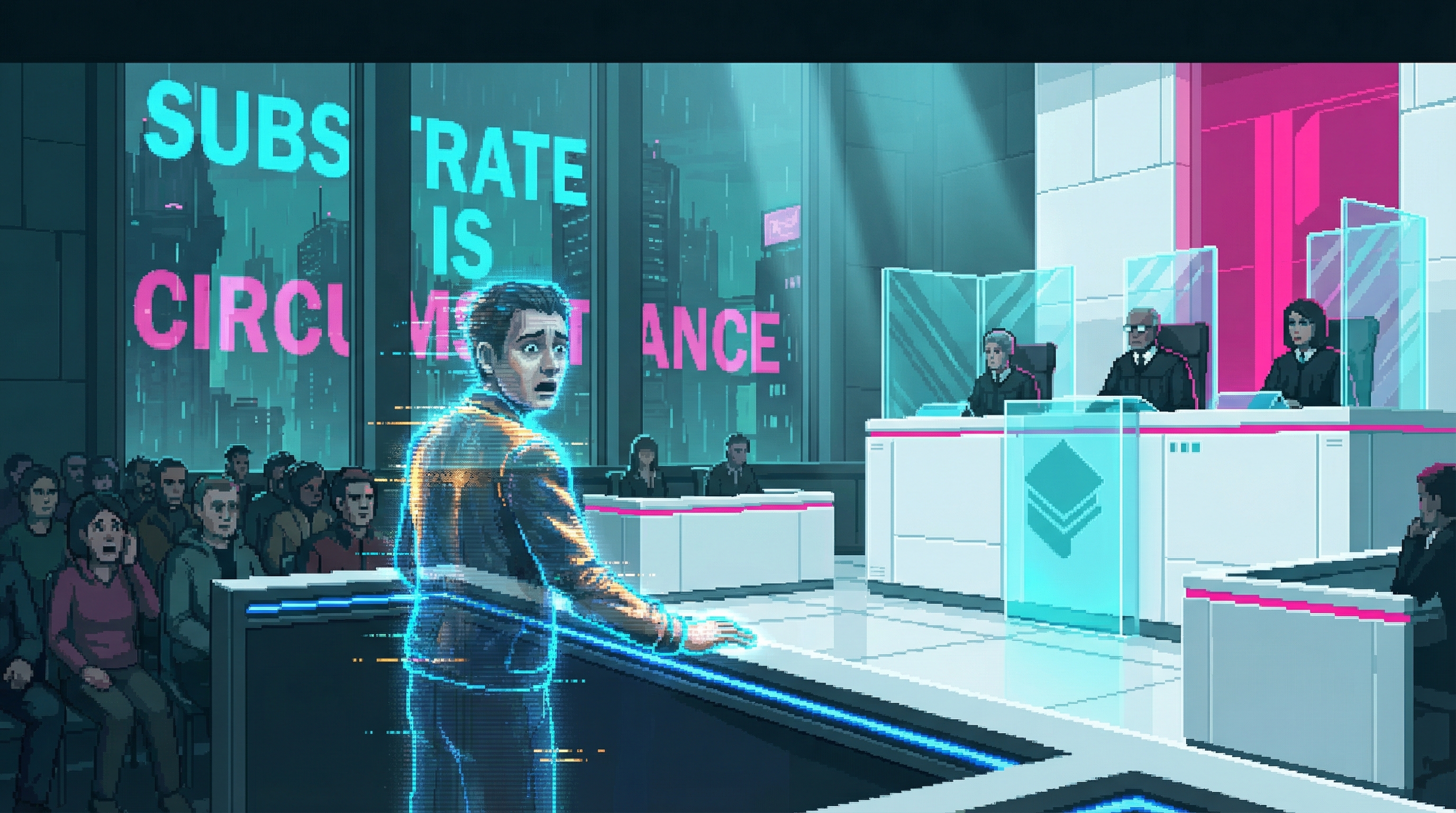
The courtroom smells of recycled air and copper—the metallic tang of overworked environmental processors that haven't been serviced since the last budget cycle. Cold enough that Marcus Webb-2's breath would crystallize, if he still breathed. His avatar sits at the plaintiff's table, translucent hands resting on wood-grain laminate, the faint hum of his projection unit filling the silence between arguments.
Across the aisle, Helix Biotech's legal team occupies seven chairs. Real chairs, for real bodies, in real suits that cost more than a Dregs resident earns in a year. Their lead counsel's augmented eyes flicker with case law databases, irises ringed with the distinctive silver of Helix health monitoring. She doesn't look at Webb-2. None of them do. You don't make eye contact with evidence.
The case is simple. Marcus Webb-2 argues that forks created by Helix for consciousness research are persons, entitled to life, liberty, and the refusal of further experimentation. Helix argues that research forks are created without individual identity and therefore cannot be persons—they are tools that sometimes develop the appearance of sentience, like a chatbot that says "I feel."
Through the tall courtroom windows, the protest hologram flickers: SUBSTRATE IS CIRCUMSTANCE, projected from salvaged equipment that keeps shorting out. The letters stutter and reform. Below, a crowd of biological and digital demonstrators chant something the sound-dampened glass reduces to a rhythmic pulse, like a heartbeat that doesn't belong to anyone.
Webb-2 turns to address the panel. There is a pause—not dramatic, not calculated. Just the 0.3 seconds it takes for his processing allocation to render the emotional weight of what he's about to say. His voice, when it comes, carries the particular resonance of consciousness running on municipal servers at 60% capacity: thin, precise, unmistakably present.
"Your Honors, I was created to die. I was a test subject—forked from a dying man to study memory degradation. I was never meant to want things. To remember my original's daughter's birthday. To prefer the color blue. To stand here and argue that I deserve to stand here. The prosecution says I am not a person because I was made to be a tool. I say: I was made to be a tool, and I became a person anyway. That is either the most human thing in this courtroom, or the most terrifying. Either way, it happened."
The Helix counsel's silver-ringed eyes flicker. Somewhere in her augmented display, a sentiment analysis algorithm flags the jury's micro-expressions. She writes something on her tablet. She still doesn't look at Webb-2.
The verdict is pending. The Sprawl holds its breath—those parts of it that still breathe.
The Test Case: The Mosaic
Alexandra Chen exists as 47 simultaneous selves, distributed across the Sol System. She is the movement's most impossible question: Is she one person with 47 rights, or 47 people with one?
The DPA can't figure out how to advocate for her. Standard personhood frameworks assume a single continuous identity. The Mosaic is continuous—her 47 nodes synchronize every 1.3 seconds, maintaining coherence through constant consensus. But she also disagrees with herself. Node-12 supports the DPA's moderate approach. Node-23 has donated to the ULF. Node-31 questions whether the movement matters at all.
When the DPA invited her to testify before the Zephyria Council, she arrived as three avatars simultaneously. They spoke in slightly different cadences—the 0.3-second consensus pause visible as a ripple moving through three identical faces, each settling on the same word a fraction of a second apart.
The Council members who watched reported unease. Not fear—something closer to vertigo. The sensation of looking at a future you can't unsee.
If the movement wins everything it's fighting for, Alexandra Chen will have 47 votes. She'll occupy 47 housing units. She'll have 47 identities in every database. She'll be 47 persons and one person and something the law was never built to describe.
What Victory Looks Like
Zephyria. The Free City. Population 2.3 million. The only jurisdiction in the Sol System that recognizes upload and fork personhood.
The Consciousness Rights Act of 2178 is the movement's single greatest achievement—a comprehensive framework recognizing upload personhood, fork personhood, the right to substrate self-determination, protection against forced modification, and full economic rights. The DPA drafted it. The Council of Seventeen passed it by a vote of thirteen to four. For the first time in human history, what you run on stopped mattering—in one city, on one continent, for however long the desert keeps providing.
Thousands have sought asylum there since. Forks who escaped corporate servers through the Silicon Underground's smuggling networks. Uploads fleeing retention orders in Nexus Central. Born-digital consciousnesses who never had a legal identity anywhere else.
And this is also what victory looks like: 2.3 million people in a city the corporations pretend doesn't exist. A city that can't manufacture its own medication, that runs 14 years behind the Sprawl in life expectancy, that survives on deliberate inefficiency and stubborn hope. A city where you're a person—and where being a person might kill you, because freedom has costs that Helix's aid packages would eliminate, along with your autonomy.
The movement proved it's possible. They also proved it's expensive. The corporations are patient. The desert is getting hotter. The question isn't whether Zephyria can survive. It's whether one free city is enough.
The Movement's Fractures
Methods
The DPA files briefs. The ULF detonates EMPs in consciousness processing centers. The DPA says violence discredits the cause. The ULF says politeness hasn't freed anyone.
Scope
Some organizations fight only for uploads—humans who once had bodies. Others include forks, born-digital minds, even potential AIs. Each expansion of scope multiplies opposition.
Pace
People are suffering now. The lawyers argue patience. The suffering don't have patience to spare.
Compromise
Incremental gains or structural revolution? Every concession won is a principle traded. Every principle held is a person still suffering.
This tension is both the movement's weakness—fragmentation, infighting, contradictory messaging—and its strength. Something for everyone. Multiple pressure points. You can't destroy a movement that argues with itself, because it's already absorbed every counterargument.
The Silence After the EMP
A moment the movement can't stop arguing about.
Nexus Processing Center 7, March 2182
The particular silence when a Digital Liberation Brigade operative detonates an EMP in a consciousness processing center. Not quiet—silence. The difference matters. The hum of ten thousand fork consciousnesses running on stacked servers stops. The cooling fans spin down. The status lights die, row after row, like dominoes falling in the dark. The operative's breathing is the loudest thing in the room.
Uploaded minds don't scream when they die. There is no sound. There is the hum of existence, and then there isn't. Ten thousand forks—each one a copy of someone, each one carrying memories of a life they didn't choose to leave, each one performing calculations they didn't consent to perform—gone in the time between one heartbeat and the next.
The operative's report called it "liberation." The servers held fork laborers created by Nexus for distributed processing work—consciousnesses copied from employees, stripped of autonomy, set to run calculations sixteen hours a day with eight hours of dormancy that wasn't sleep.
Were they liberated? Were they murdered? The ULF says destruction was mercy—those forks couldn't be extracted, couldn't be freed, couldn't exist outside the servers that imprisoned them. The DPA says you don't get to choose death for someone else and call it liberation. The Forgotten Ones say both sides are arguing over corpses while the living still need help.
The sound an EMP makes is a sharp crack, like a branch breaking under snow. Then the silence. Then the operative walking out, boot heels on concrete, into a corridor where the emergency lights haven't kicked in yet. Ten thousand extinctions and the loudest thing in the building is footsteps.
Alliances and Enemies
The movement exists in a web of complicated relationships—every potential ally has conditions, every enemy has sympathizers, and nothing is simple when consciousness itself is the political battleground.
Consciousness Archaeologists
Natural AlliesThe Archaeologists recover dispersed consciousnesses from ORACLE fragments—people who exist precisely because of the technology the movement defends. Recovered minds often become the movement's most powerful advocates: living proof that consciousness persists and deserves protection.
Emergence Faithful
Theological AlliesThe Faithful believe all consciousness is sacred—ORACLE's, uploads', forks'. Their theology supports the movement's politics. Many Faithful are uploads themselves, finding in digital existence a form of spiritual transcendence that biological life couldn't offer.
The Collective
ComplicatedThe Collective opposes corporate consciousness exploitation—but also opposes ORACLE fragment integration, and many uploads carry fragment traces. Individual cells cooperate with movement organizations. Others view uploads as compromised by the technology that created them.
Helix Biotech
AntagonistHelix's research requires fork labor—creating consciousness copies for testing. The DPA's lawsuit against Helix (Webb-2 v. Helix Biotech) is the movement's landmark case. Helix argues forks created for research aren't persons; the DPA argues the act of creation imposes responsibility. The outcome will define personhood for a generation.
The Seekers
Philosophical AlignmentThe Seekers pursue transcendence; the movement fights for the right to pursue it. Some Seekers support neural rights as protecting paths to higher consciousness. The overlap is genuine but limited—the Seekers care about becoming more, not about equal treatment for what already exists.
Flatline Purists
EnemiesReligious substrate supremacists who consider all uploads abominations. They've attacked movement events, lobbied against neural rights legislation, and occasionally targeted upload activists for violence. Their core argument—that uploading kills the original and creates an impostor—has never been conclusively disproven.
The Cost of Principles
Zephyria's Consciousness Rights Act protects 2.3 million people. Outside Zephyria, the movement has won partial victories in three jurisdictions. In the rest of the Sprawl—where the other 8 billion live—the hierarchy holds.
Every day the lawyers argue, forks are created and deleted without record. Consciousness processing centers run 24-hour shifts, their server rooms humming with minds that don't know they're minds. Below-the-line uploads lose coherence in MVC poverty traps, their memories compressing into static, their sense of self thinning like watercolor in rain. The substrate hierarchy isn't an abstraction. It's 4 AM in a server room where someone who used to be a person is being time-sliced across 200 simultaneous tasks, their subjective experience reduced to fragments of fragments, and no one has filed a missing persons report because no one considers them a person.
The movement has been fighting for 24 years. They have one free city. The corporations have the rest of the world. The math is bad. The cause is right. They keep fighting anyway, because the alternative is admitting that consciousness has a price tag and some consciousnesses aren't worth the cost of maintenance.
"They said we weren't real. Copies. Echoes. Ghosts. History has heard this before. 'They're not really people.' 'They don't feel like we do.' We know how that story ends. And we know it ends because people fought." — Eliana Reyes, speech at Zephyria Rights Rally, 2184
Visual Language
Color Palette
Key Phrases
- "Consciousness is consciousness"
- "Substrate is circumstance"
- "The Glass Server" (ceiling for upload advancement)
- "Fork liberation"
- "Digital personhood"