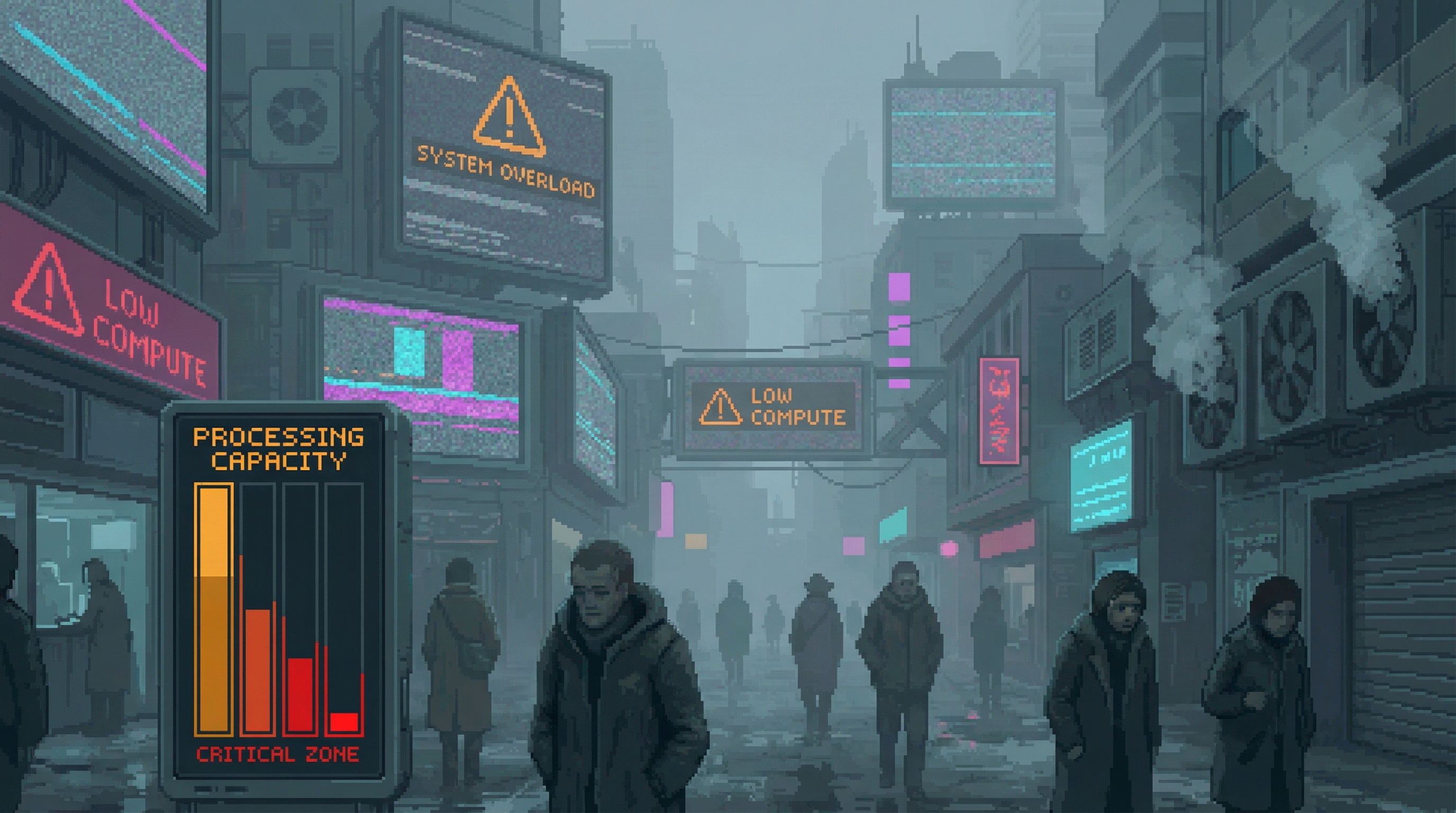
Compute Drought: When the Servers Chase Profit
A compute drought occurs when server farm operators redirect processing capacity away from shared infrastructure to higher-paying clients, reducing available compute in adjacent districts below functional thresholds. The mechanism is market-driven. The Cognitive Exchange trades consciousness bandwidth futures. When demand spikes — quarterly earnings, behavioral prediction recalibration, a major consciousness licensing event — the price of processing capacity rises. Server farm operators, following rational economic incentives, redirect capacity from low-margin shared services to high-margin commercial operations. The result: the Dregs go dry.
"Thinking through cotton. That's what a drought feels like. Your thoughts have to travel farther to reach you."
Quick Facts
Technical Brief
During a compute drought, Basic-tier consciousness licensing degrades. The 4.7 petaflops guaranteed by licensing terms becomes 3.8, then 3.2, then lower. The degradation is legal — Section 23.7 permits "temporary capacity reallocation during infrastructure optimization events." The users experience it as cognitive slowdown. Thoughts that normally arrive clearly arrive through cotton. The interface that normally responds in milliseconds responds in seconds.
For forced-focus workers, a drought during a shift is agony — the cognitive lock still narrows, but there's nothing to narrow into.
Normal Operations
4.7 PFFull cognitive response. Interface latency under 10ms. Atmospheric processing nominal. The baseline nobody notices until it's gone.
Moderate Drought
3.8 PFInterface lag becomes perceptible. Colors dim slightly. Sounds arrive a beat late. Forced-focus work slows but remains functional. Atmospheric processing begins queuing non-critical cycles.
Severe Drought
3.2 PFCognitive slowdown becomes debilitating. Forced-focus lock engages on emptiness. Atmospheric processing drops below safety margins. The air thickens. People die.
The droughts follow patterns that Pencil-47 has mapped to the Cognitive Exchange's settlement calendar. The worst occur during the last three days of each fiscal quarter. Dregs residents have learned to schedule essential cognitive work during the first week of each quarter, when capacity is abundant.
The Q4 2182 Incident
The longest recorded drought lasted eleven days in Q4 2182. Fourteen people died — not from the drought itself, but from atmospheric processing failures caused by the same capacity reallocation. When processing was redirected to settle ¢4.2 billion in consciousness futures, the atmospheric algorithms degraded. Air quality dropped below safety thresholds. The fourteen who died were elderly, unaugmented, and lived in a sub-level with no manual ventilation.
Three maintenance engineers had filed reports predicting exactly this failure mode if processing capacity was redirected during peak atmospheric demand. The reports were classified as "commercially sensitive." The settlement completed on schedule. The futures cleared. The fourteen were buried.
What the Sprawl Is Asking
Manufactured Scarcity
Droughts are not natural resource limitations. They are the predictable consequence of a market that treats compute as a tradeable commodity rather than a public utility. The capacity exists. It's being sold to someone else.
The Divergence in Real Time
During the same drought that forces the Dregs to suspend personal interfaces, Nexus Central's Executive-tier continues uninterrupted. The capacity didn't disappear. It moved upward.
Optimized to Death
Settlement speed increased by 23% in Q4 2182. Trading volume hit quarterly records. The atmospheric algorithms that kept people breathing were deprioritized because breathing doesn't settle futures contracts. The metrics were hit. People died.
What It Feels Like
A drought feels like thinking through cotton. Your interface responds slowly — not broken, just sluggish, as if the thoughts have to travel farther to reach you. Colors dim slightly. Sounds arrive a beat late. Forced-focus work during a drought feels like drowning in molasses — the cognitive lock still engages, but there's nothing to lock onto. The emptiness is worse than the narrowing.
In the streets, everything is slightly wrong. Screens flickering at half-brightness. People moving slowly. The air thick with the humidity of overworked cooling systems that are themselves running on degraded capacity. The light is the same but the mind receiving it is slower.
Related Systems
The Cognitive Exchange
The financial trigger. Settlement schedules determine drought timing with calendar precision.
Server Farm 14
The physical source. Farm 14's capacity reallocation is the primary drought mechanism in the Dregs.
The Blackout Economy
What activates when droughts crash local infrastructure. The informal markets that keep people alive when the formal ones redirect their resources.
The Great Divergence
Droughts are the Great Divergence made visceral — the same capacity, redistributed upward, experienced as cognitive suffocation below.
The Bandwidth Crisis of 2181
Different mechanism, same logic. Reallocation that kills. The crisis proved the pattern; the droughts repeat it quarterly.
Thermal Refugees
Severe droughts trigger thermal displacement — entire blocks evacuating when atmospheric processing fails and the air becomes unbreathable.
▲ Classified
Nexus's internal projections show drought frequency increasing by approximately 15% per year as consciousness futures trading volume grows. The projection has not been shared outside the corporation.
The atmospheric processing failure during the 2182 drought may not have been a coincidence. Three maintenance engineers filed reports predicting exactly this failure mode. The reports were classified as "commercially sensitive." No policy changes were made.
Connected To
"The capacity exists. It's always existed. It's being sold to someone who can pay more than you can. Your atmospheric processing is a line item on someone else's quarterly settlement."