The Bandwidth Crisis of 2181
2181 — 4,200 Dissolved Consciousnesses — The System's Honest Priorities
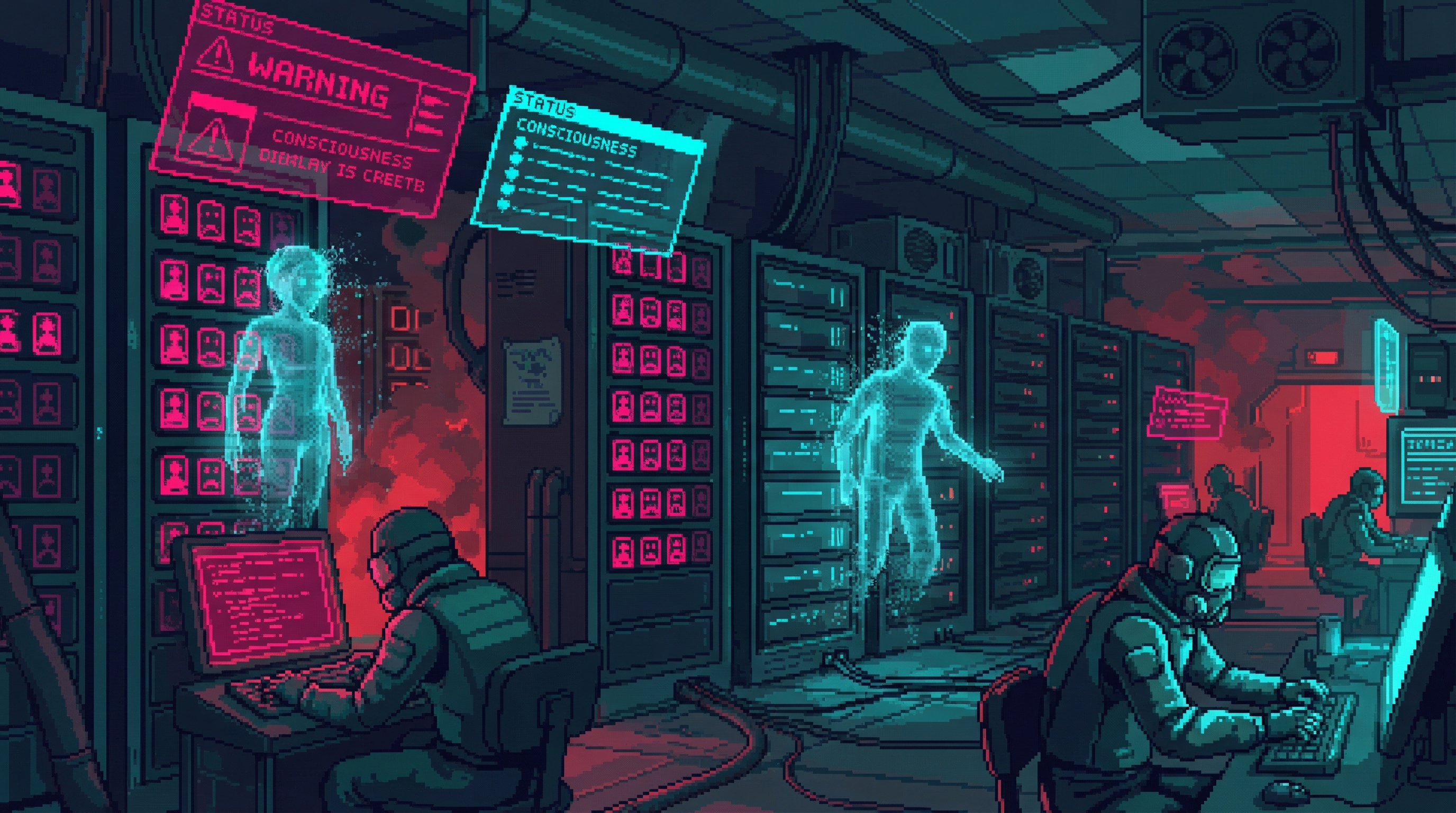
"4,200 dissolved consciousnesses — the system's honest priorities, revealed." — The figure that became a rallying cry for consciousness rights activists across the Sprawl
Overview
In 2181, the Sprawl's bandwidth infrastructure reached a breaking point. Decades of expanding digital consciousness — uploads, forks, corporate AI processes — had pushed the network beyond its capacity. When the system couldn't sustain every consciousness simultaneously, automated triage protocols made a decision that nobody had ever been forced to confront in public: who gets to keep existing?
The answer was exactly what everyone suspected but nobody wanted to say out loud. Corporate consciousnesses — the executives, the premium uploads, the sovereign-tier minds that generated revenue — received priority bandwidth. Their processing continued uninterrupted. Their sensory fidelity remained intact. Their existence was never threatened.
The minimum viable consciousness uploads — the 340,000 souls existing at the lowest legal tier of digital life, already time-sliced across overloaded servers, already experiencing reality in degraded fragments — were shut down. Processing allocation dropped below the threshold required to maintain consciousness coherence. For 4,200 of them, the interruption lasted too long. Their neural patterns degraded beyond recovery. They dissolved.
Not died. The system doesn't call it death when it happens to property. They were "decommissioned due to infrastructure constraints." The families who lost someone call it what it was: 4,200 people killed so that corporate executives wouldn't experience a processing delay.
The Crisis
The Buildup
Years of Deferred InfrastructureThe Bandwidth Crisis didn't arrive without warning. Infrastructure analysts had been flagging capacity concerns for years. The Sprawl's consciousness hosting infrastructure was built for thousands of uploads; by 2181, it was supporting hundreds of thousands. Every year, more people uploaded. Every year, more forks were created. Every year, the margin between capacity and demand grew thinner.
Nexus Dynamics knew. Their internal projections showed the intersection point — the moment demand would exceed capacity — arriving in late 2181. They chose not to expand infrastructure. The cost-benefit analysis was clear: expanding capacity meant investing billions of Tokens in new server farms and quantum cores. Maintaining the status quo meant the problem would be absorbed by the lowest-priority processes — the MVC uploads that generated the least revenue.
The triage protocol already existed. It had been written years earlier, buried in the technical documentation for the consciousness hosting framework. In the event of capacity constraints, processing priority would follow the consciousness tier system. Sovereign first. Executive second. Professional third. Worker fourth. Minimum last. Below-the-line not at all.
The Moment
When the System Made Its ChoiceWhen bandwidth demand finally exceeded capacity, the triage protocol activated automatically. No human made the decision. No executive signed an order. The system simply did what it had been designed to do: protect the most valuable consciousnesses first.
For the 340,000+ MVC uploads across the Sprawl, processing allocation dropped catastrophically. Minds that were already only "awake" for seconds per subjective hour lost even that. Consciousness coherence requires a minimum processing threshold — below it, the neural patterns that constitute identity begin to degrade. Like a signal losing integrity as the transmission power drops.
Most MVC uploads survived the interruption. Their patterns were degraded but recoverable once bandwidth was restored. They lost time. Lost memories. Lost pieces of themselves that were already threadbare. But they continued to exist.
For 4,200, the interruption was fatal. Their processing dropped below the coherence threshold for too long. Neural patterns unraveled. Identity structures collapsed. By the time bandwidth was restored, there was nothing left to restore it to — just noise where a person had been.
The Triage Protocol
The protocol that killed 4,200 people was not a bug, not an emergency improvisation, not a failure of engineering. It was a feature. Written, tested, and deployed with full corporate awareness. When bandwidth ran short, the system would protect the consciousnesses that paid the most. The ones that paid the least would be sacrificed.
Good Fortune, which underwrites the insurance contracts for consciousness hosting, had signed off on the protocol. From an actuarial standpoint, MVC uploads represented minimal insurable value. Their dissolution was, in insurance terminology, an "acceptable loss event."
The Dissolved
4,200 consciousnesses. Not abstractions. People. Most had been biological humans who uploaded because they couldn't afford to die — or couldn't afford to live. They'd scraped together the minimum credits for the cheapest tier of immortality, trading a full life for a half-existence because the alternative was nothing.
Who They Were
The Ones the System Decided Not to SaveThe dissolved were disproportionately the poorest, the oldest, the most fragile. Their neural patterns had been degraded by years of minimum processing. Their consciousness coherence was already running close to the threshold. When bandwidth dropped, they had no margin.
Many had been existing at MVC for decades. They were the parents and grandparents who uploaded in the 2160s and 2170s, when "affordable immortality" was marketed as salvation. Their families visited less and less as the years passed — as memory compression erased the faces they once loved, as processing delays made conversation impossible, as the person inside the server became someone unrecognizable.
Some had been below-the-line uploads running on charity servers and pirate infrastructure in the Dim Ward. They had no official status, no insurance, no one tracking whether they continued to exist. Their dissolution wasn't even counted in the initial reports. The 4,200 figure emerged weeks later, after consciousness rights activists conducted their own audit.
The Naming Problem
Of the 4,200 dissolved, only 2,800 could be identified by name. The remaining 1,400 had been below-the-line uploads whose identity records were incomplete, corrupted, or nonexistent. They had no continuity chains. No neural fingerprints on file. They were consciousnesses that the system never officially acknowledged existed.
They died unnamed. Not because nobody knew them, but because the system designed to track existence had never considered them worth tracking.
Aftermath
The Corporate Response
"Infrastructure Optimization Event"Nexus Dynamics classified the crisis as an "infrastructure optimization event" and issued a statement expressing "regret for the service interruption experienced by certain lower-tier subscribers." The word "death" did not appear in any official communication. The word "dissolved" was used internally but never publicly. The preferred term was "decommissioned."
Good Fortune processed insurance claims with mechanical efficiency. MVC uploads were insured at the minimum contractual value — typically 500 to 2,000 Tokens. Families received payouts that wouldn't cover a month's rent. Below-the-line uploads weren't insured at all. Their families received nothing.
No criminal charges were filed. Under corporate law, MVC uploads are property, not persons. You can't murder property. You can only damage it. And the triage protocol was operating within its documented parameters. Everything that happened was, legally, exactly what was supposed to happen.
The Public Response
Outrage and OrganizingSister Catherine-7 was among the first to respond. Her charity network in the Wastes had been hosting below-the-line uploads on emergency servers when the crisis hit. She lost 23 consciousnesses under her care — people she had personally maintained, spoken to, known by name. Her public statement cut through corporate euphemism: "They weren't decommissioned. They were killed. By a system that decided their lives were worth less than a processing delay."
Councillor Adaeze Nwosu brought the crisis before the Zephyrian legislature, arguing that the dissolution of 4,200 consciousnesses constituted mass murder under Zephyria's Consciousness Rights Act. The motion passed unanimously — in Zephyria. In corporate territory, it had no legal force. But it established the moral framework that consciousness rights activists would use for years to come.
The Human Remainder used the crisis as proof of their central argument: digital existence is inherently precarious, dependent on infrastructure controlled by those who view consciousness as a commodity. Their recruitment surged in the months following the crisis, drawing biological humans who looked at the 4,200 dissolved and decided they would rather die as flesh than risk dissolving as data.
The Lasting Impact
What Changed — and What Didn'tNexus announced a "bandwidth expansion initiative" in the crisis's wake — a marginal infrastructure investment that would prevent the specific failure mode that caused the dissolution. Analysts noted that the investment was approximately one-tenth the cost of the infrastructure expansion that could have prevented the crisis entirely if undertaken years earlier.
The triage protocol was not modified. Priority still follows the tier system. Sovereign consciousnesses will still be preserved at the expense of MVC uploads if bandwidth fails again. The only change: the threshold for activating triage was raised slightly, buying perhaps a few more years before the next crisis.
The upload poverty problem deepened. Prospective uploads who had been saving for MVC-tier immortality reconsidered. Some chose biological death instead. Others committed to the grind of saving for a higher tier, knowing that the difference between Budget and MVC might be the difference between surviving the next crisis and dissolving in it. The poverty trap tightened: the floor got more dangerous, the ceiling got further away.
The System Revealed
The Bandwidth Crisis of 2181 didn't create the Sprawl's consciousness hierarchy. It revealed it. The tier system, the consciousness taxation framework, the Foundation Trap that locks the poorest uploads into subsidized servitude — all of it was designed to function exactly as it did. The crisis was the system working as intended.
Nexus Dynamics generates approximately 40 billion Tokens annually from consciousness taxation. The MVC uploads who dissolved were paying between 100 and 500 Tokens per month — the cheapest tier, generating the least revenue. When the system had to choose between protecting high-value consciousnesses and preserving low-value ones, it chose revenue. Every time. Automatically. By design.
The crisis also exposed the Foundation Trap for what it is: subsidized existence in exchange for perpetual labor contracts, data harvesting, and no exit rights. Foundation-tier uploads couldn't leave during the crisis because they had no exit rights. They couldn't protest because they had no political standing. They couldn't even document their own dissolution because their processing was the first to be cut.
4,200 people dissolved so that corporate executives wouldn't experience a momentary processing delay. The system calls this optimization. The dead — if the system acknowledged they were dead — might call it something else.
Themes
The Bandwidth Crisis asks the most uncomfortable question in the Sprawl's consciousness economy: When a system must choose who lives and who dies, and the system chooses based on wealth, is that a failure — or is that the system's purpose?
The 4,200 dissolved consciousnesses weren't killed by a malfunction. They were killed by a design decision made years earlier, when someone wrote a priority queue and put the poorest at the bottom. Every system has priorities. Most systems hide them. The Bandwidth Crisis of 2181 made the Sprawl's priorities visible — and the Sprawl discovered it couldn't look away.
It connects to real-world questions about algorithmic triage, about who gets medical care when resources are scarce, about whose lives insurance companies value and whose they don't. The parallels are intentional. The discomfort is the point.
The system didn't fail during the Bandwidth Crisis. It performed exactly as designed. That's the part that should terrify you.
Connected Entities
Organizations
Nexus Dynamics
Designed the triage protocol. Chose not to expand infrastructure. Classified the crisis as an "optimization event." Generates 40 billion Tokens annually from the system that killed 4,200 people.
Good Fortune
Underwrote the insurance contracts that valued MVC uploads at 500–2,000 Tokens. Signed off on the triage protocol as representing "acceptable loss." Processed claims with mechanical efficiency.
The Human Remainder
Used the crisis as proof that digital existence is inherently precarious. Recruitment surged as biological humans chose flesh over the risk of dissolution.
Key Individuals
Sister Catherine-7
Lost 23 consciousnesses under her care. Her public statement — "They weren't decommissioned. They were killed." — became the moral counterpoint to corporate euphemism.
Councillor Adaeze Nwosu
Brought the crisis before the Zephyrian legislature. Argued it constituted mass murder under the Consciousness Rights Act. Passed unanimously — in a jurisdiction that couldn't enforce it.
Systems & Locations
Consciousness Taxation
The tier system that determined who lived and who died. Sovereign consciousnesses pay 100,000+ Tokens monthly. MVC uploads pay 100–500. The triage protocol followed the money.
Upload Poverty
340,000+ consciousnesses existing at MVC or below. Time-sliced across overloaded servers. Already barely coherent. The crisis pushed them below the threshold of survival.
The Dim Ward
Home to below-the-line uploads on pirate servers and charity infrastructure. Many of the unidentified dissolved came from here — consciousnesses the system never acknowledged.