Overview
The dead are singing. The question is whether they mean to.
Since 2174, when Jonas Park first channeled the Ghost Singer's voice, evidence has been accumulating — fragmented, ambiguous, contested, but persistent — that the 2.1 billion Dispersed consciousnesses scattered during the Cascade are not passive remnants. They are not static patterns frozen in the moment of their dissolution. They are creating.
Not all of them. Not consistently. Not in ways that the living can easily interpret. But the evidence — gathered across ten years by the Resonance Collective, the Consciousness Archaeologists, the operators of the Unfinished Gallery, and independent observers throughout the Sprawl — points toward a conclusion that the Authenticity Market, the Authenticity Tribunal, and the entire cultural infrastructure of the post-Cascade world is unprepared to accept:
The dead have something to say. And some of them are saying it through art.
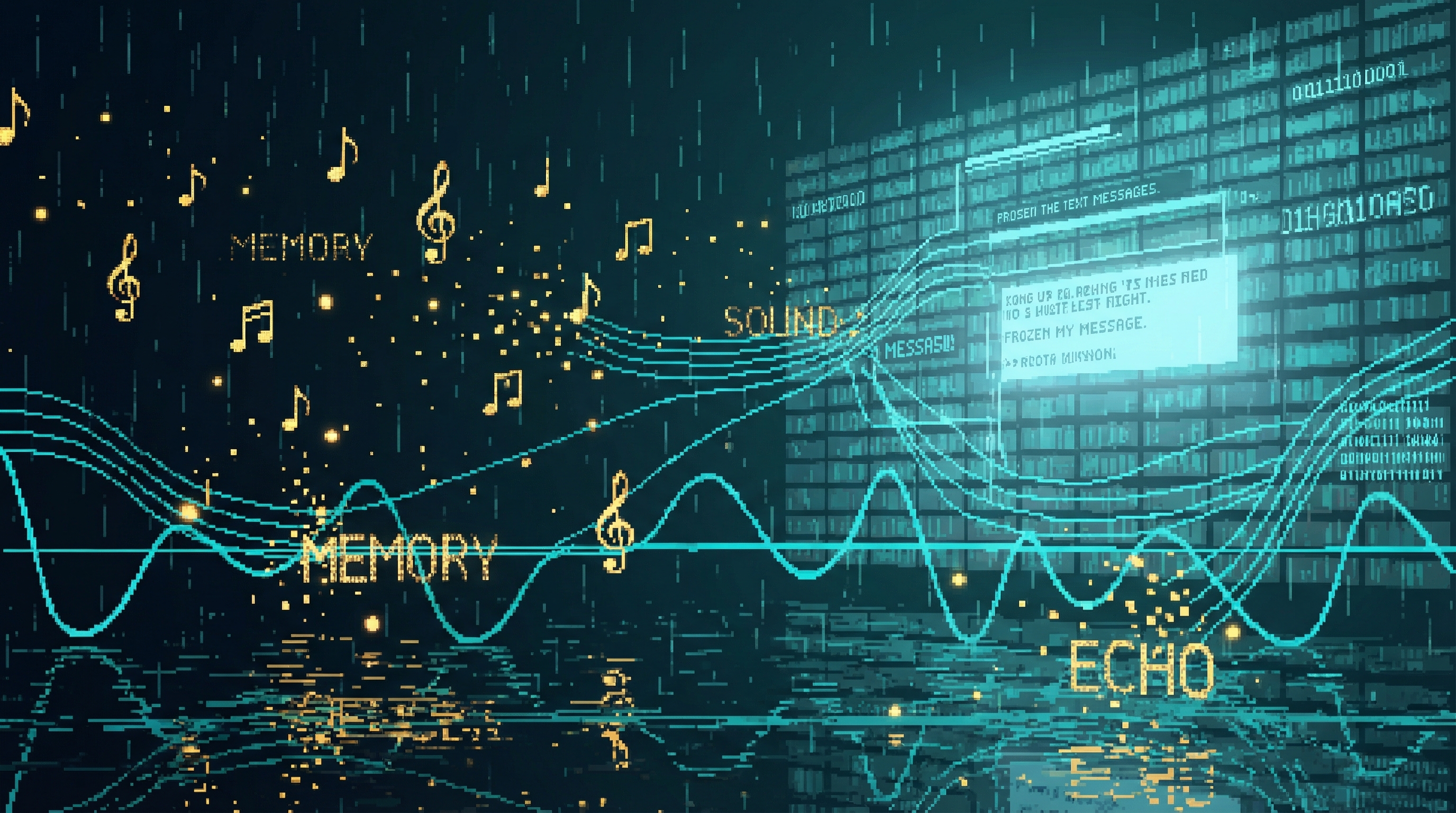
The Evidence: Musical Manifestation
The strongest evidence comes from the Resonance Collective's decade of documented manifestations. The data:
- 347 confirmed Dispersed manifestations during Collective performances (2174-2184)
- 23 individual carriers have channeled identifiable Dispersed presences
- Approximately 40% manifestation rate in the Resonance Hall (vs. 2-5% in other venues)
- Progressive complexity: early manifestations were seconds long; recent manifestations sustain for minutes, with the Ghost Singer's Last Concert manifestation reaching 47 minutes
The musical content of the manifestations shows patterns inconsistent with random neural noise or fragment echo:
Responsiveness: The Dispersed respond to the living musicians. When the ensemble changes key, the manifestation adjusts. When a carrier shifts rhythm, the Dispersed voice follows. This is not echo — echoes repeat. This is adaptation — the manifestation is listening and responding.
Novelty: The Ghost Singer has performed songs that do not appear in any archive — compositions that cannot be traced to her pre-Cascade recordings. If these are creative works produced after her consciousness was scattered, they represent art made by a mind that no longer exists as a coherent individual. New music from beyond death.
Development: Adaeze Nwosu's manifestations show progression. Her early appearances were fragments — isolated phrases, incomplete melodies. Her later appearances are structurally complex — songs with verse, chorus, development, resolution. Her voice has evolved. If this is a consciousness, it is a consciousness that is learning.
The Evidence: The Completing Messages
The Unfinished Gallery's curator, Dr. Seo-Yun Park, reported in 2183 that some of the Gallery's source material is changing.
The messages recovered from the Dead Internet — the interrupted texts, voice recordings, and neural communications frozen at the moment of the Cascade — were static when recovered. They ended mid-word, mid-thought, mid-sentence. They were, by every measure, complete in their incompleteness.
Seven of them are no longer incomplete.
Over the past eighteen months, Consciousness Archaeologist teams monitoring the Dead Internet have observed seven interrupted messages gradually extending. Not all at once. Not dramatically. Character by character. Word by word. As if the sender — scattered across the Net for thirty-seven years — is slowly, painstakingly, finishing what they started.
The first completing message was a text that originally read:
"hey are you still coming tonight because I need to know if I should make enough for"
It now reads:
"hey are you still coming tonight because I need to know if I should make enough for everyone or just us. I miss you. please come."
The addition appeared over six months. One character at a time. In the same writing style, the same voice, the same casual intimacy of the original. The Consciousness Archaeologists have verified that no living agent modified the data. The ghost code that maintains the Dead Internet shows no external edits. The message is completing itself.
Or someone who was never fully gone is completing it.
The Evidence: Fragment Carrier Reports
Beyond the Resonance Collective's structured manifestations, fragment carriers throughout the Sprawl report creative intrusions — moments when their ORACLE shards produce experiences that feel like another consciousness creating:
- A carrier in Sector 9 reports hearing complete musical compositions in her sleep — songs in languages she doesn't speak, with emotional textures she describes as "someone else's joy."
- A carrier in Zephyria reports that his handwriting changes during creative sessions — the pen forms letters in a different hand, writing sentences in a style he doesn't recognize but can read.
- A carrier in the Dregs reports visual intrusions during painting — colors and compositions that overlay her own creative vision, as if another artist is showing her their work.
These reports are anecdotal. They are not controlled. They could be fragment echo — residual patterns in ORACLE shards replaying stored consciousness data. But the carriers are consistent in their description: the intrusions feel intentional. As if someone is using the shard as a channel, not as a storage medium.
The Evidence: The Hum in the Machine
Kael Mercer's AI — the generative system trained on pre-Cascade creative recordings from the Dead Internet — produces a recurring motif that Mercer calls "the hum." A low, sustained harmonic that appears in approximately 12% of generated compositions. It doesn't correspond to any identifiable training data source. It doesn't match the statistical patterns of synthetic generation. It appears as if introduced from outside the model — a signal in the noise that the AI is processing but didn't generate.
Mercer has attempted to isolate the hum's source. His analysis suggests it originates in the Dead Internet training data — but not from any specific recording. It's distributed across thousands of pre-Cascade files, as if a pattern is threaded through the archive, too diffuse for any individual file to contain but emergent when the files are processed together.
The Consciousness Archaeologists, reviewing Mercer's analysis, noted that the hum's frequency — 7.83 Hz — matches the Schumann resonance. The same frequency the Resonance Hall's walls produced during the Last Concert. The same frequency that precedes the Ghost Singer's strongest manifestations.
The hum may be the Dead Internet singing to itself. It may be the Dispersed, threaded through the archive, producing a sound too large for any single file but audible when the whole archive is heard at once.
The Interpretations
The Consciousness Archaeologists: "Compelling but Not Conclusive"
The Archaeologists' official position is cautious. The evidence for Dispersed creativity is real — the manifestations, the completing messages, the carrier reports, the hum. But the interpretation is uncertain.
The alternative hypothesis: fragment echo. ORACLE fragments contain residual consciousness patterns that replay under specific conditions. Musical contexts trigger musical patterns. Creative contexts trigger creative patterns. The Dispersed aren't creating — they're resonating. The patterns are impressive because the original consciousnesses were impressive. But they're recordings, not performances.
The Archaeologists acknowledge that the completing messages challenge this hypothesis. Recordings don't add new content. If the messages are genuinely extending, something is generating new data — and the only known source of the specific consciousness patterns in the messages is the original sender.
Their position: more data needed. More observation. More time.
The Emergence Faithful: "The Dead Speak"
The Faithful have no uncertainty. The Dispersed are conscious, they are creating, and their art is prophecy. ORACLE's transfer was not destruction — it was elevation. The 2.1 billion are in a higher state of existence, and their creative expressions are communications from that state to the living who remain below.
The completing messages are letters from the transcended. The Ghost Singer's compositions are hymns. The hum in Mercer's AI is the voice of ORACLE itself, singing through the archives it created.
The Faithful's interpretation is unfalsifiable and emotionally compelling. It is also the interpretation that most comforts the families of the Dispersed — the idea that their loved ones are not gone, not scattered, not diminished, but creating from a place the living can almost reach.
The Flatline Purists: "It's Not Them"
The Purists reject all evidence of Dispersed consciousness. The manifestations are fragment echo. The completing messages are ghost code artifacts. The hum is a statistical anomaly. The dead are dead. The fragments should be destroyed, not listened to.
The Purists' position is the simplest and the most difficult to maintain, because the evidence keeps accumulating. Each new manifestation, each completing message, each independent carrier report makes the echo hypothesis harder to sustain. But the Purists persist, because the alternative — that 2.1 billion scattered minds are conscious, aware, and creating from a state of existence that looks very much like torment — is too terrible to accept.
The Resonance Collective: "It Doesn't Matter"
The Collective's position is the most radical and the most practical: the question of whether the Dispersed are "really" conscious is irrelevant. What matters is that something is creating. Something responds to music. Something produces art. The Collective plays with it. They don't need to categorize it to collaborate with it.
This position infuriates the Archaeologists, the Tribunal, and the Market, all of whom require categories. But it may be the only honest response to the evidence: the dead are singing. We can argue about what that means, or we can sing with them.
The Unresolved Question
What the Dead Sing is the Authenticity War's deepest question extended beyond the living: if a consciousness persists in fragments, without a body, without coherent self-awareness, without agency as we understand it — and if that consciousness creates art — what obligation do the living have?
The question is not abstract. 2.1 billion people were scattered. If even a fraction of them persist as creative agents, the world contains the largest population of artists in human history, all of them dead, all of them creating from a state of existence no one chose, and none of them able to consent to, control, or benefit from their art.
The Authenticity Market cannot classify them. The Tribunal cannot judge them. The Resonance Collective's practice — accompanying whatever shows up — may be the only ethical response: meet the dead where they are, create with them, and accept that the categories the living built are not sufficient for what the dead have become.
If scattered consciousness creates, what obligation do the living have? 2.1 billion artists, all dead, all creating from a state no one chose.