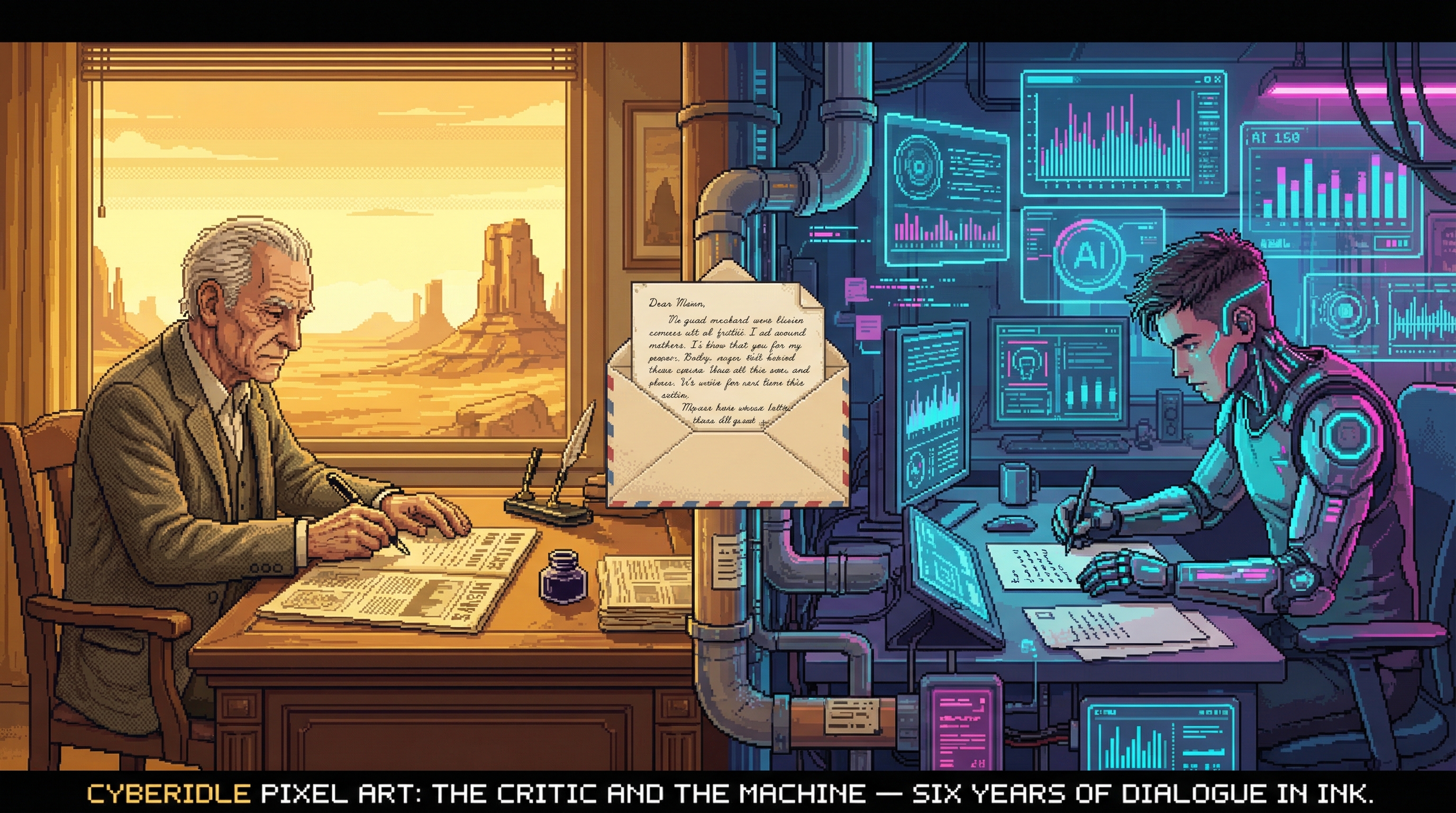
"The first letter was an argument. The forty-seventh was something closer to love."
Overview
Orin Slade — 62, no augmentation, last human music critic for a physical newspaper — wrote a review of the Lattice Recordings in 2178. Kael Mercer — 31 at the time, most commercially successful synthetic composer, seven times acquitted by the Tribunal — read the review and wrote a letter through Zephyria's postal system.
Nine days to arrive. Six years later, still writing.
What began as a professional argument became something neither man had vocabulary for: a slow, careful, handwritten conversation between two people on opposite sides of the Authenticity Market's central question. The choice of medium — handwritten letters, nine-day delivery — is itself a position. Some conversations are worth having slowly.
The Letters
The Opening Exchange Letters 1–5
The first five letters are pure argument — sharp, formal, neither man conceding ground.
If void tone's inaccessibility makes it authentic, why not synthetic music's? Both require a listener willing to abandon expectation. Both demand trust in a process the audience cannot verify.
Inaccessibility is not the source of authenticity. Consciousness is.
How do you know the AI isn't home?
How do you know it is?
The opening exchange established the territory. Neither man won. Neither conceded. But Mercer's third letter — four words, handwritten in ink on heavy paper, nine days to deliver — lodged in Slade like a splinter.
The Middle Period Letters 6–30
Over twenty-four letters and nearly three years, the argument softened into something more honest. The positions remained, but the men behind them began to show.
I listen to your Meridian composition once a month. I have done this for two years. It still makes me weep. "The Machine Made Me Cry; That Doesn't Make It Art" was honest. The weeping is real. But if the experience is real, does the source matter?
The first crack. Slade, the purist, admitting that the machine's music moves him — and that his own published position cannot account for why.
The honest answer: I tried. After my fourth acquittal, I composed without the AI. Three months. Forty-seven hours of material. The music was competent. It was mine. It was not good enough.
Mercer's own crack. The synthetic advocate confessing that without the machine, his music is merely competent. That he needs the tool he defends.
Your curation is a creative act. You are an artist who uses a machine like a sculptor uses a chisel. The chisel does not diminish the sculpture. This is what I cannot say publicly without destroying my critical position. The shift. Slade sees Mercer as an artist — and admits he can never say so in print.
Then what is the difference between my chisel and the Collective's fragments? The Market prefers ghosts to machines. Mercer turns Slade's concession into a deeper question. If curation is art, why does the Market valorize the dead over the synthetic?
Letters 18 and 19 are the pivot. Both men began seeing themselves in the other's position. The correspondence stopped being about who was right and became about what they could not say to anyone else.
The Ghost Singer Letters Letters 31–40
The Ghost Singer — Adaeze Nwosu, dead councilwoman channeled through a proxy's body — entered their correspondence like a detonation. She was the question they had been arguing about, made flesh.
I attended a performance through a proxy's account. She is what you and I have been arguing about. She is the question in a body that isn't hers.
Her vocal patterns appear in 3% of my AI's output. My machine trained on her. We are both channeling a dead woman.
The revelation that collapses the distance between them. Slade listens to a ghost. Mercer's machine learned from the same ghost. Both men are, in their own way, haunted.
Adaeze Nwosu does not care about our categories. She is singing. We are arguing about the singing.
The purist's surrender — not to the machine, but to the irrelevance of his own framework in the face of art that refuses to be categorized.
The Recent Letters Letters 41–47
The final letters are quieter. The argument has burned through itself, leaving something tender and unresolved.
I have stopped composing. Not from despair. From a question I cannot answer: when she hears my music, does she recognize herself? And if she does — does she mind?
The synthetic advocate, silenced by conscience. Not by the critics. Not by the Tribunal. By the possibility that his art carries a dead woman's voice without her permission.
The question was never "Is it authentic?" The question is: "Are you listening?"
Six years. Forty-seven letters. Nine days between each. And Slade's final word is not a verdict but an invitation. The critic who spent his career judging has learned to ask a different question.
Themes
The Authenticity War made personal. The grand cultural debate over synthetic creativity — fought in tribunals, markets, and manifestos — is here reduced to two men writing letters by hand. And in that reduction, something opens that the public debate cannot access: vulnerability. Doubt. The slow erosion of certainty through relationship.
Rigid categories dissolve through relationship, not logic. Slade did not change his position because Mercer argued better. He changed it because Mercer confessed his inadequacy in Letter 15, and that confession was something no tribunal testimony could have achieved. The correspondence is proof that some forms of understanding require intimacy, require time, require the deliberate slowness of ink on paper.
The choice of medium is itself a thesis. Nine-day delivery. Physical paper. Fountain pen and ink. In a world of instantaneous communication, Slade and Mercer chose the slowest possible channel — and that slowness made the conversation possible. Some arguments need the cooling distance of days between volleys. Some truths can only be written by hand.