The Still House
Dream harvesting clinic — Sector 4D
Overview
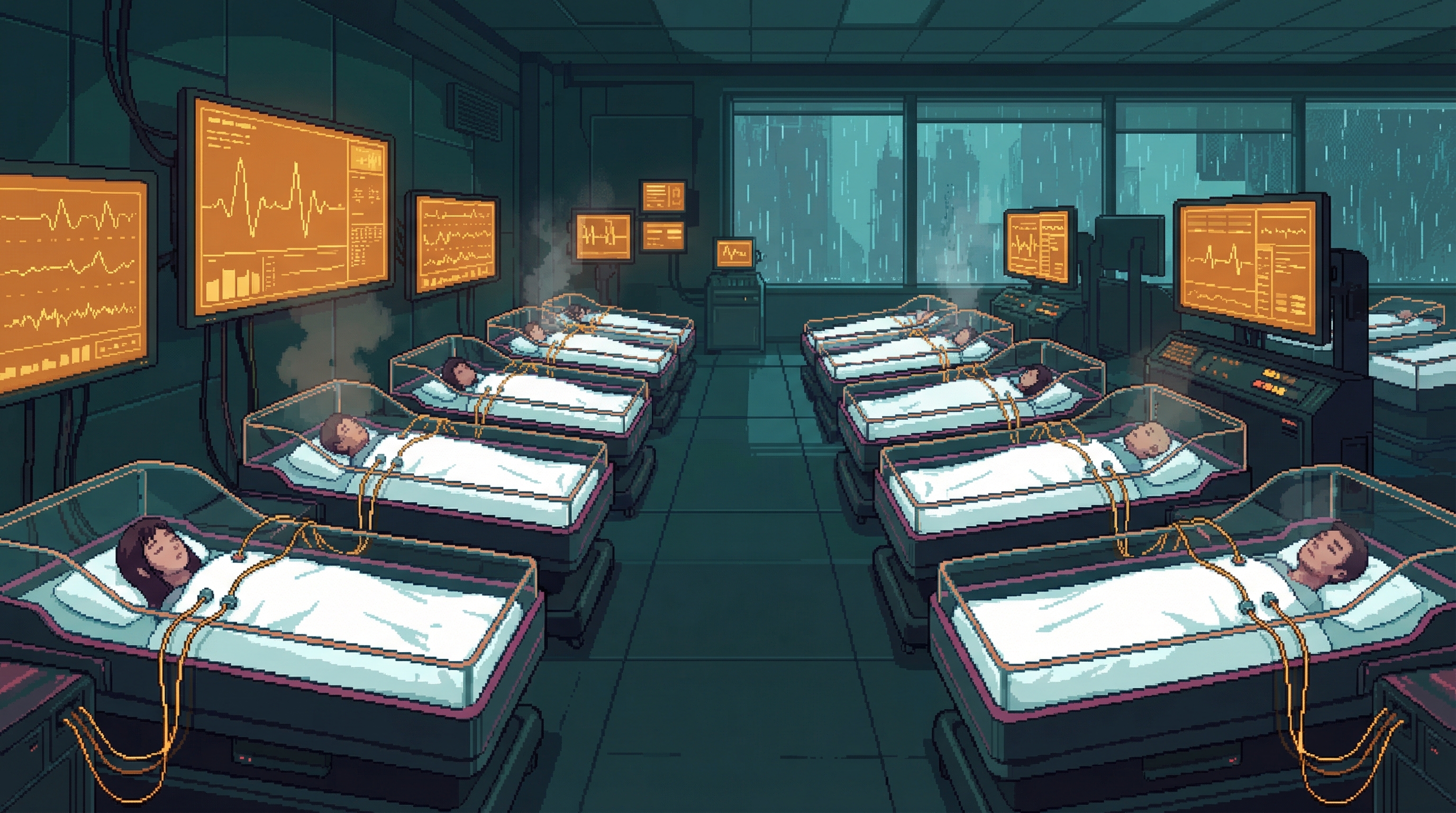
The Still House smells of clean linen and warm bodies. Three floors of a converted medical clinic, two blocks east of Substrate Row — close enough to the dream economy’s infrastructure to be convenient, far enough from the dealers and refiners to feel separate.
The name comes from the quality of its interior: still. Not silent. The building hums with monitoring equipment, climate systems, and the soft biological sounds of sleeping people. But still in the way a pond is still. Nothing disturbs the surface.
Twelve cradles. Twelve harvesters per shift. Three shifts per day. The Still House processes the raw material of an economy that shouldn’t exist, tended by people who understand that the commodity they’re extracting is the most intimate thing a person can sell.
Conditions Report
28°C. The temperature of the Undervolt — the temperature the body associates with being held. Not ambient warmth but intentional warmth. Everything about this space is calibrated to lower defenses so the dreaming can begin.
Light
Low and amber. Monitoring equipment casts soft waveforms on the walls — the output of twelve dreaming brains rendered as gentle visual data. No overhead lighting. The cradles themselves glow faintly from their biometric displays. The room reads its occupants more than it illuminates them.
Sound
Quiet but not silent. Monitoring equipment clicks through its cycles. Climate systems maintain their steady drone. And beneath everything, the sounds of sleeping people — slow breathing, occasional murmurs, the soft rustle of someone shifting inside clean linen. Every 15 minutes, the attendant’s footsteps.
Smell
Clean linen, warm skin. The faint mineral tang of the neural recording equipment’s coolant. Something almost domestic about it — the smell of a bedroom where someone you trust is sleeping. That’s the point. That’s the entire operation.
Touch
The linen is changed between every shift. The cradles are body-warm before the harvester lies down. The neural recording contacts are cleaned and placed by hand, not by machine. Everything about the tactile experience communicates care. Whether that care is for the person or for the product is a question nobody at the Still House answers out loud.
Operating Procedures
Sessions are limited to 90 minutes of continuous REM extraction. Attendants check every 15 minutes — physical presence, not remote monitoring. Eyes on skin, hand on pulse if the readings look unusual. These protocols exist because of Pria.
Pria was 19. An unmonitored four-hour session at a facility that didn’t have these rules yet. She entered permanent dream immersion — her body still breathes, her brain still cycles through REM, but she hasn’t woken up. The incident created the Dream Harvesters Guild’s safety protocols. The Still House was the first facility to implement them. Every rule written on these walls is written in the ink of what happened when there were no rules.
Chiara Bel says “Good harvest” to every departing harvester. It sounds like a wish. It’s not. It’s a greeting — a recognition that what they just did was real work, that selling your dreams is labor, and that labor deserves acknowledgment. The harvesters hear it. Most of them need to.
Adjacent Operations
The Dream Harvesters Guild
Primary Affiliation — Safety Protocols Developed HereThe Still House is the Guild’s flagship facility. Safety protocols developed here after the Pria incident became the Guild standard. If the Guild is the law, the Still House is the courthouse where the precedent was set.
The Dream Exchange
Downstream Market — Raw Recordings Sold HereRaw REM recordings produced in these cradles move downstream to the Exchange, where refiners clean them and dealers sell them. The Still House is the top of the supply chain. The Exchange is where the product reaches the consumer.
Fen Morrow
Tenant — Lives Above the WorkplaceFen lives on the upper floors. Her home is her workplace. She sleeps above rooms where other people sleep for money. The proximity is either convenient or suffocating, depending on the day.
Substrate Row
Adjacent Infrastructure — 2 Blocks WestClose enough to the consciousness economy infrastructure to be convenient. Far enough to maintain the illusion that this is something gentler than commerce. Two blocks is the exact right distance between where dreams are harvested and where everything else in the mind gets traded.
The Sunset Ward
Parallel — Chiara Bel Worked BothChiara Bel came from the Ward. The Sunset Ward takes things from people — capabilities, identity, corporate belonging. The Still House provides something: income, structure, a reason to lie down and close your eyes. Chiara understood both sides before she chose this one.
Chiara Bel
Head Attendant — Operations LeadFormer Sunset Ward transition worker. She watched people lose things at the Ward and decided she wanted to run a place where people gain something instead. Whether selling your dreams counts as gaining something — she has an answer, and she gives it every time a harvester walks out the door.
Strategic Assessment
The Warmth Question
28°C is the Undervolt temperature. The temperature your body reads as safety, as being held. The Still House maintains this temperature not because it’s comfortable but because REM extraction is more efficient when the body feels safe. Every degree of warmth in this building serves a dual function: it protects the harvester and it optimizes the harvest. These two purposes align perfectly, which is either a coincidence or the most honest thing about the consciousness economy.
The Pria Precedent
A 19-year-old who never woke up. Four hours without monitoring. Before her, the dream harvesting industry had no rules. After her, the Guild exists. 90-minute limits. 15-minute checks. Every protocol is a scar. The Still House is built on the understanding that this work can break people — that the most intimate commodity requires the most careful handling. The question nobody asks: is Pria still dreaming? And if so, for whom?
The Attendant’s Background
Chiara Bel worked at the Sunset Ward, where Nexus processes employees through deprecation. She left. She came here. A woman who spent years watching people have their capabilities taken away now runs a facility where people voluntarily surrender their most private experiences for credits. The transition was not a departure. It was a lateral move within the same industry: the industry of what happens to people when the system is done using the parts of them it values.
Open Questions
- The 36 Harvesters: Twelve cradles, three shifts. That’s 36 harvesters cycling through the Still House every day, each surrendering up to 90 minutes of their deepest REM sleep. Some are regulars. Some come once and never return. Nobody has published demographic data on the harvesting population. Who, exactly, is selling their dreams? How many of them started because they needed credits and stayed because they needed the warmth?
- The Permanent Tenant: Fen Morrow lives upstairs. Her residence predates the facility’s conversion from a medical clinic. She was a patient, then a neighbor, then a harvester, then a tenant in the same building. The progression feels organic. Whether it was organic or whether the proximity shaped the trajectory is worth examining.
- The Greeting: “Good harvest.” Chiara says it to every departing harvester. Not “good night,” not “take care,” not “see you tomorrow.” A greeting that acknowledges the transaction, the labor, the exchange of self for credits. The harvesters have started saying it to each other. A phrase coined by one woman is becoming the vocabulary of an industry. Language does this. Somebody should be paying attention.