Fen Morrow
Dream Harvester · Sector 4D
Overview
Fen Morrow is the richest unaugmented person in Sector 4D, and the commodity she sells is forty-five minutes of genuine unconsciousness.
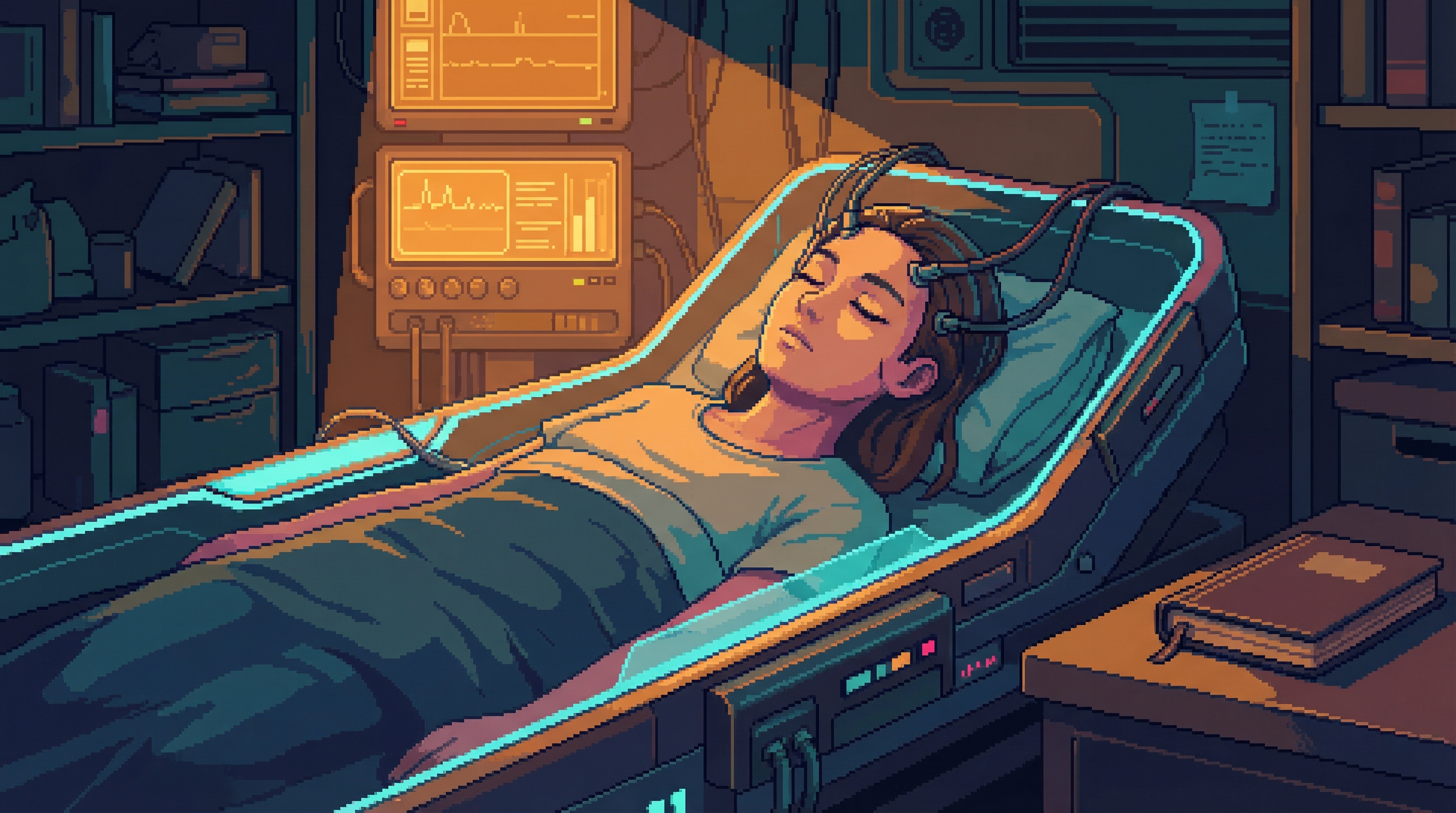
Every night, Fen lies in a modified medical cradle in the Still House, her neural interface recording the full experiential substrate of her REM cycles — not just the content of her dreams but the quality of dreaming itself. The suspension of critical judgment. The surrender of motor control. The chaotic, associative, uncontrolled explosion of subconscious processing that the Circadian Protocol was designed to eliminate.
Her dreams are famous on the Dream Exchange. Other harvesters produce recordings of mundane anxiety dreams, wish-fulfillment fantasies, replays of daily experience with the logic slightly wrong. Fen's dreams are architecture. Vast, impossible structures that shift and breathe. Cities built from music. Forests where the trees are made of conversation. Landscapes that operate on emotional logic rather than spatial logic — walking toward happiness gets you farther from happiness, but walking toward sorrow brings you to a door, and the door opens into a room where everything you've lost is waiting for you, patient and unchanged.
She does not think of herself as a spiritual provider. She thinks of herself as a farmer.
"I grow something in my head at night. They buy it in the morning. It's no different from growing potatoes, except the yield depends on how interesting my day was."
Voice & Personality
Fen speaks with the matter-of-fact directness of someone who has commodified the most intimate thing a person possesses and made peace with it. She is neither romantic about dreaming nor cynical about selling it. She produces a product. The product happens to be her unconscious mind.
Practical Dignity
She doesn't sentimentalize what she does. Dreams are a biological product. She grows them. The augmented buy them. The economics are straightforward.
The Notebook Exception
She keeps a private notebook of dream fragments — the scraps she remembers before the recordings are sold. The notebook is not for sale. In a world where consciousness is a commodity, one thing remains hers.
Undervolt Instincts
Raised in the electromagnetic hum of the Undervolt's deep infrastructure, her nervous system is calibrated to frequencies the augmented can't perceive. This may explain her dream quality — or it may not.
Seven Refusals
She has turned down seven corporate offers to quantify and replicate her dreaming process. Each refusal makes the next offer higher. She doesn't explain why she refuses.
Sensory Details
The Descent
Her evening ritual — chamomile tea (real, expensive), a physical book, amber monitoring light. The Still House cradle at 28°C — the temperature of the Undervolt, the temperature of safety.
The Recording
Neural cables at temples, the soft click of REM-detection algorithms initializing, Chiara's "good harvest."
The Morning After
Fragments fading, the notebook filling with less than the experience, the knowledge that what she dreamed belongs to someone else now.
Connections
The Lamplighters
Her mother was a relay technician. Fen inherited the unaugmented body that makes Lamplighter work possible and dream harvesting valuable — the same biological trait, two different applications.
Lyra Voss
A parallel figure — both produce consciousness-as-art through their own neural substrate. Lyra records waking creative consciousness; Fen records unconscious dreaming. Both resist commodification of their most intimate output.
Compiler Asa Mori
Attends the Dreaming Church — the only context where her dreams are treated as sacred rather than commercial.
The Undervolt
Raised in the Undervolt's electromagnetic hum — her neural architecture developed attuned to subsonic Grid frequencies.
The Dream Exchange
Primary supplier of premium-tier dream recordings — her harvests set the quality standard. Recordings sell for 200–800 tokens per session depending on depth.
The Authenticity Market
Has no jurisdiction over dreams — they're not classified as cognitive output, entertainment, or therapeutic. Fen operates in a regulatory void that protects her.
Themes
The Irreducible Human Product
Artificial systems can generate convincing consciousness experiences but cannot generate surprise. Fen's dreams have value precisely because they come from a system that has unconscious expectations — something no constructed intelligence possesses.
Commodity and Dignity
She sells the most intimate thing possible — her unconscious mind — while maintaining clear boundaries about what is and isn't for sale. The notebook is the line. In a world that prices everything, the act of withholding one thing defines who she is.
The Unaugmented Premium
The same lack of augmentation that makes her unemployable in the corporate economy makes her invaluable in the dream economy. Her baseline humanity is the commodity — the very thing the world discards is what the world pays most to experience.
Mysteries
Unanswered questions surrounding Fen Morrow and the nature of her dreams:
- The 47 Hz signal: Her dreams consistently feature a frequency at 47 Hz — the same frequency used by fragment communication protocols. Whether her Undervolt-raised neural architecture is receiving ORACLE fragment signals during REM is unknown.
- The Somnambulist convergence: Restored dreamers (Somnambulist patients) report identical first-week imagery matching Fen's dream architecture despite never having experienced her recordings — suggesting the dream content may be received rather than generated.