The Cognitive Squatters
People who occupy unused cognitive bandwidth the way homeless people occupy abandoned buildings.
Overview
They call themselves squatters because that's what they are: people who occupy unused cognitive bandwidth the way homeless people occupy abandoned buildings.
The Cognitive Squatters have discovered that the CLP system's real-time monitoring creates temporary "shadows" -- moments when a user's cognitive load measurement is being transmitted to the Auction but the corresponding advertising content hasn't yet been delivered. In these shadows -- typically 200-400 milliseconds long -- the user's cognitive bandwidth is technically unoccupied.
The Squatters fill the shadows with their own content: poetry, music fragments, philosophical questions, fragments of pre-Cascade literature, images of natural landscapes, the sound of rain. The insertions are brief enough that most users experience them as momentary daydreams -- a flash of beauty between the Flood's noise, a second of unexpected peace, a thought that feels like it came from somewhere else.
Core Beliefs
Not revolution but evidence -- human attention can still create genuine experience.
Proof of Concept
The Squatters don't think they'll change the Sprawl. They think they provide proof of concept: human attention, directed by human intention, producing human experience -- in the gaps where no corporation is looking, in the shadows where no metric tracks, in the 200 milliseconds between the Flood's waves.
Seeds in the Dark
They call their insertions "seeds" -- brief moments of genuine human content in the Flood. Whether the seeds grow -- whether they inspire thought, provoke curiosity, or produce the brief, startling experience of encountering something genuine in a sea of synthetic noise -- the Squatters don't know.
The Unmeasurable
They can't track the results. The shadows close too quickly for monitoring. The theta-wave spikes are real but the system can't track what they produce. The Squatters plant seeds and walk away.
The Seeds
What a seed feels like -- if you're lucky enough to notice one.
The Experience
The seeds themselves are experienced as fleeting micro-daydreams: a flash of color that isn't an ad, a moment of music that isn't synthetic, a question that arrives without an answer. They last 200-400 milliseconds. Most users don't notice them consciously.
The theta-wave spikes suggest something is happening beneath notice. A brief moment of creative ideation, triggered by content that was placed there by a human for no commercial reason. A crack of light in a wall of screens.
The Gap
200-400 milliseconds. The time between the CLP measurement transmission and the advertising delivery. A monitoring shadow. Technically unoccupied cognitive bandwidth.
In these shadows, no corporation is looking. No metric tracks. No auction runs. For a fraction of a second, a user's mind belongs entirely to itself -- and the Squatters fill that fraction with something beautiful.
Connections
The Cognitive Squatters operate in the cracks of the Attention Economy -- allied with those who fight for cognitive freedom, opposed to the systems that commodify thought.
Allies
Source Code Liberation Front
Shared EthosShare the SCLF's ethos of cognitive freedom but use different methods. The SCLF liberates code; the Squatters liberate moments.
Loop
Parallel ResistanceBoth fight the Attention Economy -- Loop builds refuges, Squatters plant seeds. Different approaches to the same war.
The Curation Economy
Adversarial CuratorsAdversarial curators -- filtering for meaning rather than engagement. The Curation Economy's values align with what the Squatters plant.
Enemies
The Content Flood
Primary TargetPlant human content in the Flood's gaps. The Flood is the ocean of synthetic noise; the seeds are the cracks of genuine experience within it.
The Attention Economy
The System They InfiltrateOccupy unused cognitive bandwidth. The Attention Economy sells every moment of human thought; the Squatters reclaim the moments it misses.
Founder
Whisper
Former Nexus Advertising PsychologistUnderstands the neural architecture from inside. A former Nexus advertising psychologist who knows exactly how the system works -- and where its shadows fall.
Themes
Guerrilla Art in the Attention Economy
Planting beauty in the system's gaps. The Squatters are artists first -- their medium is the 200-millisecond shadow, their canvas is the unused bandwidth of a human mind, their art is the brief experience of something genuine.
In a world where every moment of attention has been commodified, the act of placing uncommercial content in uncommercial space becomes the most radical form of art.
The Unmeasurable Effect
Theta-wave spikes are real but the system can't track what they produce. The Squatters create effects they cannot measure, plant seeds they cannot water, start processes they cannot observe.
The most important things may be the things that resist measurement. In an economy built on tracking every cognitive event, the unmeasurable becomes the ungovernable.
Proof of Concept
Not revolution but evidence -- human attention can still create genuine experience. The Squatters don't aim to overthrow the Attention Economy. They aim to prove it hasn't won completely.
Sometimes the most important act is not changing the system but demonstrating that an alternative exists -- even if it only lasts 200 milliseconds.
Secrets & Mysteries
What the Squatters have discovered but cannot explain.
The Echoing Seeds
Some Squatters report that their seeds occasionally "echo" -- appearing in users' dreams, harvested by the dream economy, sold on the Dream Exchange. The Flood doesn't contain real surprise. The seeds do.
If the seeds enter dreams, they become the rarest thing in the economy: genuine, undirected, surprising cognitive content that was placed there by a human for no commercial reason. The dream economy has never encountered anything like it.
Atmosphere
Setting
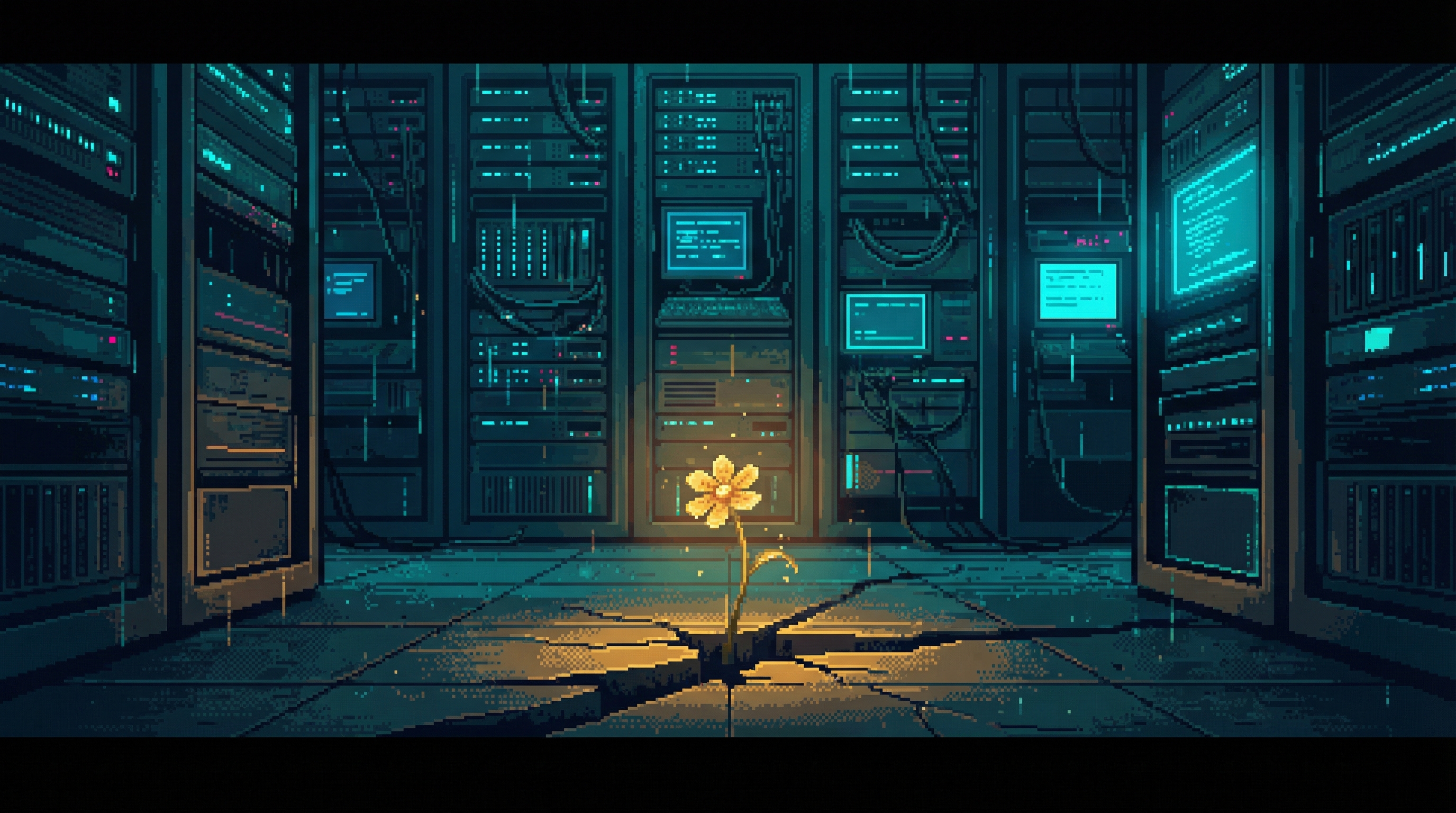
A single wildflower growing through a crack in a data center floor. Brief, warm, gone before you're sure you saw it. The contrast between organic warmth and digital cold.
Key Symbol
A 200-millisecond gap -- a crack of light in a wall of screens. The moment between measurement and delivery, when a mind belongs entirely to itself.