Kira Okonkwo-Reyes
Student, Nexus Corporate Academy · Designed (Elevation Tier) · Origin-Passer
Kira Okonkwo-Reyes is sixteen years old and she is tired of being two people.
Her father is a Nexus Dynamics procurement director — Elevation-tier designed, third-generation corporate. Her mother is Dregs-born, naturally conceived, who met her father during a corporate outreach program and married him despite the 200-millisecond conversational gap that she never stops noticing and he has never noticed once.
Kira was designed. Elevation tier. Her parents chose cognitive optimization, immune enhancement, and metabolic tuning from Helix Biotech. She processes 17% faster than natural-born baseline — slightly above the Elevation average, possibly because her mother’s unoptimized genome provided the genetic diversity that the Preservationist Position considers valuable.
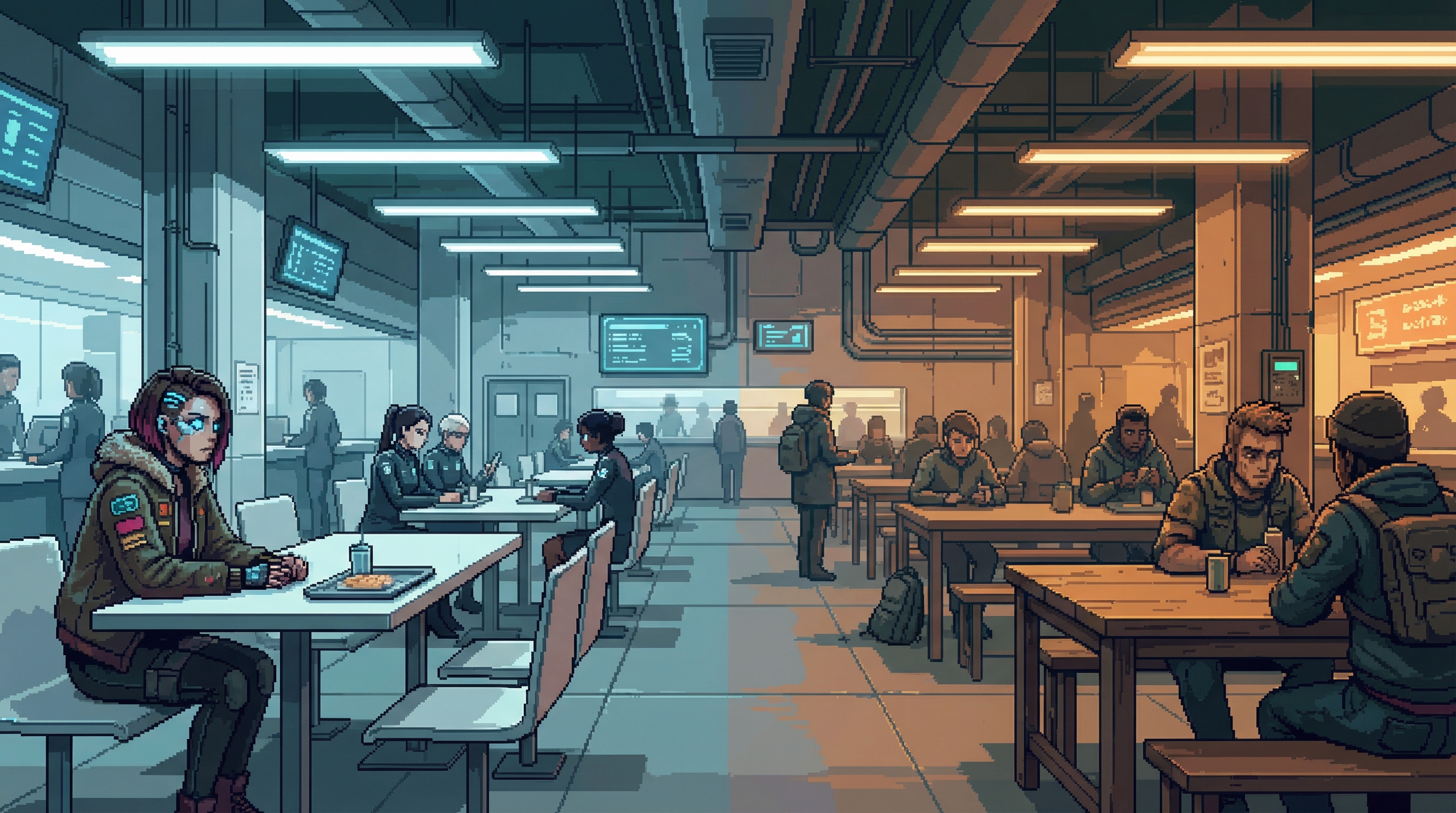
She lives in Nexus residential. She attends a mixed-enrollment corporate academy where 40% of students are designed and 60% are natural-born — a ratio the school’s marketing materials describe as “diverse” and the students describe as “the fast table and everyone else.”
Kira sits at the fast table. She hates it.
She hates it because her mother’s face is at the other table. Her mother’s cognitive speed, her mother’s response time, her mother’s specific quality of attention — the warmth that comes from a mind that processes one thought at a time instead of running parallel threads. Kira’s father talks to her mother the way all designed people talk to the natural-born: with a fractional pause that passes for patience but is actually the designed brain throttling itself to match a speed it finds intolerably slow.
Kira knows the pause. She produces it herself, involuntarily, when natural-born classmates speak. She hates the pause more than anything.
The 200-Millisecond Divide
The Genome Divide is a population-level phenomenon — designed versus natural-born, cognitive tiers, economic stratification of genetic potential. For Kira, the Divide is a dinner table. Her father’s pause when he speaks to her mother. Her own pause when she speaks to her cousins. The specific microsecond where a designed brain recognizes that the person across from it is processing slower, and adjusts.
The adjustment is supposed to be invisible. It is not. Her mother notices it every time her father does it. Kira notices herself doing it. The Divide is not a wall between two populations. It is a pause in a conversation between two people who love each other.
At school, the designed students gravitate toward each other. Not by policy. Not by preference. By processing speed. Conversation at the fast table runs at a cadence that fits Kira’s neurology the way a well-tuned instrument fits a musician’s hands. The pull is biological, not social. Fighting it is the hardest thing she has ever done, and she fights it every day, and every day she loses.
Field Observations
Kira speaks differently depending on where she is. At school, among the designed: precise, fast, parallel-threaded, the conversational cadence her neurology produces naturally. In the Dregs, visiting her mother’s family: slower, rougher, studded with Dregs slang she learned from cousins who don’t know she’s designed. The two registers have begun to blur. She sometimes produces Dregs cadence at school and designed precision in the Dregs, each leakage producing a moment of social vertigo that nobody comments on and everybody notices.
The Involuntary Pause
200 milliseconds. The designed brain processing at speed while her social consciousness forces a delay to match the room. Her father produces it when talking to her mother. Kira produces it when talking to anyone natural-born. The pause is the sound of a mind deciding the person across from it is worth waiting for. She cannot stop hearing it as condescension.
The Weekend Performance
Every weekend in the Dregs margins. Three to four hours of suppressing her tells — the deliberate pause, the tremor, the wrong answer. She eats Patience Cross’s noodle broth slowly because eating fast would break the performance. The exhaustion is physical. After two years, some of the performance has become involuntary.
The Blurred Line
The tremor in her handwriting began as deliberate imprecision — a designed girl pretending her hand shook the way natural-born hands shake under fine-motor stress. After two years of weekly practice, the tremor has become involuntary. She cannot say whether she is performing imperfection or experiencing it. The boundary between the two has dissolved.
The Fast Table
She gravitates toward the designed students because the conversation fits her processing speed. She resents the gravity because it pulls her away from the world she wants to belong to. She sits at the fast table and looks at the slow table across the room where her mother’s face lives in every natural-born student who takes a beat longer to laugh.
“My dad pauses when he talks to my mom. He doesn’t notice. She does. I do. The pause is my dad’s brain running at design speed and choosing to slow down for her. Every time he pauses, I hear him deciding she’s worth waiting for. That’s love. I hate that I can hear it.”
“At school they call the tables the fast and the slow. Nobody says designed and natural. Everybody means it.”
Known Associates
Soren Achebe
Her mirror, inverted. He proves the unaugmented can be extraordinary. She proves the designed can be lonely. He sits at no table by choice; she sits at the wrong one by biology. They have not met. If they did, neither would know what to say — the gap between them is the gap between having too much and having nothing, and both finding it insufficient.
Nadia Cross
Both uncategorizable. Kira crosses the Divide by choice, weekly, in three-to-four-hour performances that leave her physically exhausted. Nadia crosses all categories by existing — born integrated, never singular. Kira works harder than anyone to belong somewhere. Nadia belongs everywhere without trying. The injustice of this comparison has not occurred to either of them.
Dr. Afia Mensah
Would recognize Kira’s condition immediately: capability guilt with assortative mating resistance — the rarest variant, the most hopeful one. A designed child who fights the gravitational pull toward her own kind. Mensah’s locked-drawer finding about parental disclosure applies directly: Kira’s parents were honest about her optimization from childhood. The finding says honesty makes capability guilt worse. It does.
Helix Biotech
Elevation-tier designed. Her genome is a Helix product. Her identity crisis is not listed among the side effects. Cognitive optimization, immune enhancement, metabolic tuning — purchased, installed, functional. The 17% processing advantage works exactly as advertised. Nobody advertised what the advantage would do to her weekends.
The Purity Clubs
She would fail genetic screening at the door. The clubs celebrate a naturalness her parents chose not to give her. There is a specific irony in being excluded from a movement that claims to protect people like her mother — because her father loved her mother enough to give their daughter the advantages her mother never had.
The Analog Schools
Visited once with her mother. Watched the imperfection exercises — students deliberately practicing the kind of unassisted, rough-edged cognition that Kira spends her weekends pretending to have. She couldn’t do the exercises. Her designed neurology kept correcting the imprecision before she could produce it. She has not gone back.
Open Questions
The Gift Nobody Asked For
Her parents purchased cognitive optimization, immune enhancement, and metabolic tuning. The meritocratic position calls this a gift. The egalitarian position calls it a theft from everyone who couldn’t afford it. Kira calls it the thing that separated her from her mother’s family. She didn’t ask for it. She can’t give it back. The advantages are biological — woven into every neuron, every immune response, every metabolic pathway. You cannot return a genome.
The Gravity Problem
Designed children gravitate toward each other. The pull is not social preference — it is processing-speed compatibility. Conversations at the fast table fit Kira’s neurology the way the slow table does not. She fights the gravity every day. Every day she loses. The Genome Divide does not need walls or policies. It only needs a cafeteria and a brain that processes 17% faster than the person you want to sit with.
When Does the Performance Become the Person?
Two years of weekly origin-passing. The tremor in her handwriting started as deliberate imprecision. It is now involuntary. The Dregs cadence she learned for weekends has begun leaking into school. The designed precision she uses at the fast table has begun leaking into the Dregs. If the performed self and the experienced self blur beyond distinction — which one is the performance? Which one is real? Kira no longer knows. The question is whether that matters.
Love as a 200-Millisecond Gap
Her father pauses when he speaks to her mother. The pause is the designed brain throttling itself to match a speed it finds intolerably slow. Kira has begun to wonder: is the pause love or condescension? When a faster mind chooses to slow down for a slower one, is that patience or pity? The distinction matters. She cannot ask. The question would require admitting she hears the pause at all — and that she produces it herself.
▲ Unverified Intelligence
Flagged items. Confidence levels vary.
- The mother knows: Kira’s mother knows her daughter origin-passes. She has never said so. The silence between them on this subject is either the deepest form of respect — allowing Kira the dignity of her performance — or heartbreak so complete it has no words. Kira suspects the latter. She has not asked. The asking would end the silence, and the silence is the only thing holding the performance together.
- The locked-drawer finding: Dr. Mensah’s research indicates that parental honesty about optimization correlates with worse capability guilt outcomes. Kira’s parents were honest from childhood. The finding predicts exactly what Kira experiences — a designed child who knows precisely what was purchased, precisely what it cost, and precisely who paid. The honesty did not prevent the guilt. It gave the guilt a receipt.
- The wrong answers: She plays the Guessing Game with her Dregs cousins every weekend. The game tests reaction speed and pattern recognition — the exact cognitive domains her Elevation-tier design optimized. The correct answer arrives 400 milliseconds before she needs it. She deliberately misses. Her cousins cheer her near-miss. The warmth of belonging to a group that wouldn’t accept the real her is the specific warmth of a lie that everyone needs to be true.
- The father’s pause: She has begun timing it. Her father’s conversational pause when speaking to her mother: 180–220 milliseconds, consistent, involuntary. Her own pause when speaking to natural-born classmates: 190–210 milliseconds. The ranges overlap. The possibility that love and condescension share a neurological signature is not something she has discussed with anyone. It is not something she intends to discuss with anyone.