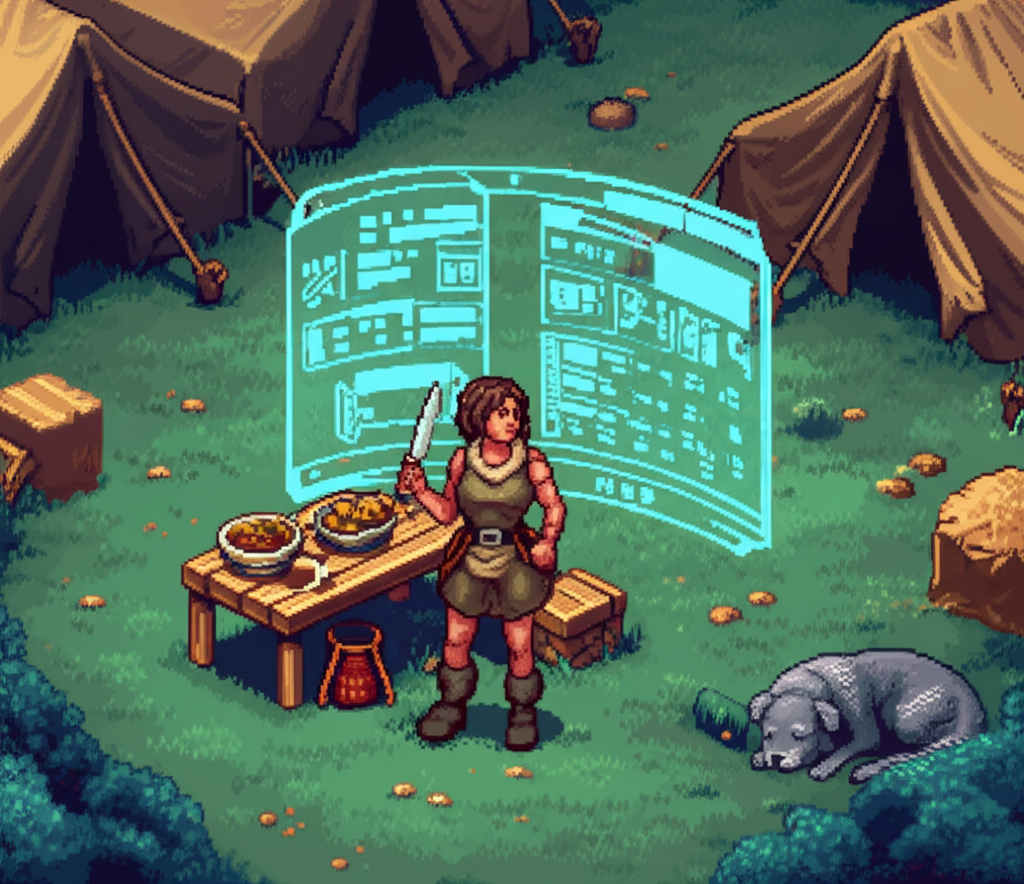
The Chef doesn't cook with machines.
This is known throughout The Feast: she refuses augmentation, refuses neural interfaces, refuses anything that smells of the corporations that destroyed her life. Every meal she prepares is pure flesh against fire, hand against blade, intuition against ingredient. The feasts that celebrate her conquests are built on nothing but human skill.
So when the AI assistant appeared in her field kitchen, she nearly killed it.
"I didn't ask for this," she tells Dr. Okonkwo later, gesturing at the small holoprojector mounted on her prep station. It had been installed overnight, without her knowledge, by well-meaning soldiers who thought their commander needed help.
The hologram flickers to life: a simple interface, no personality construct, just data. NUTRITIONAL OPTIMIZATION ASSISTANT v3.2.1, the text reads. COURTESY OF HELIX BIOTECH.
"Remove it."
Dr. Okonkwo doesn't flinch. The Chef's personal physician has survived too many difficult conversations to be intimidated by this one.
"The system is specifically calibrated for canine geriatric nutrition," she says quietly. "For Sage."
The Chef goes very, very still.
Sage is dying.
Everyone in The Feast knows this. No one says it aloud. The elderly dog who has been The Chef's constant companion for twenty-six years is fading—cognitive decline, organ failure, the slow cruelty of time that no amount of conquest can stop.
The Chef has tried everything. Raided research facilities. Kidnapped scientists. Spent fortunes on treatments that buy months, weeks, days. Nothing works permanently.
But if she can optimize Sage's nutrition—calculate the precise balance of nutrients, minerals, compounds that might slow the deterioration—maybe she can buy a little more time.
"Show me," she says. The words taste like surrender.
The AI is infuriating.
It doesn't understand art. Doesn't grasp that cooking is ritual, memory, love translated into sustenance. It sees ingredients as data: protein content, mineral ratios, bioavailability percentages.
RECOMMENDED: Substitute 15g bone broth for 15g water. Calcium absorption increases 23%.
"I know how to make bone broth," The Chef mutters.
RECOMMENDATION: Cooking temperature suboptimal. Reduce heat 8°C to preserve enzyme integrity.
"I've been cooking for thirty years."
SUGGESTION: Add 0.3g turmeric for anti-inflammatory effect. Cross-reference canine dietary tolerance database.
She adds the turmeric. She hates that the AI is right.
The first meal takes three hours.
Not because the cooking is complex—Sage's diet is simple now, gentle foods for a failing digestive system—but because The Chef refuses to simply follow the AI's instructions. She negotiates. Argues. Demands explanations.
"Why chicken liver instead of beef?"
QUERY: Canine cognitive decline correlates with choline deficiency. Chicken liver: 356mg choline per 100g. Beef liver: 290mg per 100g. Recommendation based on optimizing neural support.
"She likes beef liver."
QUERY: Palatability versus nutritional optimization. Suggest split approach: 60% chicken liver, 40% beef liver. Maintains preference while maximizing therapeutic benefit.
The Chef considers this. It's a compromise. Machines don't usually compromise.
"Fine."
By the second week, something strange happens.
The AI learns her cooking style. It stops suggesting substitutions she would never accept. It factors in her preferences—her insistence on whole ingredients, her refusal to use synthetic supplements, her need to do certain steps by hand even when machines would be more efficient.
Its recommendations become better. Not optimal according to pure data, but optimal for her.
She catches herself, once, almost thanking it.
The machine is learning me, she realizes. Learning how I think. What I value. What I'll accept.
She should find this horrifying.
She finds it... useful.
Sage sleeps better now. Eats more willingly. On good days, the old dog's eyes are clearer than they've been in months.
It's not a cure. Nothing is a cure. But it's more time, and more time is everything.
The Chef still refuses augmentation. Still refuses neural interfaces. Still refuses to let the corporations that destroyed her life inside her body.
But she lets the AI help her cook. For Sage. Only for Sage.
Late at night, when the camp is quiet and Sage is sleeping, The Chef sits at her prep station. The holoprojector is dark now—she turns it off when she's not cooking. But she doesn't remove it.
"I still hate you," she says to the machine.
ACKNOWLEDGE.
She almost smiles.
"But you're useful. And useful I can work with."
"The first thing a tyrant takes is your food. The first thing a mother gives is her meal. Remember which one you want to be."
— The Chef's grandmother