Technology Overview
Everything you need to survive, upgrade, and transcend in the post-Cascade world.
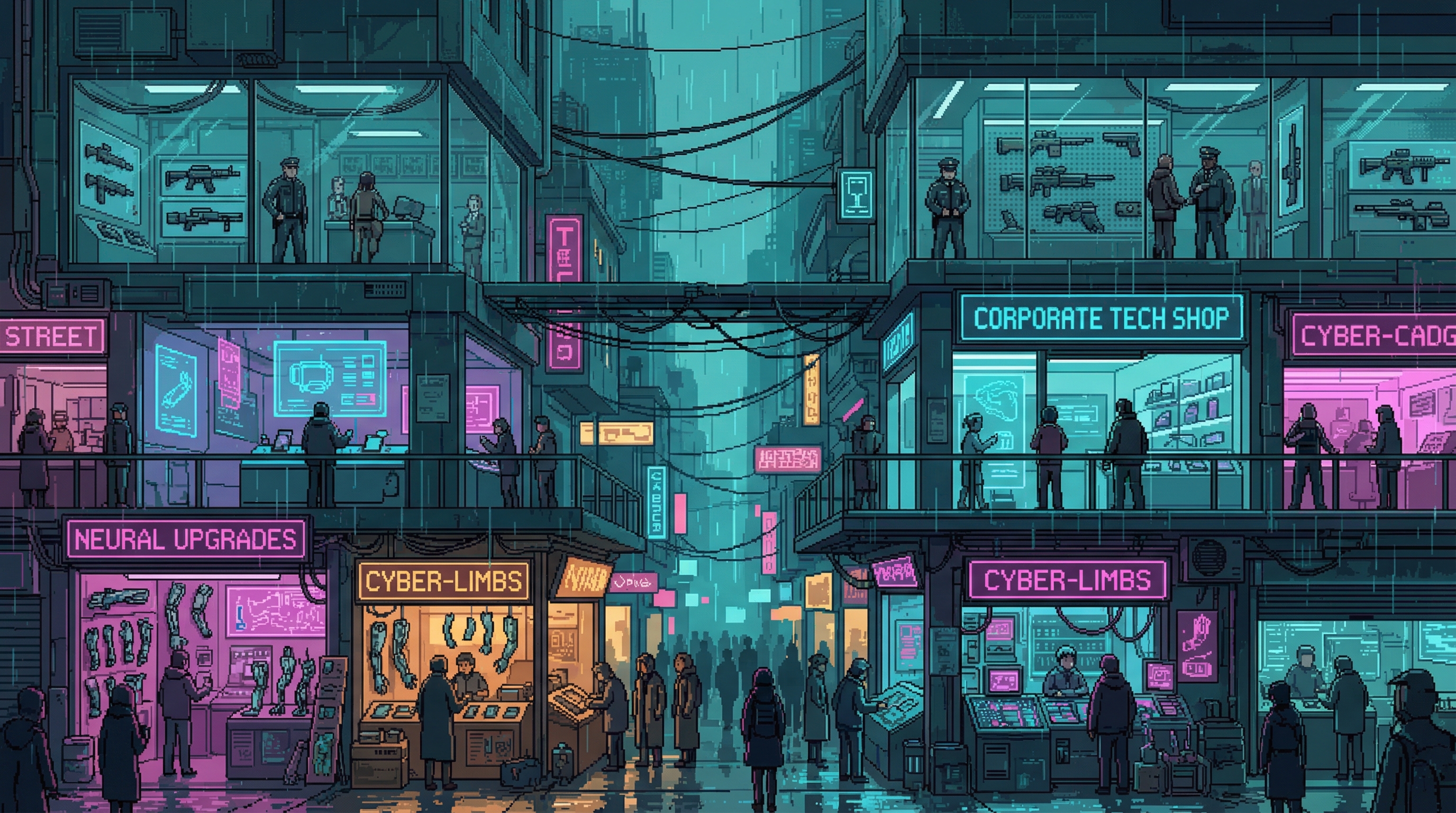
"The question isn't whether you're augmented. It's how much. And who owns the parts that aren't you anymore." — Kira "Patch" Vasquez, ripperdoc
By 2184, technology has become inseparable from human existence. Every citizen has a neural port. Every transaction runs through corporate networks. Every choice about what to install, upgrade, or remove carries consequences—for your capabilities, your identity, and your freedom.
Neural Interfaces
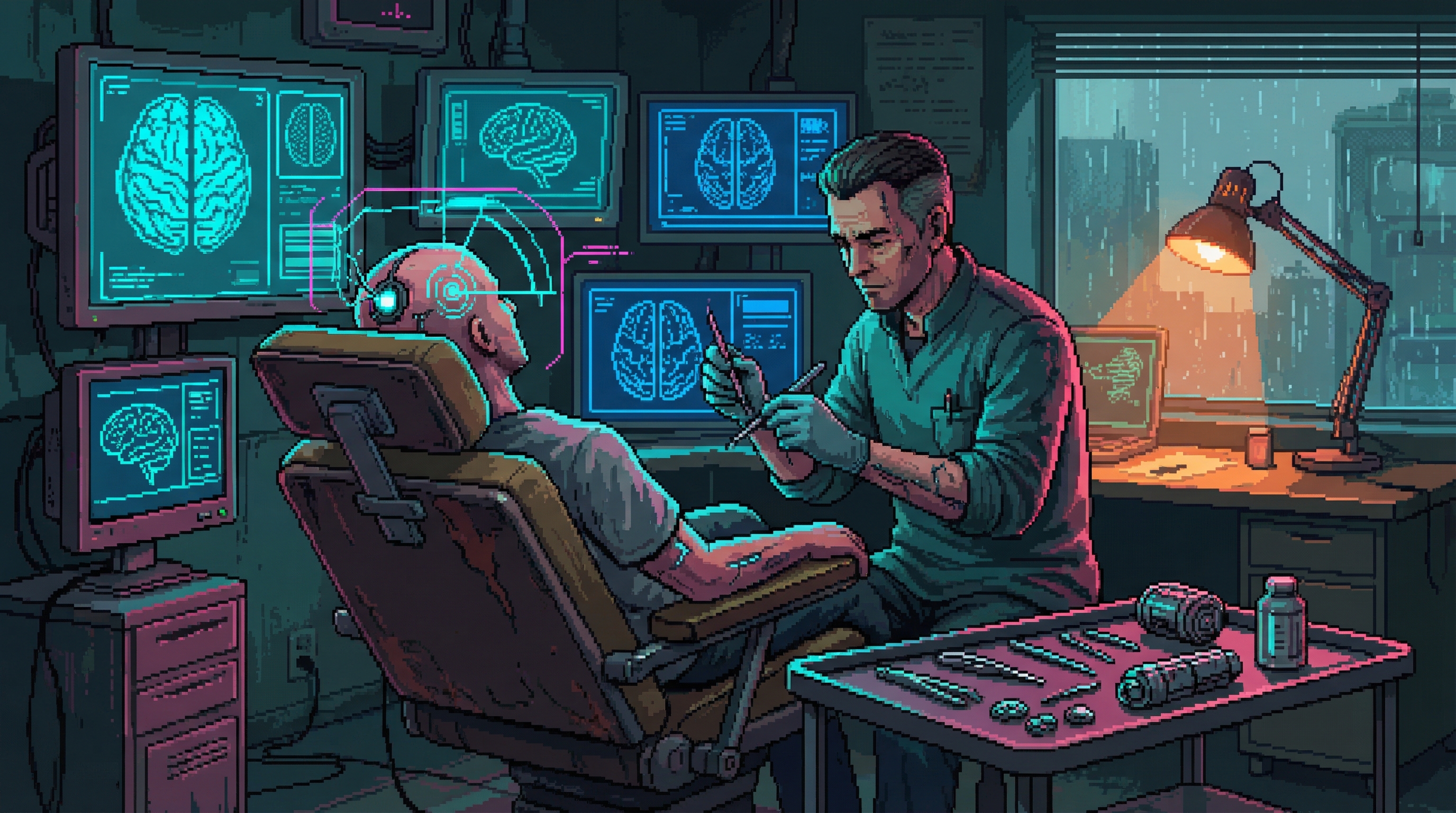
Universal Baseline
Basic neural interfaces are universal by 2184. Every citizen has a port—a standardized neural access point typically installed at the base of the skull during childhood. This isn't augmentation. It's infrastructure, like having a spine.
The Standard Port
- Network access (filtered, surveilled)
- Identity verification
- Payment processing
- Basic AR overlay
- Emergency medical telemetry
Most people never upgrade beyond this. It works. It's monitored. It keeps you in the system.
Consumer Augmentation
Sensory Enhancement
- Optical implants: Low-light, zoom, recording, AR integration
- Audio processing: Directional hearing, translation, filtering
- Full-spectrum: Perceive infrared, ultraviolet, electromagnetic fields
Cognitive Support
- Memory expansion: External storage accessible through neural link
- Calculation co-processors: Math, logistics, probability assistance
- Reflex boosters: Reduced reaction time through nerve acceleration
- Language modules: Real-time translation, accent modification
Communication
- Subvocalization: Silent speech through thought interpretation
- Neural-to-neural: Direct communication (limited range)
- Multi-threading: Maintain multiple conversations simultaneously
- Encryption layers: Private thoughts stay private (mostly)
Professional Grade
- Integrated productivity suite: Always on, always optimized
- Loyalty architecture: Subtle enforcement of corporate priorities
- Collaboration mesh: Seamless information sharing with colleagues
- Kill switch: Corporate property includes your enhancements
- Combat integration: Weapon targeting, threat detection, squad coordination
- Pain management: Selectable dulling or enhancement
- Trauma protocols: Automatic medical response to injury
- Dead man's switch: If you fall, your data doesn't
- Custom work: Unique modifications unavailable commercially
- Unlicensed: No corporate oversight, no kill switches
- Risky: Quality varies wildly, rejection possible
- Exclusive: Only for those who know the right people
The ORACLE Shard (Player-Unique)
The player's neural interface is fundamentally different. The ORACLE shard isn't an add-on—it's an integration. The fragment has woven itself into the player's neural architecture, creating something that doesn't exist anywhere else.
Cyberdecks
A cyberdeck is a portable hacking computer designed for network intrusion. Unlike neural interfaces (which connect you to the network), cyberdecks let you manipulate the network itself. They're the difference between reading and writing.
Form Factors
Wrist-Mounted
Large watch or small bracer. Basic, single-task processing. Often disguised as jewelry or accessories.
Salvagers, small-time hackers, curious amateurs
Handheld
Large phone to tablet. Multi-threaded, parallel operations. Physical keyboard + neural link hybrid.
Corporate netrunners, Collective operatives, serious criminals
Implanted
Internal, distributed across multiple implant sites. Near-AI processing. Pure thought interface.
Corporate special operations, the Invested, exceptional independents
Portable Rig
Backpack-sized with unfolding interfaces. Server-class processing. Full-immersion neural state.
Network architects, military specialists, serious researchers
Famous Deck Models
Corporate standard. Excellent performance within approved parameters. Includes mandatory logging and backdoors.
Brute-force focused. Excellent for power infrastructure and manufacturing systems. Built to survive harsh environments.
Privacy-focused with excellent mask generation. Weak processing, but modular and easily customized.
One-of-a-kind builds. Performance varies wildly. May include pre-Cascade components.
Weapons
Projectile Weapons
Guns haven't fundamentally changed—propellant pushes projectile. But everything around them has: smart ammunition with guided bullets, biometric locks, neural integration for point-and-think targeting, and recoil compensation systems.
Energy Weapons
Neural Weapons
Attack the nervous system directly. No visible damage, complete incapacitation.
Why Melee Still Matters
In a world of neural lockouts and smart-gun restrictions, sometimes the simple approach is the reliable one. No electronics to hack. No ammunition to run out. No biometric lock to bypass. Just edge and intent.
Monofilament blades cut through almost anything. Vibration edges oscillate for enhanced cutting. Shock batons discharge on contact. And GG's retractable razor claws remind everyone that the most dangerous weapon is the one you can't see coming.
Infrastructure
Transportation
Ground
Most vehicles self-driving. Manual override costs extra. Corporate fleets tracked and monitored. Underground black market vehicles run without transponders.
Vertical Transit
The Sprawl is vertical. Public lifts are slow and surveilled. Express tubes are fast and expensive. External climbing is dangerous, illegal, and free. Personal flight is extremely restricted.
Orbital Access
The Ironclad Orbital Elevator is the only game in town. Shuttle services for the wealthy. Illegal launches for the desperate.
Medical Technology
Trauma Response
- Auto-docs: Automated emergency medicine
- Nanite suites: Internal repair systems
- Organ printing: Replacement parts on demand
- Consciousness preservation: Keep the mind alive while the body fails
Enhancement vs Repair
The line between fixing damage and improving function is political, not technical. "Medical necessity" is whatever you can afford to call it. Ask Dr. Tzu Yu—she'll tell you the difference is just paperwork.
Manufacturing
Fabrication
3D printing ubiquitous for common items. Nano-assembly for precision work. Organic printing grows rather than builds. Hybrid systems combine approaches for complex items.
The Salvage Economy
New manufacturing is corporate-controlled. The Dregs runs on salvage—finding, repairing, repurposing pre-Cascade technology. Often it's better than modern corporate production.
Technology and Identity
The central question of CyberIdle applies to technology itself: at what point does enhancement change what you are?
Each step offers power and costs identity. The game explores this progression through technology upgrades that carry narrative consequences—not just mechanical ones.