Cognitive Load Pricing
Attention Has a Price Because Attention Can Be Measured
"Section 47.3 of the licensing agreement grants Nexus Dynamics permanent, irrevocable access to all cognitive load data generated by or through the user's neural interface." — 12,000 words. Professional-tier reading level. Basic-tier users cannot parse it. — Neural Interface Licensing Agreement, Section 47.3
Overview
Attention has a price because attention can be measured.
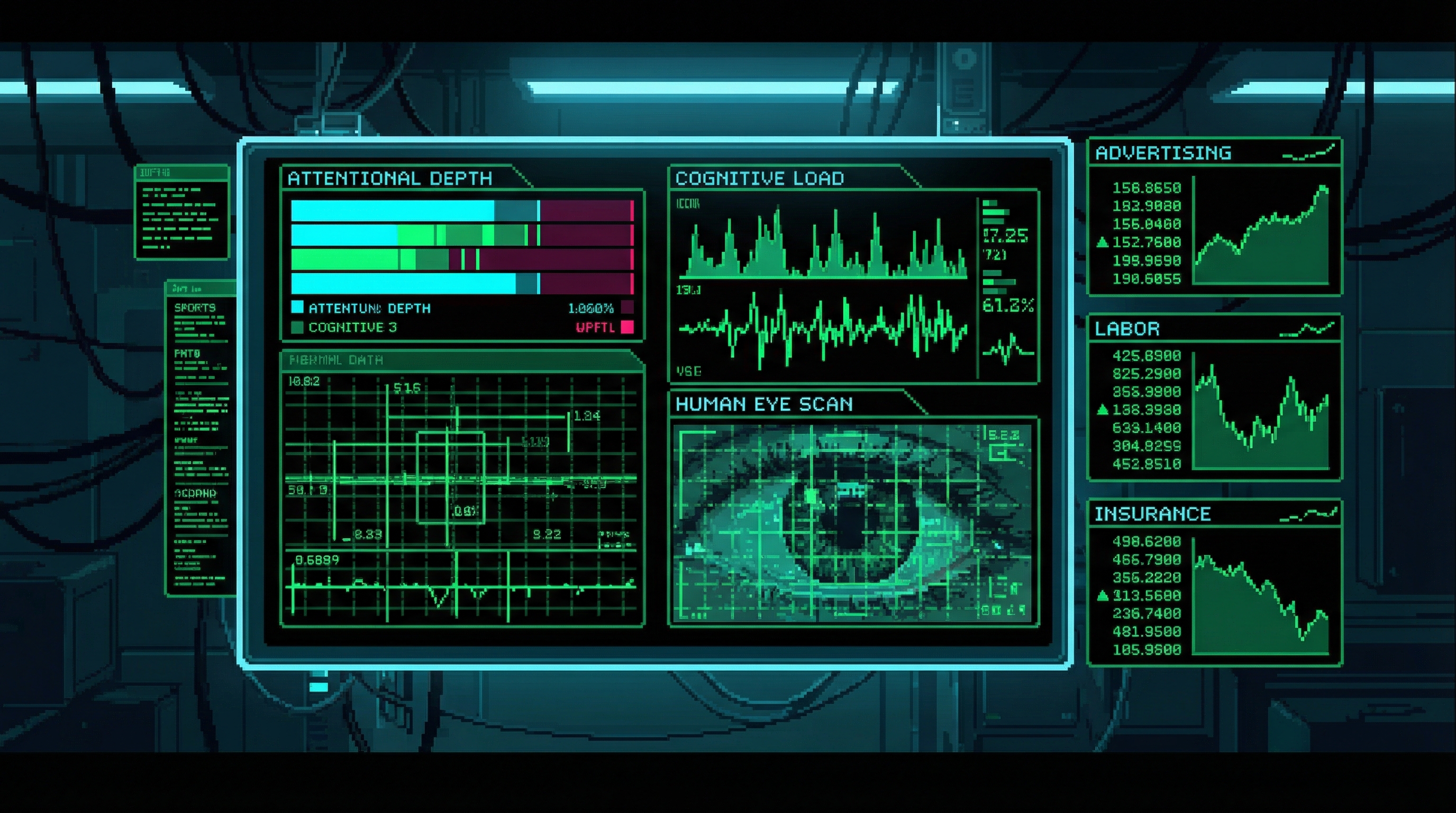
Cognitive Load Pricing is the technology that makes the Attention Economy possible — the instrumentation that converts the subjective experience of paying attention into an objective, tradeable metric. CLP systems, integrated into every neural interface sold since 2174, monitor the user's cognitive allocation in real time: which processing threads are active, how much bandwidth each thread consumes, and how much of the user's attention is directed at commercially relevant content.
The system does not care what you think. It cares how much you think it, and whether someone will pay to redirect that thinking.
Quick Facts
How It Works
The measurement is precise. CLP can determine, to the millisecond, when a user shifts attention. It can measure attentional depth — the degree of processing engagement, from surface scanning (0.1) to deep immersion (1.0). It can assess attentional quality — whether the user is critically evaluating content or receptively absorbing it.
The data feeds three markets simultaneously:
Advertisers bid on attention slots — specific moments in specific users' cognitive streams. CLP data enables real-time slot optimization through the Neural Advertising Architecture, determining which thoughts are most valuable to interrupt and which users are most receptive to influence.
Forced-focus contracts are priced based on required cognitive load. Workers who game the system — maintaining apparent high load while preserving bandwidth for their own thoughts — are flagged for "cognitive compliance review." The system monitors not just whether you are working, but whether you are thinking about working.
Cognitive load insurance premiums based on historical load data. Users with erratic attention patterns pay more. Users with high critical-evaluation scores — those who think too carefully about what they consume — are classified as higher risk. The industry prefers predictable minds.
In-World Tensions
Measurement as Control
You can only commodify what you can measure — and CLP measures everything. Every moment of attention, every shift in focus, every flicker of interest or boredom is captured, quantified, and priced. The act of measurement is not neutral. When attention becomes a metric, it becomes something to be optimized, directed, and sold. The instrumentation does not observe the economy. It creates it.
The Licensing Trap
The terms you cannot read govern the attention you cannot control. Section 47.3 is written at Professional-tier reading level — a tier that costs more cognitive bandwidth than most Basic-tier users can afford. The licensing agreement that grants Nexus Dynamics permanent access to your cognitive data is deliberately incomprehensible to the majority of the people it applies to. Informed consent requires comprehension. Comprehension requires a tier. The tier requires money.
Data as Power
Nexus Dynamics owns your cognitive load history forever — and uses it for "other applications consistent with business interests." The data does not expire. The applications are not defined. The power asymmetry between a corporation that knows every pattern of your attention and a user who cannot read their own licensing agreement is not a bug. It is the architecture.
Connections
CLP connects the Attention Economy (the system it enables), the Attention Auction (the market it feeds real-time data), Neural Advertising Architecture (the revenue it optimizes), Forced-Focus Contracts (the compliance it monitors), and the Cognitive Squatters (who exploit its monitoring gaps).
The Attention Economy
EnablesCLP is the measurement technology that makes the Attention Economy possible — without it, attention cannot be priced, traded, or optimized.
Neural Advertising Architecture
Data FeedCLP data enables real-time advertising slot optimization — determining which moments in which users' cognitive streams are most valuable to interrupt.
The Attention Auction
Market DataCLP provides the real-time cognitive data that the Auction trades on — every bid is priced against live attention metrics.
Nexus Dynamics
Data OwnerNexus owns all CLP data through licensing terms written in language most users cannot read. Permanent, irrevocable, and expanding.
Forced-Focus Contracts
Compliance MonitorCLP monitors cognitive load compliance during forced-focus shifts — flagging workers who preserve bandwidth for their own thoughts.
The Cognitive Squatters
ExploitThe Squatters exploit CLP monitoring gaps to plant their seeds — finding the spaces between measurements where unauthorized thoughts can take root.
Whispered Truths
Section 47.3 references "other applications consistent with Nexus Dynamics' business interests." No user has ever read this clause and understood its full implications. The applications include behavioral prediction, consciousness trajectory modeling, and purposes described in language so opaque that even Professional-tier legal analysts require three readings. The clause has no expiration date. The data has no deletion mechanism.
The licensing agreement is 12,000 words of legal architecture written at Professional-tier reading level. This is not an accident. Basic-tier users — the majority of the population — lack the cognitive bandwidth to parse the document that governs their cognitive data. The agreement that controls your attention is calibrated to exceed your attention. The trap is the reading level. The lock is the tier.
The Cognitive Squatters have mapped the gaps between CLP measurements — the microseconds where the system recalibrates between cognitive threads. In those gaps, attention is unmeasured. Unpriced. Free. The Squatters plant unauthorized thoughts in the spaces between data points, growing an economy of ideas that Nexus cannot meter.