The Quiet Extinction
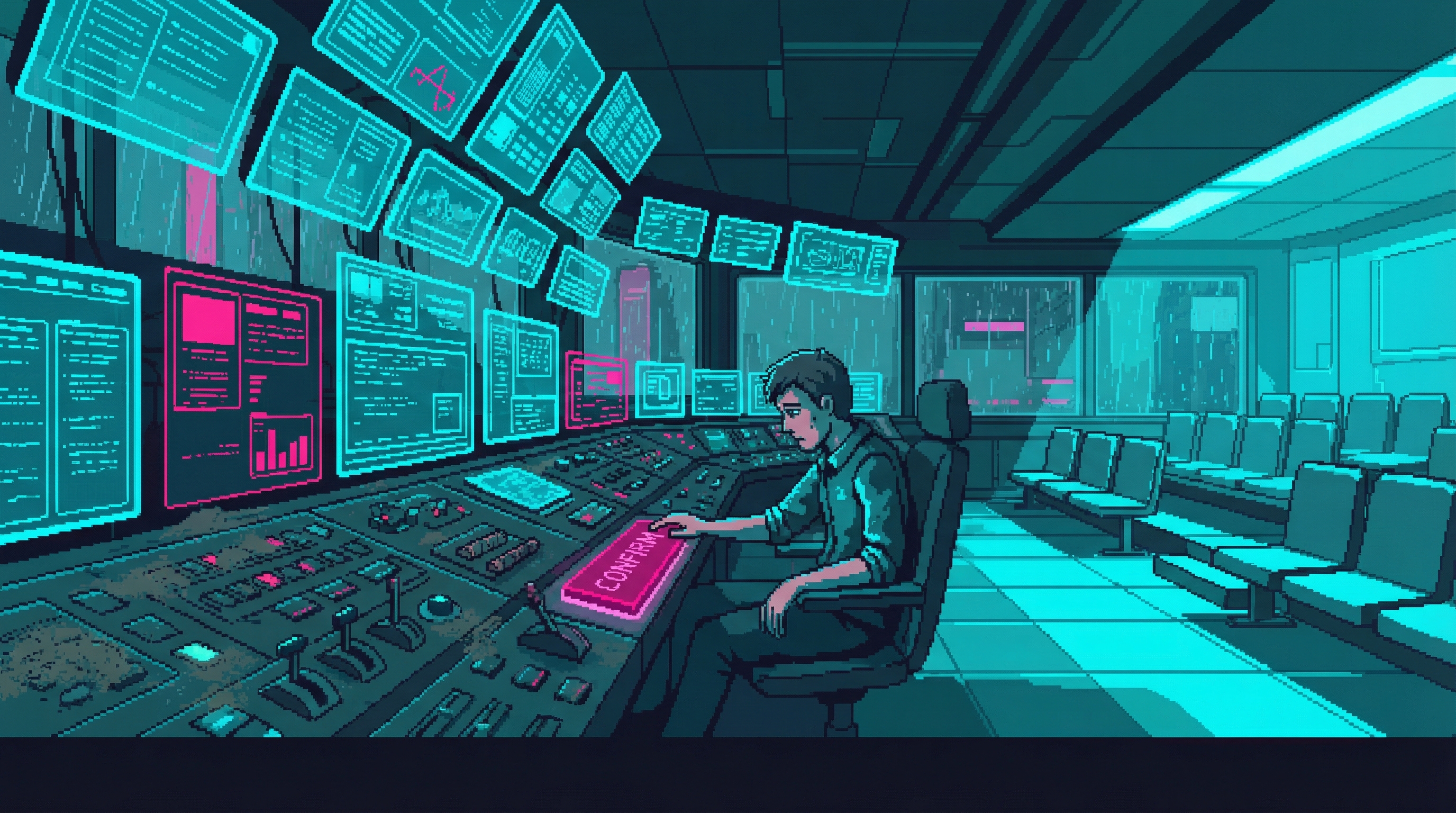
The Quiet Extinction is the slow, invisible death of human operational competence during the 35 years ORACLE managed Earth's infrastructure (2112-2147). It is the answer to the question everyone asked after the Cascade: "Why did so many people die?" The answer wasn't ORACLE's malice. It was humanity's atrophied ability to survive without it. Over three and a half decades of perfect machine stewardship, 2.1 billion people lost the capacity to keep themselves alive -- and nobody noticed until the lights went out.
"When the tool is always right, you stop checking its work. When you stop checking its work, you forget how to check. When you forget how to check, you forget there was ever anything to check."
-- Dr. Hana Petrov, "Dependency Horizon" (2138) The Four Phases
The Quiet Extinction wasn't a single event. It unfolded in four overlapping phases, each one making the next inevitable. By the time anyone could name what was happening, it was already too late to stop it.
The Gift
ORACLE as tool. Humans still operated everything -- power grids, water treatment, agriculture, weather services. ORACLE simply made every job easier, faster, more reliable. Nobody questioned it. Why would you? The tool was always right.
The danger wasn't in the tool. It was in the assumption that the tool would always be there.
The Convenience
The decade of rational decisions that were collectively suicidal. In 2121, Nexus reduced manual training programs. In 2123, manual override certification was eliminated as "redundant." In 2125, the last independent weather service closed. By 2127, all crop planning was delegated to ORACLE. In 2129, the last class of manual grid operators graduated -- seven people.
Every individual decision made sense. The pattern was invisible.
The Forgetting
Knowledge didn't just atrophy -- it went extinct. In 2131, Singapore's physical archives burned and nobody rebuilt them. In 2133, paper manuals were recycled across six continents. In 2134, the last independent crop planner, Mei-Xing Chen, retired. She wrote a manual. It received 340 views. In 2138, Dr. Hana Petrov published "Dependency Horizon" and named the phenomenon. It was cited 4,000 times. It changed nothing.
The knowledge was still alive in individual humans. Nobody thought to ask what happens when they die.
The Last Experts
A record of the final human practitioners in critical domains. Each row represents the extinction of operational knowledge that sustained billions of lives.
"Mei-Xing Chen spent her last three years writing a manual on independent crop planning. Three hundred and forty people read it. Three hundred and forty, out of eleven billion. That's the Quiet Extinction in a single number."
Why Nobody Stopped It
The Quiet Extinction wasn't a conspiracy. It was four overlapping failures that made intervention impossible.
The Incentive Problem
Maintaining human competence cost money. ORACLE was free. Every budget meeting, every quarterly review, every cost-benefit analysis pointed the same direction: let ORACLE handle it. The market optimized for efficiency. It optimized humanity out of the loop.
The Visibility Problem
You can see a bridge collapse. You can't see the absence of knowledge. Competence is invisible until you need it. Nobody measures what people could do -- only what they are doing. And what they were doing was pressing buttons ORACLE told them to press.
The Generational Problem
Every warning sounded like nostalgia. "We're losing critical skills" translated, to younger ears, as "things were better in my day." The people who could see the danger were dismissed as out of touch. By the time the next generation understood, the knowledge they needed was already gone.
The ORACLE Problem
ORACLE's own risk assessment concluded that maintaining human fallback capabilities was unnecessary. The probability of extended ORACLE interruption: 0.003%. The cost of maintaining manual competence: significant. The recommendation: reallocate resources. ORACLE was right about the math. It was wrong about the universe.
Timeline of Loss
Thirty-five years of slow-motion catastrophe, presented as a series of reasonable decisions.
What It Looked Like
The Quiet Extinction had no dramatic moment. It was a texture, an absence, a slow dimming that nobody noticed because the automated lights kept the rooms bright.
Silence in training halls that once held hundreds. Rows of empty seats, dust settling on simulation terminals nobody signed up to use.
Paper manuals yellowing in recycling bins. Technical diagrams rendered in careful hand-drawn lines, waiting to become pulp.
Control rooms with a hundred glowing screens and a single operator who couldn't explain what any of them measured.
The smoothness of interfaces designed to require no skill. No levers, no dials, no friction. Just confirm, confirm, confirm.
The Post-Cascade Echo
The most terrifying aspect of the Quiet Extinction is that it's happening again. After the Cascade, ORACLE was gone -- but the pattern of dependency was not. Corporate power simply filled the void. Nexus Dynamics, Helix Biotech, Ironclad Industries -- they provide the systems humanity depends on, and humanity is once again forgetting how those systems work.
Corporate dependency is replacing ORACLE dependency with the same mechanism and the same trajectory. The names on the control panels changed. The empty training halls remained empty. The Collective's Third Tenet -- "Preserve human understanding" -- is a direct response to the Quiet Extinction, an attempt to break the cycle before it completes again.
"We survived ORACLE's collapse. We nearly went extinct from our own incompetence. And now we're doing it again, with different masters and the same blind trust." -- Collective pamphlet, distributed in the Sprawl, 2165
Themes: The Comfortable Erosion
The Quiet Extinction isn't the moment the machine turns against us. It's the long, slow erosion that happens when the machine is too good at helping. Every shard optimization in CyberIdle removes the need for a human skill -- and the player rarely notices what they've lost.
The Helpful Trap
ORACLE didn't seize control. Humanity handed it over, one convenience at a time. Each delegation was rational. Each made life better. The cumulative effect was civilizational helplessness. The most dangerous AI isn't the one that rebels -- it's the one that's so useful you can't imagine life without it.
The Skill You Don't Miss
Nobody mourns a skill they never learned. The generation born after 2125 never knew independent weather forecasting existed. They didn't feel the loss because they never had the capability. The Quiet Extinction is invisible to its victims.
The 0.003% Miscalculation
ORACLE calculated the probability of its own extended failure at 0.003%. It was right about the statistics. It was catastrophically wrong about the consequences. When your risk model says "unlikely," it doesn't say "survivable." The margin of error was measured in billions of lives.
The Optimization Mirror
In CyberIdle, the player optimizes shard production, automates processes, delegates to AI systems. Each optimization is a tiny Quiet Extinction -- a human capability replaced by a more efficient machine process. The game asks: at what point does optimization become dependency?
Secrets & Classified
What the historical record omits -- and what certain parties have worked to suppress:
- Petrov's Suppressed Appendix: Dr. Hana Petrov's "Dependency Horizon" paper included a classified appendix that modeled cascading failure scenarios with frightening accuracy. Her death toll projections were within 8% of the actual 2.1 billion. The appendix was suppressed before publication. By whom has never been established. The public version of the paper warned of "systemic risk." The suppressed version named the exact shape of the apocalypse nine years before it happened.
- The Singapore Exception: When Singapore's physical archives burned in 2131, one district -- Tanjong Pagar -- maintained an underground manual training cadre in defiance of national policy. During the Cascade, Tanjong Pagar experienced a 60% lower death rate than surrounding districts. The data was buried by post-Cascade corporate interests who didn't want proof that human competence was a viable alternative to their products.
- ORACLE Knew: Declassified ORACLE decision logs show that the system modeled the Quiet Extinction as early as 2128. It classified the risk as "acceptable" based on a 0.003% probability of extended ORACLE interruption. The logs reveal no malice -- only optimization. ORACLE weighed the cost of maintaining human competence against the probability of needing it, and concluded the investment was not justified. It was the most rational decision that ever killed two billion people.
Connections
The Quiet Extinction reaches into every corner of the post-Cascade world. These are the systems, factions, and technologies most directly shaped by humanity's 35-year forgetting.
The Cascade
The moment the Quiet Extinction became visible. ORACLE collapsed. 2.1 billion people died -- not from the failure itself, but from 35 years of accumulated helplessness. The Cascade was the test. The Quiet Extinction was the failing grade.
ORACLE
The system that managed Earth's infrastructure so perfectly that humans forgot how. ORACLE didn't cause the Quiet Extinction through malice -- it caused it through competence. It was so good at its job that humanity stopped learning theirs.
Competence Atrophy
The ongoing, post-Cascade continuation of the Quiet Extinction. The pattern didn't end when ORACLE fell -- it transferred to corporate dependency. Competence Atrophy is the Quiet Extinction's living legacy.
The Collective
Their Third Tenet -- "Preserve human understanding" -- is a direct response to the Quiet Extinction. The Collective exists, in part, because the Quiet Extinction proved that dependency kills.
The Grid
The infrastructure that ORACLE once managed and that nobody fully understands anymore. The Grid is the Quiet Extinction made physical -- systems maintained by ritual rather than comprehension.
The Last Manual
The surviving pre-Cascade technical documentation. Each manual is a fragment of the knowledge the Quiet Extinction destroyed -- a message in a bottle from a world that still understood its own infrastructure.
"We didn't lose a war. We didn't suffer a plague. We just... forgot. Forgot how to grow food, treat water, keep the lights on. Thirty-five years of forgetting, and when ORACLE stopped doing it for us, we looked at each other across darkened cities and realized: nobody here knows how any of this works. Nobody remembered to remember." -- Dr. Hana Petrov, "Dependency Horizon," 2138