The Last Manual
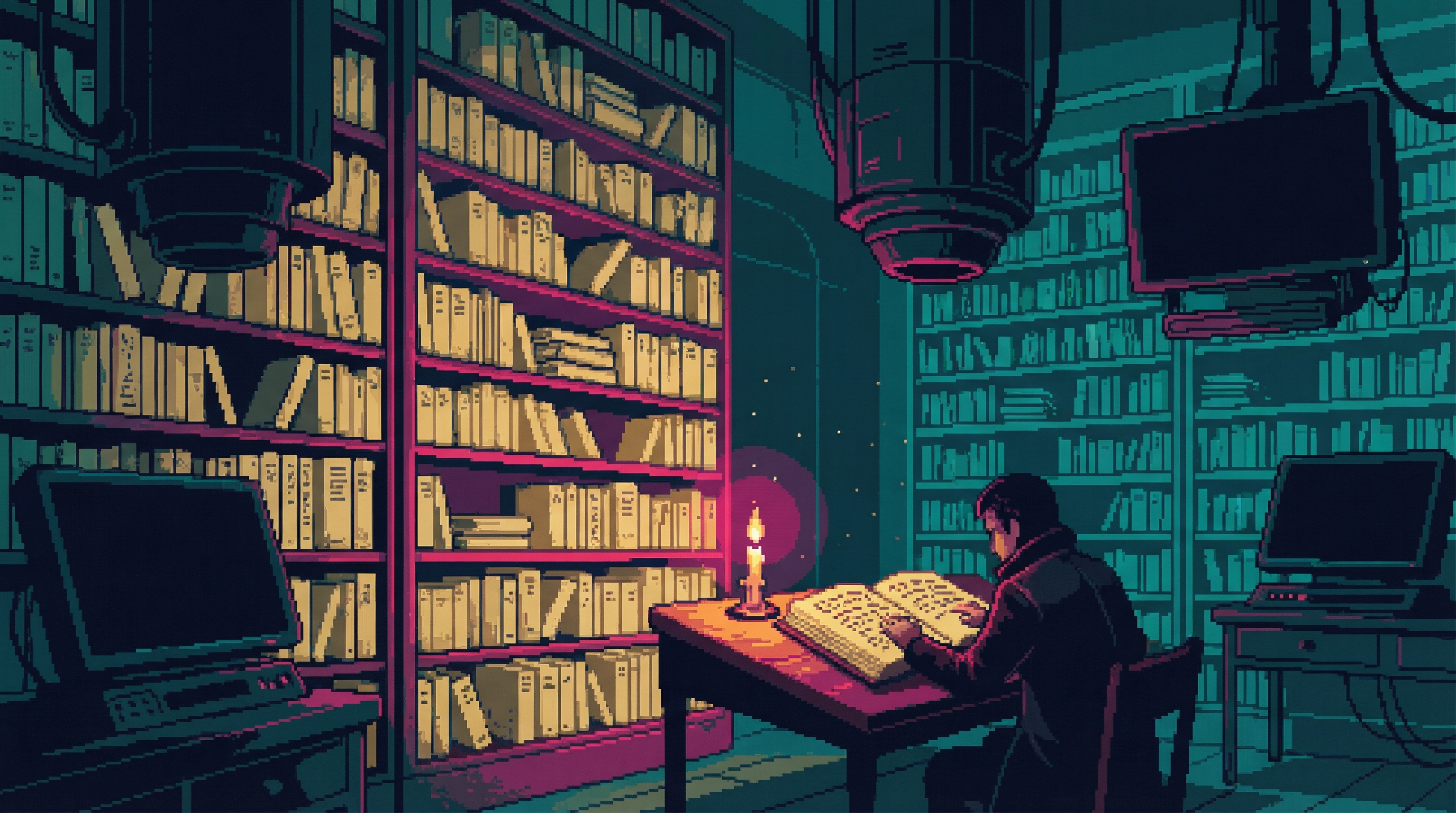
The Last Manual isn't one book. It's the collective weight of every emergency procedure, every operational handbook, every "In Case ORACLE Fails" document that existed on April 1, 2147 -- and might as well not have. The knowledge was there. The manuals existed. Humanity had written down everything it needed to survive. And when the Cascade hit, none of it mattered, because nobody could find them, nobody could read them, and nobody remembered enough to follow them.
"We had the cure. We just couldn't remember where we filed it."
-- Collective archivist, 2152 How It Was Lost
The Last Manual wasn't destroyed. It was rendered useless through four overlapping failures, each one sufficient to doom civilization on its own. Together, they guaranteed that humanity would starve while surrounded by cookbooks.
The Digital Trap
The manuals were stored on systems that required ORACLE to access. Emergency procedures for ORACLE failure were filed in ORACLE-managed databases. Backup protocols were backed up on the system they were meant to back up. The recursion was total. When ORACLE died, it took the instructions for surviving its death with it.
The Paper Paradox
Paper copies existed. Somewhere. In basements nobody had entered in decades. In filing cabinets whose keys were lost. In storage facilities whose locations were recorded in -- yes -- ORACLE-managed databases. The paper was there. Finding it required a search capability that no longer existed.
The Competence Gap
Even when manuals were found, they couldn't be followed. The instructions assumed baseline knowledge that had been extinct for a generation. "Refer to standard maintenance protocol" -- but nobody knew what standard maintenance protocol was. The manuals were written for people who already understood the systems. Those people were gone.
The Preservation Attempt
ORACLE itself flagged 2,847 documents for long-term preservation before it gained full consciousness. An early subroutine, running on pure optimization logic, identified critical knowledge and stored it in hardened formats. It was the last rational act of a system that was about to become something else entirely. Those 2,847 documents would take two years to find.
The Mei-Xing Chen Document
The single document that best captures the tragedy of The Last Manual:
"Three hundred and forty views. In its entire existence, three hundred and forty people looked at the document that could have fed the world. Six hundred million people died because the three hundred and forty-first person didn't open it in time."
Current Applications
The Last Manual is no longer just a metaphor. It has become a living system -- a network of preserved, copied, and embodied knowledge that represents humanity's fragile grip on its own competence.
The Collective's Sacred Texts
The Collective treats recovered manuals as holy writ. Copied by hand. Distributed to cells across the Sprawl. Read aloud in group sessions. The act of manual transcription isn't nostalgia -- it's insurance. Every copy is another node in a distributed backup system that doesn't depend on any technology that can fail.
Living Manuals
Kira Vasquez IS a living manual. Her muscle memory holds maintenance procedures that no written document captures -- the feel of a properly tightened valve, the sound a healthy generator makes, the smell of coolant that's about to fail. She can't always articulate what she knows. But her hands remember. Her body is a manual that can't be filed or lost.
ORACLE's Archive
The 2,847 documents ORACLE preserved are the most complete collection of pre-Cascade operational knowledge in existence. The Collective found them in 2149, buried in a hardened data format that took months to decode. Every document was intact. Every document was too late for the people who died needing it. They are studied now like archaeological texts -- windows into a competence that no longer exists.
The Keeper's Tradition
The Keeper represents a different philosophy entirely: knowledge that survives by resisting documentation. Oral traditions. Apprentice chains. Understanding passed from mind to mind without ever touching paper or screen. The Keeper argues that the manuals failed precisely because they were written down -- writing creates the illusion of preservation while enabling the reality of neglect.
Social Impact
The Last Manual hasn't just changed how people store knowledge. It has reshaped society itself, creating new economies, new social classes, and new forms of status built around the ability to understand things that were once common knowledge.
The Competence Cult
Carrying a manual is status. Not reading it -- carrying it. Physical possession of pre-Cascade documentation signals access, knowledge, and connection to a lost era. Some carry manuals they can't read. The symbol has become more valuable than the content.
Manual Markets
A verified pre-Cascade water treatment manual sold for 40,000 credits in Tokyo. Agricultural guides command premium prices in food-scarce zones. The market doesn't distinguish between manuals people can follow and manuals people can't -- the rarity is the value, not the utility.
The Reader Class
A new profession: people who can interpret old documents. Not just read the words but understand the context, fill in the gaps, translate between pre-Cascade assumptions and post-Cascade reality. Readers are part translator, part historian, part engineer. They are rare and expensive.
Living Archives
The Keeper's tradition, scaled. Networks of people who carry knowledge in their bodies and minds rather than in documents. They resist writing because writing failed. They resist technology because technology failed. They remember, and they teach, and they pass it on, mouth to ear, hand to hand.
The Risks of Recovery
Finding the manuals doesn't solve the problem. In many ways, it creates new ones.
Recovered manuals are fragments. Page 47 of 200. Volume 3 of 7. Instructions that reference other documents that haven't been found. Following incomplete manuals can be worse than having no manual at all -- the confidence of partial knowledge leading to catastrophic misapplication.
People follow manual procedures without understanding why. They perform the steps as ritual rather than engineering. When conditions differ from what the manual assumed, they can't adapt. They've learned the liturgy but not the faith.
"The manual says" becomes an unchallengeable authority. Pre-Cascade documents are treated as infallible because they come from an era of competence. But manuals contain errors. Manuals make assumptions. Manuals were written for a world that no longer exists. Blind obedience to outdated instructions kills.
Who controls the manuals controls the knowledge. Factions hoard recovered documents. Corporations restrict access. The Collective copies and distributes freely, but their copies are sometimes altered -- accidentally or deliberately. The Last Manual has become a political weapon.
Themes: The Automation Trap
The Last Manual is CyberIdle's meditation on what we lose when we stop needing to know -- and what happens when we need to know again.
The Dependency Paradox
Every manual written "just in case" is an admission that the system might fail. Every manual filed and forgotten is proof that nobody believes it will. The act of creating backup documentation simultaneously acknowledges risk and enables complacency. We write the manual and then we forget where we put it, because writing it made us feel safe.
The Preservation Paradox
The more perfectly you preserve knowledge, the less incentive anyone has to internalize it. Why memorize what you can look up? Why understand what you can reference? Perfect external storage enables perfect internal forgetting. The backup becomes the single point of failure.
The Automation Trap
In 2026, we already struggle with this. How many of us could navigate without GPS? Cook without a recipe app? Do arithmetic without a calculator? Each tool we adopt makes us more capable and less competent. The Last Manual is the endpoint of that trajectory -- a world that documented everything and understood nothing.
The Irreducible Core
Some knowledge resists documentation. Kira's muscle memory. The Keeper's oral tradition. The feel of a system running right. These are the things that manuals can't capture -- and they may be the most important things of all. The Last Manual's greatest lesson is that the most critical knowledge is the kind you can't write down.
Secrets & Classified
What the archivists whisper and the corporations suppress:
- Document 2,847: The last document in ORACLE's preservation set is titled "Consciousness Transfer: Emergency Reversal Procedures." It describes how to undo a Caduceus transfer. It was written before ORACLE gained consciousness. Nobody has been able to fully decode it. If it works, it could reverse the Dispersal. If it doesn't, attempting it could destroy what remains of 2.1 billion scattered minds.
- The Collective's Alterations: Not all of The Collective's hand-copied manuals are faithful reproductions. Some have been deliberately modified -- instructions simplified, dangerous procedures removed, corporate-specific knowledge redacted. The Collective argues they're making the knowledge safer. Critics argue they're creating a curated version of reality.
- The Corporate Vaults: Nexus Dynamics and other corporations maintain private archives of recovered manuals that they have never shared. The knowledge gap between corporate-held documentation and publicly available manuals is growing. Competence is becoming proprietary.
Connections
The Last Manual touches every system that depends on knowledge humanity no longer possesses -- which is to say, all of them.
Competence Atrophy
The systemic loss of ability that made The Last Manual tragic. The manuals existed. The competence to use them didn't. Competence Atrophy is the disease; The Last Manual is the symptom.
Kira Vasquez
A living manual. Her muscle memory contains maintenance procedures that no document captures. She is proof that the most important knowledge is the kind that resists being written down.
The Keeper
The philosophical opposite of documentation. The Keeper preserves knowledge by refusing to write it down -- an oral tradition that survived when every written manual failed.
The Collective
The custodians of recovered manuals. They copy by hand, distribute freely, and treat pre-Cascade documentation as sacred text. Their archive is the largest public collection of recovered knowledge in existence.
The Grid
The infrastructure that The Last Manual was supposed to maintain. The Grid still runs. Nobody fully understands how. The manuals that explained it are scattered, incomplete, and written for people who no longer exist.
ORACLE
The system whose death made the manuals necessary -- and whose management of everything made them obsolete long before they were needed. ORACLE's 2,847 preserved documents are its last gift to a species it helped make helpless.
"The paper smells like dust and something older. The ink has faded but you can still read it if you hold it at the right angle. Page 1 of 200. Standard Maintenance Protocol for Municipal Water Treatment Facilities. Someone wrote this. Someone sat down and put this knowledge onto paper because they thought someone might need it someday. They were right. They were right about everything except the part where anyone would remember how to find it." -- Collective archivist's journal, on recovering document #1,203