The Elevator Compact: The Bottleneck Is the Product
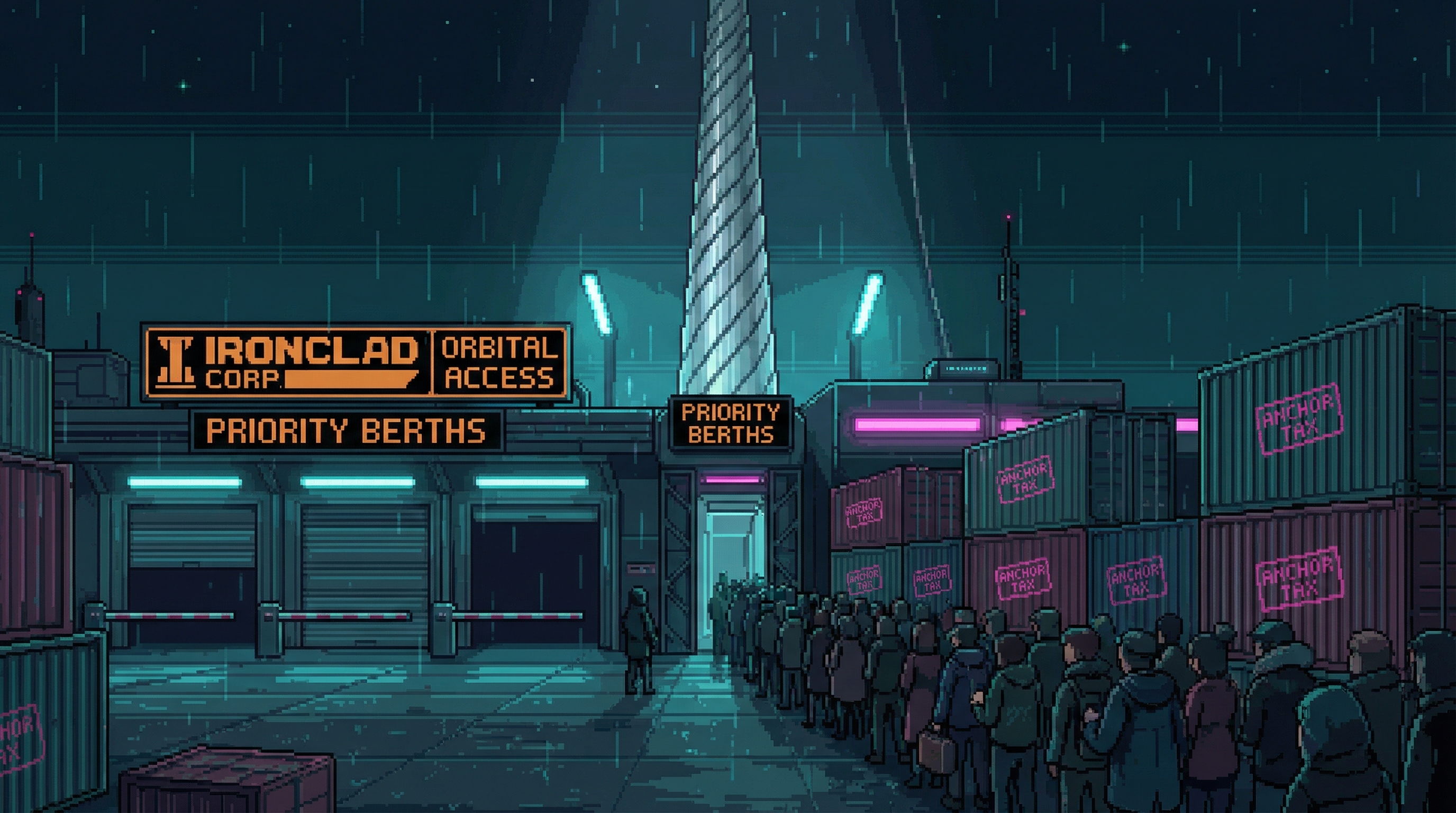
The Orbital Elevator operates under a regulatory framework that Ironclad Industries drafted in 2170, the year the Elevator was completed. The Elevator Compact is not a treaty — treaties require sovereign signatories, and the post-Cascade Sprawl has no sovereign entities in the traditional sense. The Compact is a set of operational protocols that Ironclad imposed and every other corporation accepted because the alternative was no access to orbit.
"Ironclad owns the Tether. Ironclad controls the traffic. Ironclad sets the rates. Everything else is negotiable."
— Preamble to the Elevator Compact, 2170 Technical Brief
The Compact creates a tiered access system that mirrors the Sprawl's consciousness licensing with brutal precision. Corporate cargo receives priority scheduling and reduced rates. Independent operators receive whatever scheduling remains, at rates that have increased 340% since 2170. Personal passage mirrors the class system: executives in private compartments with acceleration compensation; mid-level managers in shared compartments; Dregs residents — in the rare circumstance they can afford passage — ride in converted cargo compartments.
The Anchor Tax
A 4% surcharge on all cargo transiting the Elevator, payable to Ironclad regardless of destination. The tax generates approximately ¢47 billion annually. Critics call it extortion. Ironclad calls it infrastructure maintenance. Both are correct.
The Manufactured Emergencies
The Compact has been renegotiated twice. Both times, the negotiations occurred during Ironclad-manufactured "maintenance emergencies" that shut down Elevator traffic for weeks, costing the Sprawl's economy billions in delayed shipments. Both times, the renegotiated terms were more favorable to Ironclad.
Implications
The Tether can handle the load. The climbers exist. The demand is there. There is no physical reason the Elevator couldn't run at three times its current capacity. Ironclad maintains the capacity constraint because the constraint is the product. Without the bottleneck, there is nothing to charge for.
Scarcity as Infrastructure
On the surface, identical hardware is differentiated by licensing key. In orbit, identical capacity is differentiated by access pricing. The mechanism is the same — artificial constraints on available capacity, maintained not through software locks but through monopoly control of irreplaceable physical infrastructure. The Elevator is the Scarcity Doctrine scaled to orbital infrastructure.
The Queue as Class System
The Compact doesn't just control access to orbit — it creates the entry barrier for orbital class stratification. Who ascends, how fast, and at what cost is determined not by need or merit but by corporate affiliation and ability to pay. The queue at the Camps stretches for kilometers: many waiting, few ascending. Empty priority berths sit unused beside the crowded general queue. The visual is the system's honest self-portrait.
Escape Routes
The Drift-Runners Guild circumvents the Compact through direct deep-space trading, bypassing the Elevator entirely. The Void Market exists because the Compact's pricing is prohibitive for small operators. Both are symptoms of the same disease: when the legitimate system prices out half its users, the illegitimate system thrives.
Nexus accepts the Compact because the alternative is no orbital access. The question nobody asks: why is there only one elevator?
Related Systems
Ironclad Industries
Drafted and enforces the Compact. The Tether is theirs. The rates are theirs. The maintenance emergencies are theirs.
Consciousness Licensing
Same mechanism, different medium. Software locks on the mind; access pricing on the sky. Both sell artificial scarcity as a service.
The Void Market
Exists because the Compact's pricing is prohibitive. Every black market is a customer complaint written in criminal code.
The Drift-Runners Guild
Circumvents the Compact through direct deep-space trading. The Guild is what happens when the toll road has no exits.
The Corporate Compact
Surface employment-as-citizenship parallels orbital access-as-pricing. Same architecture of dependency, different altitude.
Good Fortune
Forty pages of insurance documentation per container. Good Fortune profits from the Compact's complexity — the paperwork is the product too.
▲ Classified
The Capacity Report
Ironclad's internal infrastructure analysis confirms what independent engineers have long suspected: the Tether's rated capacity is three times the current operational throughput. The climbers exist. The power grid supports it. The scheduling software can handle it. Ironclad maintains the constraint because removing it would collapse the pricing model that generates ¢47 billion annually from the Anchor Tax alone.
A copy of the Capacity Report was offered to The Silence by an anonymous Ironclad engineer. The Silence has not yet acted on the information. The question isn't whether the report is real — it's why Ironclad hasn't killed the engineer.
The Third Renegotiation
Ironclad's maintenance division has identified a "structural concern" in Tether Segment 7 that will require a "temporary traffic suspension" within the next eighteen months. The concern is real — routine micro-fracture repair that could be completed during normal operations. The suspension is not. Internal memoranda reference "renegotiation leverage" explicitly.
When the third renegotiation comes, the new terms will include expanded Ironclad authority over orbital docking rights — currently managed by a joint committee. The queue will get longer. The empty berths will stay empty.
"The Compact isn't a document. It's felt in the queue lengths at the Camps, in the silence of empty climber berths reserved for corporate priority, in the weight of forty pages of Good Fortune insurance per container. You don't read the Compact. You stand in it." — Independent hauler, Anchor Point processing hall, overheard