The Drift-Runners Guild
One Light in Darkness
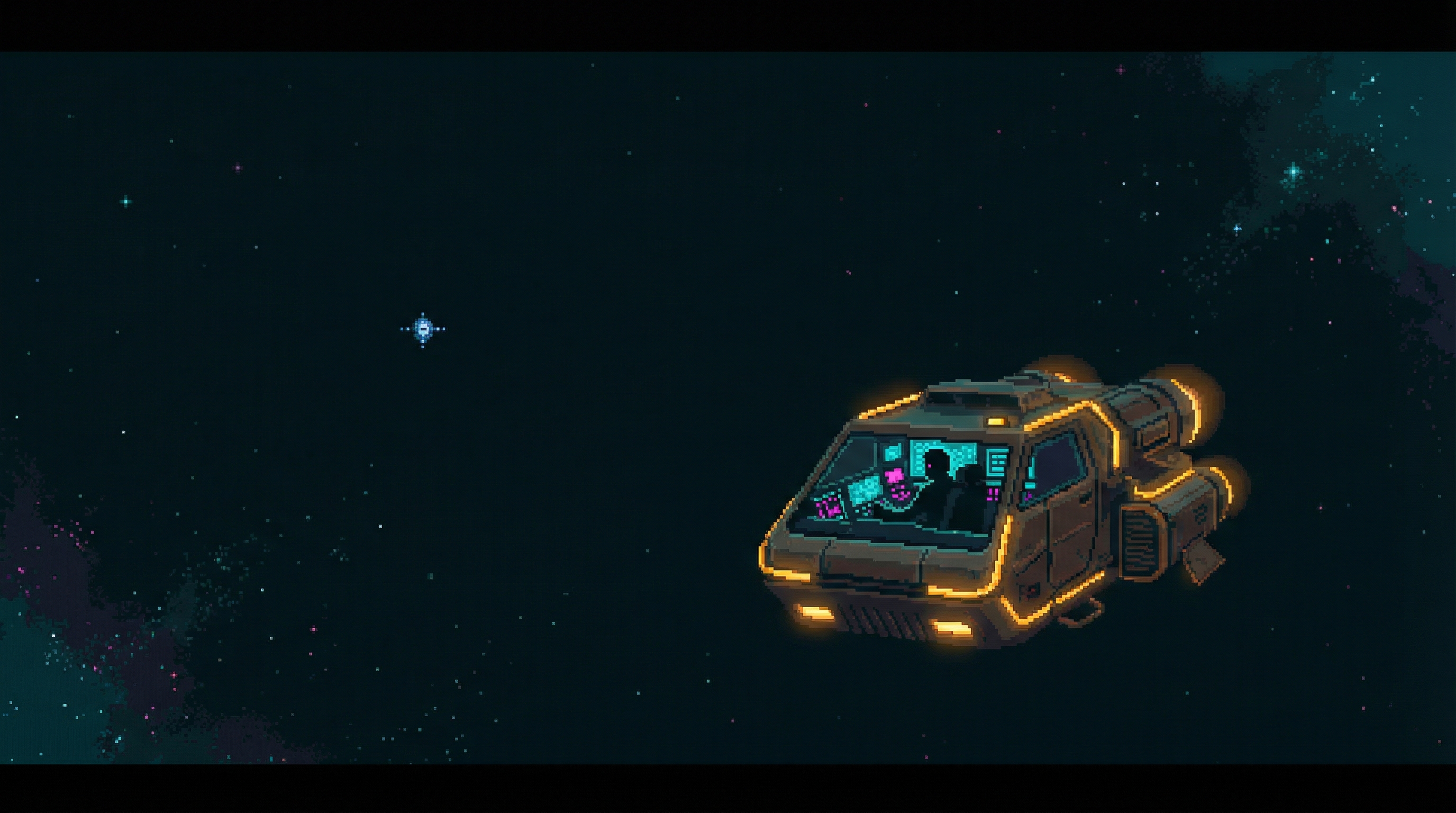
Between Highport Station and the scattered installations of the Lattice solar collection network, there is nothing. Not empty space — nothing. The void between orbital installations is the most profoundly featureless environment any human being has ever occupied, and the people who cross it for a living have formed a professional culture as distinctive as any on the surface.
The Drift-Runners Guild accounts for approximately 800 independent haulers who transport supplies, equipment, personnel, and the occasional cargo that doesn't appear on any manifest between orbital installations. They operate small, single-occupant or dual-crew vessels on routes measured in light-minutes and transit times measured in hours or days of absolute solitude.
A typical drift-run includes hours where the only proof you exist is a blip on someone else's screen.
Doctrine
The Guild has no ideology beyond mutual survival. Ask a drift-runner what the Guild believes in and they'll tell you to check your oxygen levels.
Route Coordination
Prevents delivery conflicts. Two haulers arriving at the same installation with the same cargo is a financial death sentence for both.
Rate Standardization
Prevents corporations from playing haulers against each other. Before the Guild, rate-cutting drove runners into fuel debt. Some didn't come back.
Safety Certification
Minimum life support standards. A vessel that can't maintain atmosphere for 150% of its longest route doesn't fly.
Rescue Insurance
The informal welfare system that ensures a runner whose ship fails mid-transit will be rescued before their air runs out. This is the real reason anyone joins.
What the Void Does to People
Field observations on extended deep-space transit psychology.
The Silence
A drift-run between New Prosperity and the Assembly Yards takes fourteen hours at standard burn. Fourteen hours in a cockpit smaller than most surface bathrooms, with nothing outside the viewport but the black. No radio chatter for the middle eight hours — too far from either endpoint for casual signals. Just the hum of the life support and the slow pulse of the nav instruments.
Runners who can't handle the silence wash out in their first year. The ones who stay describe it differently: some call it meditation, some call it torture, some call it the only honest place left in human civilization. A few stop calling it anything at all.
The Waystation Ping
Midway through a long run, automated waystations broadcast a locator ping — a brief pulse confirming your position is known. Drift-runners call it "the handshake." It means someone, somewhere, knows you're still alive. The ping carries no data, conveys no information beyond simple acknowledgment.
Veterans say you can tell a new runner from an old one by how they react to the ping. New runners feel relief. Old runners feel something closer to gratitude.
Void Tone
In 2170, a drift-runner named Sahar Koss was repairing a solar collector when they heard something that shouldn't have been audible in vacuum. Resonant frequencies vibrating through hull contact — the structure itself singing. Koss recorded it, shared it with other runners, and discovered that different installations produce different tones depending on their mass, composition, and orbital stress.
The discovery transformed drift-running from purely mercenary work to something that, for those who listen, approaches the spiritual. Void tone compositions are now traded between runners like folk songs. Some runners claim they can identify an installation by its tone alone, the way a surface musician might recognize a tuning fork.
The Guild named Koss their patron saint — though they'd never use that word to anyone outside the Guild. It was Koss who proved the void wasn't empty. It was singing the whole time.
Notable Members
Tomás Wren
Veteran Runner — 11 yearsOperates the New Prosperity-Assembly Yards corridor, one of the longest standard routes in the Guild's network. Eleven years on the same run. He knows every waystation ping by timing, every drift pattern in the corridor's micro-debris field.
Sahar Koss
Patron — Void Tone DiscovererThe runner who first recorded void tone frequencies while repairing a Lattice solar collector in 2170. Current status unknown — Koss stopped taking standard routes around 2180. Some say they went deeper. Some say they found something worth staying for.
The Annual Moot
Once a year, the Guild convenes at a different orbital installation. The location rotates — partly for neutrality, partly because no single station wants 800 independent haulers docked simultaneously for longer than necessary. The Moot is where route assignments shift, rate disputes settle, rescue protocols update, and the year's dead are named.
The naming of the dead is the only formal ceremony the Guild observes. Each lost runner's final route is recited — departure point, destination, last confirmed waystation ping. No eulogies. Just the facts of the run that didn't end.
There is no headquarters because the Guild exists in transit. You can't put roots in the void.
▲ Restricted
Unverified intelligence. Source reliability varies.
The Off-Manifest Economy
Guild vessels carry cargo that doesn't appear on installation docking records. This is an open secret. What's less understood is the scale: some analysts estimate that 15-20% of inter-orbital trade bypasses the Elevator Compact's pricing structure entirely, moving through drift-runner holds at rates negotiated in person, in void, where no signal intercept is possible.
If accurate, the drift-runners aren't just a transport guild. They're the backbone of a parallel economy that the Compact cannot regulate because it physically cannot surveil.
The Deep Routes
Standard Guild routes connect known installations. But veteran runners speak of "deep routes" — transits to coordinates that don't appear on any public chart. Destinations that were never built, or were built and then forgotten, or were built by someone other than any known orbital authority.
Sahar Koss reportedly left standard routes to run exclusively deep. This is the last verifiable detail of Koss's career.
The Void Market Connection
The Void Market exists because drift-runners provide transport outside Ironclad's pricing controls. Without Guild vessels, the Market has no supply chain. Without the Market, drift-runners lose their most profitable independent contracts. The symbiosis is total.
If the Elevator Compact ever moves against the Void Market, they'll have to move against the Guild first. 800 independent operators with deep-space capable vessels and nothing to lose is not a problem that solves cleanly.
Points of Inquiry
Where did Sahar Koss go? The deep routes lead somewhere. Koss found it. Koss didn't come back to tell anyone what it was.
What happens to drift-runners who spend too long in the void? The Guild tracks "void-touched" members — runners whose behavior shifts after extended deep transits. The condition isn't medical. It's something else.
The Guild operates between AI-managed installations but belongs to no AI system. They exist in the gaps. What do they see in those gaps that the managed systems don't?
800 haulers. No central command. No corporate sponsor. No enforcement mechanism beyond mutual aid. How does that survive in a world that optimizes everything?
Diplomatic Posture
The Void Market
SymbioticPrimary transport providers. Without the Guild, the Market has no supply chain. Without the Market, the Guild loses its most profitable work.
The Elevator Compact
HostileGuild members circumvent the Compact's pricing monopoly through direct deep-space trading. The Compact considers them smugglers. The Guild considers the Compact a cartel.
The Assembly Yards
Supply PartnerDrift-runners keep the Yards fed with raw materials and rotating personnel. The Yards keep drift-runner vessels maintained. Practical dependency on both sides.
The Lamplighters
ParallelSame structure, different void. Both are informal networks of invisible laborers connecting infrastructure in the spaces between corporate territories. They've never formally met. They don't need to.