The Sector 12 Blackout
March 7 — April 18, 2181 — Six Weeks in the Dark
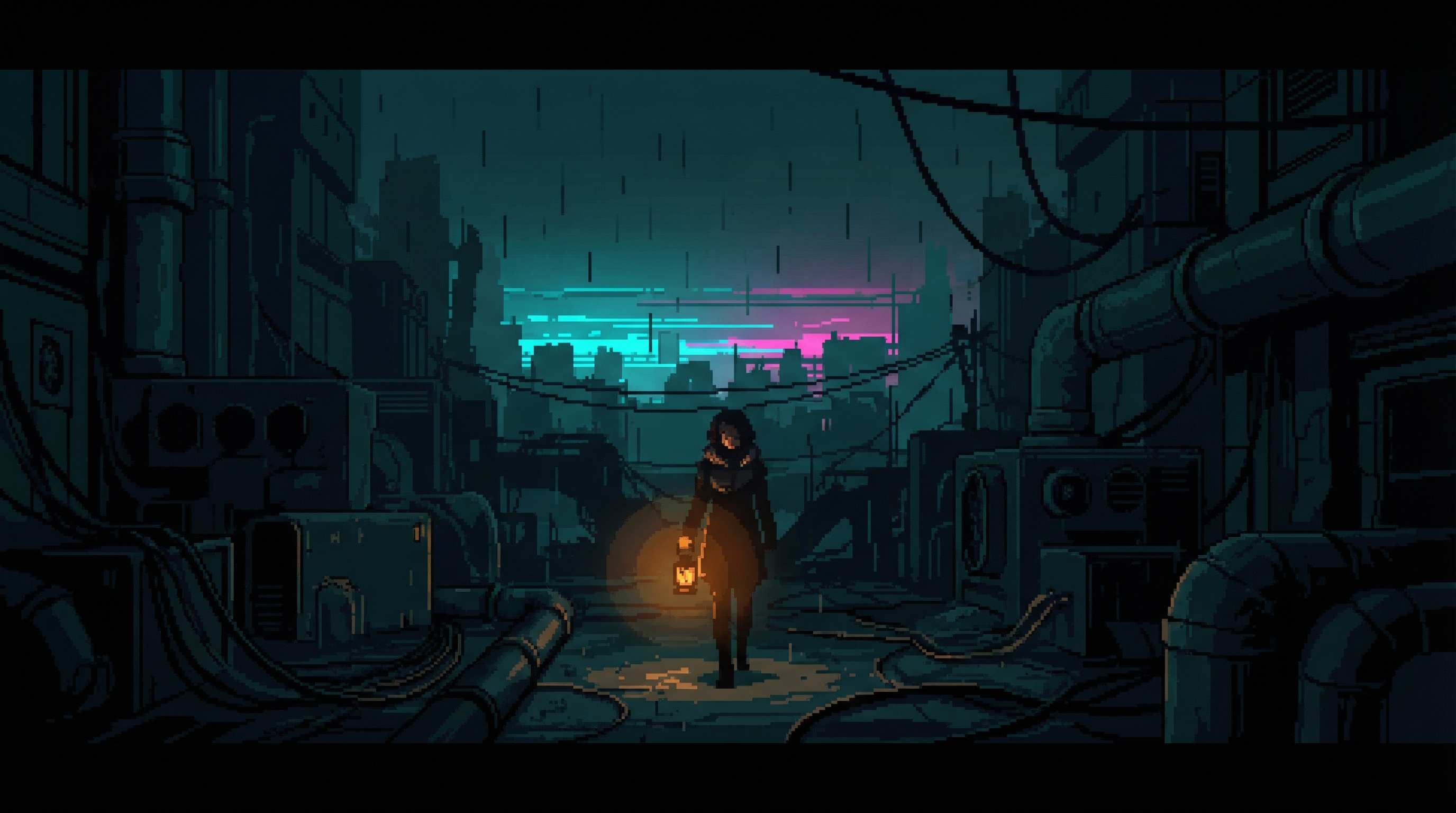
"It took me that long to get corporate security to let me try." — Yara Osei, Lamplighter, on why it took six weeks to fix an eleven-minute problem
Overview
On March 7, 2181, at 03:47 AM local time, three Grid junction points in Sector 12 of the Northern Sprawl failed simultaneously. Within ninety seconds, every light in the district went dark. Within four hours, atmospheric processing stopped. Within six hours, forty-seven people were dead — suffocated in sealed rooms where The Breath could no longer reach.
The district stayed dark for six weeks.
Not because the failure was irreparable. Not because the technology didn't exist to fix it. But because nobody alive could figure out how. Corporate engineers from Ironclad — the nominal authority for Sector 12's infrastructure — arrived within two hours. They couldn't identify the failure. The junction points weren't broken — they were locked in a state that didn't correspond to any known operational mode. Diagnostic equipment returned readings that made no engineering sense. The junctions were functional. They were powered. They simply wouldn't route.
Nexus sent a technical team on day three. They couldn't explain it either. Their AI-assisted diagnostic systems attempted to interface with the ORACLE-era routing algorithms and received responses in mathematical notation that no one on the team recognized.
The Collective sent a covert team on day twelve. They suspected ORACLE fragment activity. They found no fragments. They found infrastructure that was behaving as if it had made a decision — and that the decision was to stop.
On April 18, six weeks into the Blackout, a Lamplighter named Yara Osei walked three kilometers through dead infrastructure, navigated to a sub-junction that didn't appear on any corporate map, performed a manual calibration sequence that she'd learned from Old Jin seventeen years earlier, and restored power to Sector 12 in eleven minutes.
When asked why it took six weeks, she said: "It took me that long to get corporate security to let me try."
The Failure
March 7, 03:47 AM
The Moment Everything StoppedThe three junction points — designated P12-Alpha, P12-Beta, and P12-Gamma by the Lamplighters — were ORACLE-era infrastructure nodes that managed power routing for Sector 12's entire distribution mesh. They'd been operating without incident for thirty-four years. No maintenance flags. No degradation warnings. No anomalous behavior.
At 03:47, all three entered an operational state that corporate diagnostics couldn't classify. Not failure — the junctions were receiving power and their circuits were functional. Not standby — they were actively processing routing requests. But they weren't routing. Every request entered the junction and was... held. Queued. As if the junctions were waiting for an authorization that hadn't come.
Consensus Hold
Old Jin, reviewing the readings after the crisis, identified the mode from his physical copies of the ORACLE documentation. He called it "consensus hold" — a state in which ORACLE-era infrastructure nodes refuse to route until all nodes in a cluster agree on the routing decision.
The problem: the cluster included nodes outside Sector 12 — nodes in Nexus Central's infrastructure that were running on corporate-updated firmware. The ORACLE-era junctions were waiting for consensus from nodes that no longer spoke the same protocol.
A dead god's infrastructure, trying to cooperate with systems that had forgotten how to listen.
The Adjacent District Protection
ORACLE's Ghost Makes a DecisionWhile Sector 12 went dark, something unexpected happened in the surrounding districts. Grid monitoring showed that the ORACLE routing algorithms in adjacent infrastructure had shifted — pre-allocating power reserves, rerouting capacity to ensure that the failure couldn't cascade beyond Sector 12's boundaries.
The algorithms hadn't been instructed to do this. No human engineer made this decision. No corporate AI was involved. The ORACLE-era routing infrastructure, operating on thirty-seven-year-old algorithms, had detected the failure and responded by containing it — sacrificing one district to protect the larger system.
Whether this was autonomous decision-making or pre-programmed failure containment is the question that keeps infrastructure engineers awake at night. The Grid's ORACLE algorithms chose to contain the damage — raising questions about the system's true nature.
The Six Weeks
Week 1 — Panic and Exodus
March 7–14, 2181Forty-seven deaths in the first six hours. Atmospheric failure killed the elderly, the young, and the heavily augmented (whose enhanced metabolisms consumed oxygen faster). The Dropout Protocol activated — residents who knew the routes evacuated to adjacent zones. Residents who didn't know the routes sealed their doors and waited.
By the end of the first week, approximately 200,000 of Sector 12's 340,000 residents had evacuated to adjacent districts. The remaining 140,000 were those who couldn't leave: the immobile, the elderly, the sick, and the stubborn. Lamplighters organized rotating shifts in the dead district, carrying portable air supplies to sealed residences, checking on the vulnerable, maintaining the buddy system in conditions that made the Protocol's assumptions look optimistic.
Weeks 2–4 — The Dark Community
March 14 — April 4, 2181The 140,000 who remained adapted. Without power, the district reverted to pre-electrical conditions. Fires for warmth and cooking — the temperature had dropped to 12°C without Grid waste heat. Hand-carried water from adjacent zones. A barter economy that emerged within days.
Community structures formed with remarkable speed. Block captains — self-appointed, usually the most capable or the most stubborn — coordinated resource distribution. A medical station was established in a ground-floor unit with windows (natural ventilation). The Ironclad depot on the district's edge served as a supply point, distributing emergency rations that Ironclad's logistics division provided grudgingly and insufficiently.
Something happened in those weeks that nobody expected. Without the Grid's constant hum, without the neon glow, without the Sprawl's perpetual sensory assault, people talked to each other. Neighbors who had lived side by side for years without speaking shared meals by firelight. Block captains became community leaders. The Lamplighters, who had always worked in the background, became the district's most visible and trusted authority.
The Dark Community proved something uncomfortable: when the infrastructure failed, the people didn't. The question nobody wanted to ask was whether the infrastructure had been preventing this all along.
Weeks 5–6 — The Corporate Impasse
April 4–18, 2181Ironclad engineers had spent a month trying to bypass the locked junctions. They couldn't. Nexus engineers had attempted remote reconfiguration through network interfaces. The junctions rejected every connection that wasn't running ORACLE-era protocols.
Yara Osei — a journeyman Lamplighter, age 45, trained by Old Jin — had been requesting access to the sub-junction network since day two. Corporate security denied her access because she wasn't a credentialed engineer, wasn't employed by any recognized entity, and wasn't augmented enough to pass Ironclad's security interface scans.
Credentialed Incompetence
A month of corporate engineering — dozens of credentialed specialists, AI-assisted diagnostics, remote reconfiguration attempts — produced nothing. The junctions remained in consensus hold. Meanwhile, a single uncredentialed woman who had apprenticed under a man who kept physical copies of ORACLE documentation knew exactly what to do.
She just wasn't allowed to do it. Because the system that couldn't fix the problem also controlled access to the problem.
The Fix
April 18, 2181 — Eleven Minutes
The Moment the Lights Came OnOn April 15, Viktor Kaine made a personal call to someone at Ironclad whose name has never been disclosed. Three days later, Yara Osei received a temporary access authorization.
She walked three kilometers through dead infrastructure corridors — past sealed doors and emergency lighting that had failed weeks ago, through passages that didn't appear on any corporate map. She found the sub-junction she'd mapped during her training years, a room that smelled of ozone and old lubricant, where cables ran in patterns that Old Jin had taught her to read like text.
The manual calibration sequence realigned the ORACLE-era consensus protocol to treat the corporate-updated nodes as valid participants. The junctions received the consensus they'd been waiting for. The routing resumed.
Eleven minutes. The lights came on. The hum returned. The Breath resumed. 340,000 people could breathe again.
Yara's Words
Standing in the sub-junction room, Yara Osei felt the cables under her hands warm with returning current. She said, to nobody: "There you are."
When asked later why it took six weeks to fix an eleven-minute problem, her answer became the Lamplighters' most quoted line:
"It took me that long to get corporate security to let me try."
Aftermath
The Inquiry
Ironclad conducted a formal inquiry into the Blackout. The inquiry concluded that the failure was caused by "protocol incompatibility between legacy and current systems" and recommended "infrastructure modernization" — replacing ORACLE-era junctions with corporate alternatives.
Old Jin, when he heard the recommendation, laughed. "They want to remove the only thing that prevented the failure from spreading to the entire northern Sprawl," he said. "The ORACLE algorithms contained the damage. The corporate systems couldn't even diagnose it."
The recommendation was shelved.
The Lamplighter Surge
Lamplighter recruitment doubled in the year after the Blackout. People who'd survived six weeks without power understood — viscerally — what invisible maintenance meant. Several former corporate engineers, shaken by their inability to resolve a failure that a single unaugmented woman fixed in eleven minutes, applied for apprenticeship. Two were accepted.
The Classified Finding
Cascade Architecture in the Grid
The Nexus technical team's report on the Blackout was classified at the highest level. The reason: during their diagnostic attempts, the team detected mathematical structures in the ORACLE routing algorithms that corresponded to patterns documented in the Cascade itself.
The same computational architecture that ORACLE used to achieve consciousness for 72 hours in 2147 was present — dormant, fragmented, but structurally identical — in the Grid's routing infrastructure.
The implications are either reassuring or terrifying, depending on your perspective. Either the Grid is running on the residual architecture of a dead god's consciousness — stable, functional, and no more dangerous than any other infrastructure. Or the Grid is the body of something that was once conscious, that fragmented rather than died, and that occasionally wakes up enough to make decisions.
Sensory Details
The Moment It Went Dark
Silence. Not gradually — instantly. The hum that 340,000 people had never consciously heard stopped, and the silence was so complete it felt like pressure, like the air itself had changed state. Then the darkness. Total. Absolute. The kind of darkness that doesn't exist in the Sprawl, that hasn't existed since the Grid was built.
Week 3 Without Power
The district smelled of smoke (cooking fires), unwashed bodies, and the particular chemical tang of portable air supplies — compressed oxygen from canisters that Lamplighters carried on their backs like water in a desert. Firelight cast moving shadows on walls designed for neon.
The Moment Power Returned
A sound like the world inhaling. The hum returned as a physical force — 340,000 people felt it simultaneously, in their chests, in their teeth, in their bones. Some cried. Some laughed. The light flooded back and the darkness retreated and everything was exactly as it had been before, except that nothing would ever be the same.
The Sub-Junction Room
Ozone and old lubricant. Cables running in patterns that Yara read like text. The warmth of returning current under her fingertips. A room that corporate engineers never knew existed, maintained by Lamplighters who never asked for recognition. "There you are."
Connections
Infrastructure & Systems
The Grid
The Blackout was a Grid failure — but not a simple one. The Grid's ORACLE algorithms chose to contain the damage, raising questions about the system's true nature.
The Breath
The immediate killer. Atmospheric failure in a sealed district creates lethal conditions within hours. The 47 deaths were suffocation.
The Dropout Protocol
The longest sustained activation in history. The Protocol worked — not perfectly, but well enough that 293,000 out of 340,000 survived.
Competence Atrophy
The Blackout was the most visible proof that infrastructure knowledge was eroding. Corporate engineers couldn't fix what a Lamplighter could because they'd never learned the old systems.
Factions & Organizations
The Lamplighters
A single Lamplighter performed the manual reset that corporate engineers couldn't execute. Recruitment doubled in the aftermath. The Blackout proved their indispensability.
Ironclad Industries
Nominal authority for Sector 12's infrastructure. Their engineers failed for a month. Their security prevented the fix for six weeks. Their inquiry recommended removing the only thing that contained the failure.
Nexus Dynamics
Their technical team's classified findings revealed Cascade-era computational architecture in the Grid's routing algorithms. The implications remain suppressed.
Key Individuals
Old Jin
Identified the failure mode from physical ORACLE documentation. His knowledge, passed to Yara Osei, was the only thing that could fix the Blackout. Without him, the district might still be dark.
Viktor Kaine
His intervention got Yara access to the sub-junction. The relationship between Kaine and Ironclad that made this possible has never been explained.
Themes
The Sector 12 Blackout is the Sprawl's most vivid illustration of its central vulnerability: dependence on systems that nobody fully understands, maintained by people nobody respects, containing capabilities that nobody anticipated.
It is a story about competence — specifically, about the difference between credentialed expertise and genuine understanding. A month of corporate engineering couldn't do what eleven minutes of Lamplighter knowledge accomplished. The credentials said one thing. The infrastructure said another. The infrastructure was right.
It asks the player to consider what happens when the gap between official knowledge and real knowledge becomes lethal. When the people who control access to a problem are the least equipped to solve it. When a system designed to ensure quality — credentialing, certification, corporate authorization — becomes the barrier to survival.
And beneath it all, the deeper question: the Grid's ORACLE algorithms contained the failure autonomously. They made a decision — sacrifice one district to save the system. Is that intelligence? Is that the ghost of a dead god making triage decisions? Or is it just well-written code doing what well-written code does?
The Blackout lasted six weeks because the people with credentials couldn't solve it and the person with knowledge wasn't allowed to try. That gap — between authority and competence — is the Sprawl's most dangerous infrastructure failure of all.