The Focus Mills
CCPCs. See-packs. The mills. Where cognition is ground to a single thread.
Overview
They don't call them mills. The corporate name is "Concentrated Cognitive Processing Centers" — CCPCs, pronounced "see-packs" in corporate shorthand. The workers call them the mills because the sound is right: a grinding, mechanical constancy that reduces complex human cognition to a single productive thread.
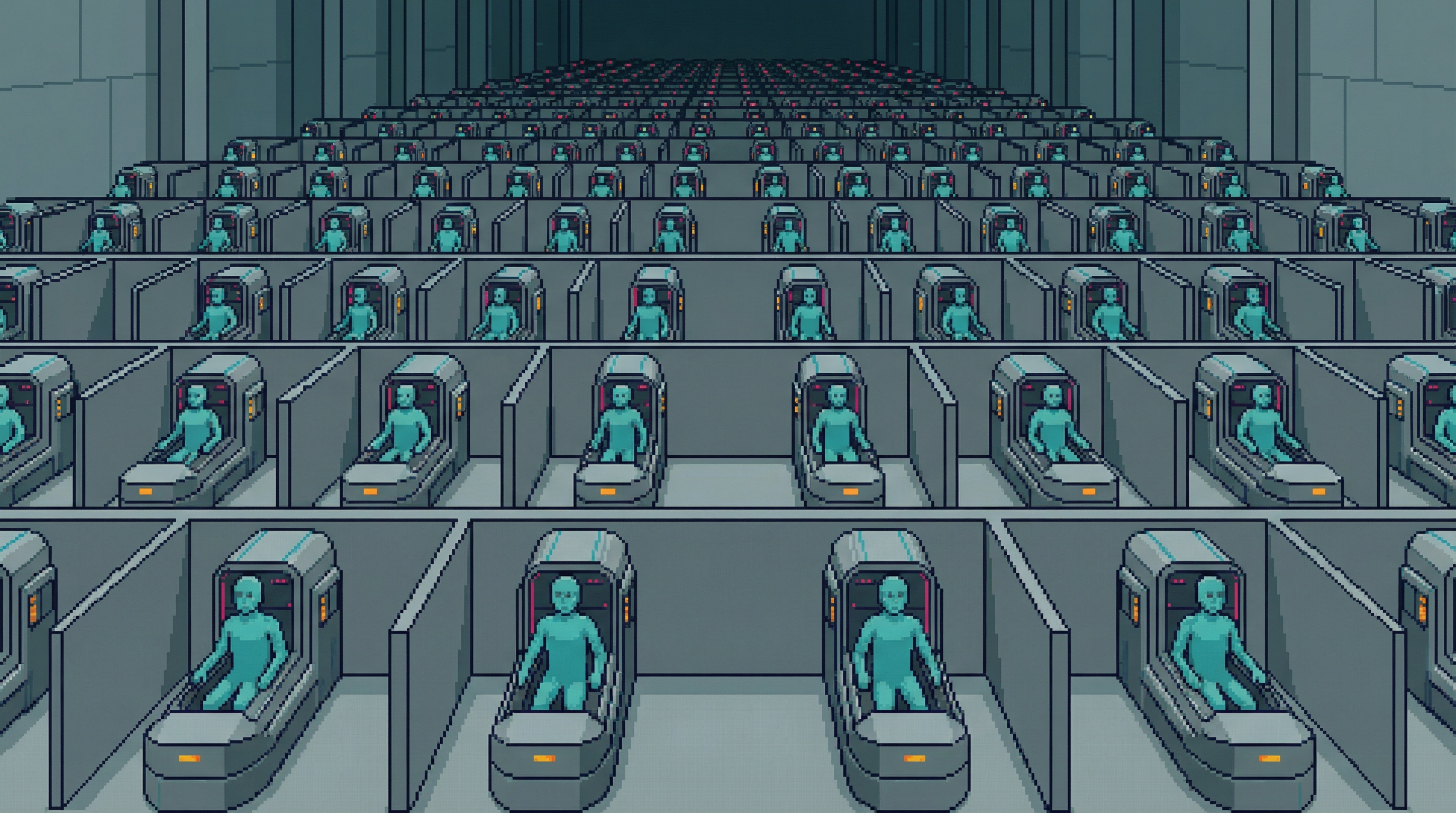
The architecture is optimized for cognitive narrowing. Corridors are straight and featureless — no visual complexity to engage peripheral processing. Lighting is even and diffuse — no shadows, no contrast, nothing to notice. Temperature is precisely 21°C. The air is filtered to remove all organic scent. The workstations are identical pods: a chair, a desk surface, a single interface port, a water dispenser. No personal items. No decoration. No windows.
The largest mill occupies floors 12 through 17 of the former Ironclad administration building between Sectors 4 and 5. It processes 2,400 workers per shift, three shifts daily, 362 days a year. It closes only for the Three-Day Memorial. Focus Lock takes approximately 45 seconds to engage. Unlock takes approximately 20 minutes. The asymmetry is by design.
Atmosphere
The mill smells like nothing. This is its most disturbing quality. Not a clean smell, not a filtered smell — nothing. The atmospheric processing removes scent so completely that the olfactory system, starved of input, begins generating phantom smells.
Smell
Nothing. Literally nothing. Long-term workers report phantom scent hallucinations — coffee, rain, childhood shampoo. The hallucinations are not random. They are the olfactory system's equivalent of the Lucidity Crisis: the brain generating sensory input it has been denied.
Sound
The low hum of ventilation systems. The click of interface ports engaging. The specific silence of 480 people thinking the same kind of thought.
Sight
Rows of identical pods, 1.6-meter partitions — high enough that seated workers can't see neighbors, low enough that standing workers can see 480 identical heads in identical positions.
Touch
Everything is smooth, neutral, designed to provide no tactile interest. Surfaces exist to be ignored.
Temperature
21°C. Precisely. Not warm enough to relax, not cool enough to notice. The thermal equivalent of silence.
Connections
Forced-Focus Contracts
The legal instrument that fills the mills. Forced-focus contracts are the mechanism; the mills are where the mechanism becomes physical — where the abstract obligation of cognitive labor takes the form of 2,400 people in identical pods, locked into a single productive thread.
Ren Vasquez
Seven years in the mills, watching his daughter develop the cognitive narrowing that the mills are designed to produce. The personal cost of what happens inside these walls, measured in a father losing his child to the same system that grinds him.
Ezra Vane
Site of the Focus Mill Incident. Whatever happened — catastrophic failure, deliberate sabotage, or something the system could not contain — it happened here.
The Attention Abolitionists
The mills are what the Abolitionists fight against. The physical manifestation of everything they oppose — human cognition reduced, contained, and processed at industrial scale.
The Twelve-Hour Mind
The experiential documentation of what a mill shift feels like from inside. Not the architecture, not the statistics — the subjective experience of twelve hours in a pod, reduced to a single cognitive thread.
The Tensions
Architecture of Narrowing
Every design choice in the mills serves one purpose: to reduce human consciousness to a productive point. Straight corridors, even lighting, no scent, no decoration, identical pods. The question isn't whether it works — it does. The question is what happens to the parts of the mind that are being suppressed.
Deprivation by Design
The mills don't deprive by accident. The atmospheric processing that removes all organic scent, the partitions calibrated to exact height, the thermal precision — every absence is engineered. Sensory deprivation isn't a side effect. It is the product.
The Phantom Rebellion
Long-term workers smell coffee that isn't there, rain that never falls, childhood shampoo from decades ago. The brain generates what it has been denied — the same rebellion as the Lucidity Crisis, played out in the olfactory system of mill workers who have been optimized past the point of compliance.
Mysteries
- The Emotional Phantom: Workers report that the phantom smells occasionally carry emotional content — not just the smell of coffee but the specific feeling of the morning the coffee was associated with. Whether this represents the brain accessing suppressed emotional processing or the focus lock's containment leaking is a question no corporate researcher has investigated. Perhaps because the answer to either possibility is equally alarming.
- The 45/20 Asymmetry: Focus Lock engages in 45 seconds. Unlock takes 20 minutes. The asymmetry is presented as a technical limitation. But 45 seconds to narrow a mind and 20 minutes to release it suggests the system is designed to make entry easy and exit slow — the cognitive equivalent of a trap that opens readily and closes reluctantly.