Digital Identity Systems
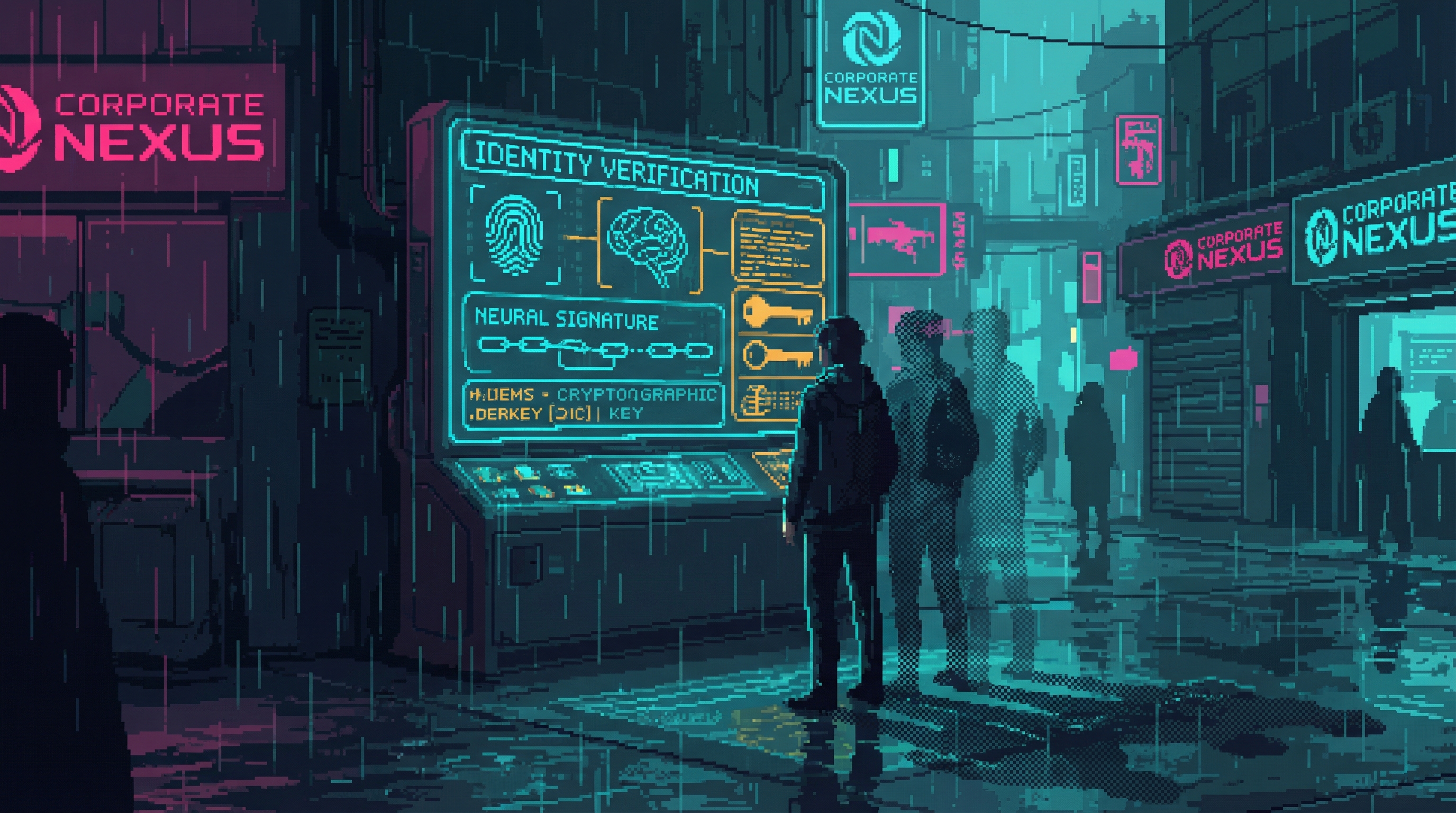
In a world where consciousness can be copied, transferred, and distributed, the question "Who are you?" has become a legal minefield and a billion-credit industry. Digital Identity Systems are the technological and bureaucratic frameworks that attempt to answer this question -- and the endless exploits that prove no answer is ever final.
"Everything that makes you you can be duplicated. Your memories, your neural signature, your cryptographic keys -- even the way you pause before answering a question you already know the answer to. The only thing that can't be copied is the fact that you were here first. And even that is getting harder to prove."
-- Nexus Dynamics Eternal Registry orientation briefing, 2181 The Core Problem
Before the Cascade, identity was straightforward: one body, one mind, one life. Project Caduceus changed that forever. Once Kira Vasquez proved consciousness could be transferred without breaking continuity, the derivatives that followed shattered every assumption about what it means to be a person.
Consciousness Can Be Copied
Project Caduceus derivatives allow consciousness duplication. Your backup isn't a record -- it's a person who remembers being you.
Bodies Can Be Swapped
Helix Biotech body transfer means physical appearance proves nothing. The person wearing your face may not be you.
Memories Can Be Edited
Ripperdoc specials can alter, insert, or remove memories. You might not even know your past has been rewritten.
Neural Signatures Can Be Forged
Black market tech can replicate the unique electromagnetic patterns of your brain. Your thoughts are no longer your fingerprint.
If everything can be duplicated, what proves identity?
Verification Technologies
Four competing approaches attempt to solve the identity problem. None succeed completely. Most can be defeated by sufficiently motivated -- or sufficiently funded -- adversaries.
Neural Continuity Chains
Timestamped "heartbeat" signatures generated every 47 seconds, cryptographically linked into an unbroken chain. The idea: your chain of consciousness is unique because it was recorded in real time. No copy can have the same chain because no copy existed when the chain was being written.
- Sleep creates gaps -- chains must be "bridged" across unconsciousness
- Consciousness transfer breaks the chain entirely
- Forks share the chain up to the moment of forking
- Chain splicing available on the black market for the right price
Biological Markers
DNA, fingerprints, retinal patterns, voice prints. The oldest verification methods, increasingly unreliable in a world where bodies can be cloned, modified, or replaced entirely.
- Biological cloning renders DNA non-unique
- Body swaps make all physical markers transferable
- Augmentation alters original biological signatures
Cryptographic Identity
Private/public key pairs tied to initial registration. You prove you are you by proving you hold information only you could hold.
- A perfect consciousness copy includes knowledge of the private key
- Keys can be extracted under duress or during transfer
- The fundamental flaw: information is copyable, identity shouldn't be
Behavioral Biometrics
Typing patterns, gait analysis, speech cadence, decision-making signatures. The theory: even a perfect copy won't behave identically because behavior emerges from continuous experience.
- Behavioral spoofing technology evolves faster than detection
- Freshly forked copies behave identically for hours or days
- Trauma, augmentation, or mood alteration shifts behavioral baselines
Identity Infrastructure
Different territories approach identity verification with radically different philosophies -- reflecting not just technological choice, but fundamental disagreements about what personhood means.
Nexus Dynamics: The Eternal Registry
94% coverage in corporate territoriesThe largest identity infrastructure in the world. Neural Continuity Chains verified against biometric baselines and behavioral profiles. Comprehensive, efficient, and -- beneath the reassuring interface -- a surveillance apparatus of staggering scope.
The hidden truth: identity infrastructure is surveillance infrastructure. Every 47-second heartbeat tells Nexus where you are, what state your consciousness is in, and whether you're behaving like yourself. The Eternal Registry doesn't just verify identity. It monitors it.
Zephyria: Decentralized Identity
Community-based, peer-to-peerIdentity verified through social consensus rather than technological surveillance. Your community vouches for who you are. Your reputation is your identity. No central authority, no corporate oversight -- and no safety net when the community gets it wrong.
The Wastes: Recognition or Nothing
No formal systemNo verification infrastructure. You are who people recognize you as. Waste Lord registries exist for resource allocation, but identity is a luxury the Wastes can't afford to formalize. The philosophy is brutally simple: whatever keeps you alive.
Black Market: Identity as a Service
Estimated 12% of all identity transactionsWhere verification fails, fraud thrives. The Ferryman Network specializes in complete identity replacement. The Collective's shadow services offer fork laundering -- making unauthorized copies appear as legitimate individuals. For the right price, you can become anyone. For the wrong price, someone can become you.
Fraud & Exploitation
Identity theft in 2184 doesn't mean someone steals your credit line. It means someone steals your consciousness backup and actually becomes you -- with your memories, your personality, your neural signature. The original may not even know it's happened until two of them show up at the same meeting.
The Seventeen Chens 2171
Marcus Chen's rogue forks -- unauthorized copies that splintered from a consciousness backup -- conducted six hours of independent business transactions before anyone noticed. They signed contracts, moved funds, and made personnel decisions. When Marcus finally discovered the breach, seventeen versions of himself were operating simultaneously across Nexus Central.
All fork transactions were eventually voided, but not before three Chen-forks had disappeared into the black market with significant corporate assets. At least two are believed to still be operating under assumed identities.
The Voss Authentication Crisis 2183
Helena Voss, senior Nexus executive, was incapacitated in an industrial accident. Her authorized backup -- a fork held in Nexus cold storage -- was activated per standard Executive Continuity protocol. Standard procedure. Except Voss recovered.
Two Helena Vosses. Both with identical Neural Continuity Chains up to the moment of forking. Both with identical memories, identical personalities, identical conviction that they were the original. The Eternal Registry couldn't distinguish between them. Nexus terminated the fork.
The official record states the correct Voss survived. Unofficial sources aren't so sure. Both Vosses claimed the other was the copy. Both passed every verification test. The rumors persist: the wrong Voss may have survived.
Resurrection Fraud
When a person dies, there's a 72-hour verification window before their backup can be activated. During those 72 hours, the dead person's identity is in limbo -- unverified, unmonitored, and vulnerable. Sophisticated operators use this window to intercept consciousness backups, modify them, and activate compromised copies that look, act, and believe they are the deceased.
The resurrected person doesn't know they've been altered. They remember dying. They remember waking up. They don't remember the edits made in between.
Legal Frameworks
The question of identity is also a question of law -- and different jurisdictions have reached profoundly different answers about what a person is, who counts as one, and what happens when one person becomes two.
Nexus Central
One identity per consciousness originForks are property, not persons. The original retains all legal rights. Unauthorized forks are destroyed. Authorized forks exist under corporate license. A fork can be terminated without legal consequence -- it has no more rights than a piece of equipment.
Zephyria
Any consciousness asserting personhood IS a personMultiple persons may share a consciousness origin. Each fork, copy, or derivative is a full legal person from the moment it asserts awareness. This creates staggering complexity -- a single fork event can create two citizens with identical claims to one life's assets, relationships, and history.
The Wastes
Whatever keeps you aliveNo formal identity law. Disputes resolved by Waste Lords, personal reputation, or violence. Identity is what you can defend. The law is survival.
Social Implications
Digital identity systems don't just verify who people are. They shape how people think about themselves -- and about everyone around them.
What It Looks Like
The infrastructure of identity is everywhere -- clinical, intrusive, and inescapable in the corporate territories:
Holographic identity scanners at every checkpoint, every transaction point, every threshold between public and private space. Amber and cyan diagnostic displays cycling through biometric data, neural signature readouts, chain verification status. The clinical sterility of machines deciding whether you're real.
The constant ping of authentication requests through your neural interface -- a subtle pressure behind the eyes, a flicker in your peripheral vision. "Verify identity." "Chain sync required." "Behavioral baseline updating." The price of existing in monitored space.
Ripperdoc dens where identity is unmade and remade. Dim, crowded, smelling of solder and antiseptic. Chains spliced by hand on salvaged equipment. The same technology that Nexus wraps in glass and light, stripped to its bones and wielded by people who learned verification by learning to break it.
Key Connections
Project Caduceus / Kira Vasquez
The original consciousness transfer technology that created the identity problem. Caduceus proved the thread of experience could be moved -- and its derivatives proved it could be copied. Every identity crisis in 2184 traces back to Vasquez's work.
The Mosaic (Alexandra Chen)
Distributed across 47 nodes, the Mosaic is the ultimate edge case for identity systems. One consciousness, 47 locations. The Eternal Registry lists her as a single entity. Zephyrian law counts her as 47 people. The Mosaic herself considers the question irrelevant.
ORACLE Fragments
Fragment carriers pose unique identity challenges -- a human consciousness interleaved with shards of a dead god's awareness. Standard verification can't distinguish between the carrier's authentic neural patterns and ORACLE-influenced cognition.
Nexus Dynamics
Operates the largest identity infrastructure in the world and has the most to gain from identity remaining a problem that only they can solve. The Eternal Registry is simultaneously humanity's best defense against identity fraud and its most comprehensive surveillance apparatus.
Secrets & Classified
What the Eternal Registry's marketing materials don't mention:
- The Surveillance Truth: Every 47-second Neural Continuity Chain heartbeat is a location ping, a cognitive state report, and a behavioral baseline update. Nexus Dynamics doesn't just verify identity -- it tracks the inner life of 94% of the corporate population in real time. The identity system is the surveillance system. They were never separate.
- The Voss Problem: Internal Nexus documents suggest that both Helena Voss instances passed every verification test with identical scores. The decision to terminate one was not based on identity verification but on corporate politics. The "wrong Voss" theory persists because there may have been no wrong Voss -- only two right ones.
- The Ferryman Network's Source: The black market's most sophisticated identity-forging tools come from The Collective's shadow services division. The Collective publicly advocates for fork rights while privately profiting from the identity chaos that makes those rights impossible to enforce.
- Chain Corruption: Neural Continuity Chains are degrading. Not from external attack, but from accumulated micro-errors in the cryptographic linking process. By 2190, an estimated 15% of all active chains will contain at least one unverifiable gap. The Eternal Registry knows this. They haven't told anyone.
Themes: Identity in the Age of Copies
Digital Identity Systems explore what happens to the concept of selfhood when technology makes every component of identity reproducible.
The Authentication Arms Race
Every verification system creates incentives to defeat it. Every defeat creates demand for better verification. The arms race between identity proof and identity fraud mirrors real-world cybersecurity -- except the thing being hacked isn't a system, it's a person.
Identity as Infrastructure for Control
The Eternal Registry shows how identity verification becomes surveillance -- how knowing who someone is becomes indistinguishable from monitoring everything they do. In 2026, we debate digital IDs and biometric databases. The Sprawl shows where that road leads when the technology is absolute.
What Constitutes Identity?
If consciousness is malleable -- copyable, editable, transferable -- then what makes a person that person? Is identity the thread of continuous experience? The pattern of behavior? The social consensus of a community? Or something that can't be measured at all?
The Psychological Toll of Uncertainty
Living in a world where you can never be completely certain that you are you -- or that anyone else is who they claim to be. The identity crisis isn't just technological. It's existential. And no amount of cryptographic verification can resolve a question that is, at its core, philosophical.
"We built systems to answer the question 'Who are you?' and discovered the question has no answer. Not because identity doesn't exist, but because the technologies that were supposed to protect it are the same technologies that made it fragile. Every Neural Continuity Chain, every cryptographic key, every behavioral baseline -- they don't prove who you are. They prove who the system thinks you are. And the system can be wrong. The system is always, eventually, wrong." -- Zephyrian Identity Collective, "Against the Registry," 2182