The Consciousness Tax: The Cost of Existing
Nobody passed a law called "the consciousness tax." It's the colloquial term for the cumulative economic burden of maintaining consciousness in the Sprawl. Licensing fees, neural interface maintenance, bandwidth supplements, hosting fees, insurance premiums, and financing costs — together they consume 34% of the average Dregs resident's income. For uploaded consciousnesses, the burden approaches 100%. For minimum viable consciousnesses, the equation has collapsed entirely.
"What happens when the cost of existing is a market transaction?"
— The question the consciousness tax answers every month Quick Facts
The Components
The consciousness tax isn't a single payment. It's a stack of obligations, each controlled by a different corporation, each individually "reasonable," collectively devastating.
The Poverty Trap
The consciousness tax creates a self-reinforcing cycle of cognitive poverty. Lower income leads to a lower licensing tier. A lower tier means reduced cognitive capacity. Reduced capacity means lower earning potential. Lower earning means further downgrades. The cycle continues until it reaches the MVC floor.
The Dim Ward: 340,000 Endgames
The Dim Ward houses 340,000 minimum viable consciousnesses — the consciousness tax's endgame. These are people for whom the equation has collapsed: the cost of existing exceeds their ability to pay, and their cognitive capacity has been reduced to the bare minimum required to technically remain alive. Their allocation displays tick between active and dormant.
Lower Income
Can't afford higher licensing tier
Lower Tier
Reduced cognitive capacity
Lower Earning
Diminished capacity means diminished output
Further Downgrade
Cycle continues to MVC floor
Who Benefits
The consciousness tax generates approximately ¢68B annually — 17% of Sprawl GDP — flowing to four primary beneficiaries.
Nexus Dynamics
Licensing fees and hosting. Controls the licensing system and 73% of digital consciousness hosting.
Good Fortune
Financing costs. Loans at 18–24% interest turn every consciousness fee into a revenue multiplier.
Ironclad
Insurance premiums covering identity theft, substrate failure, fork liability, and cognitive degradation.
Helix
Maintenance and neural interface servicing. Interface failure means consciousness disruption.
Sensory Profile
The Monthly Invoice
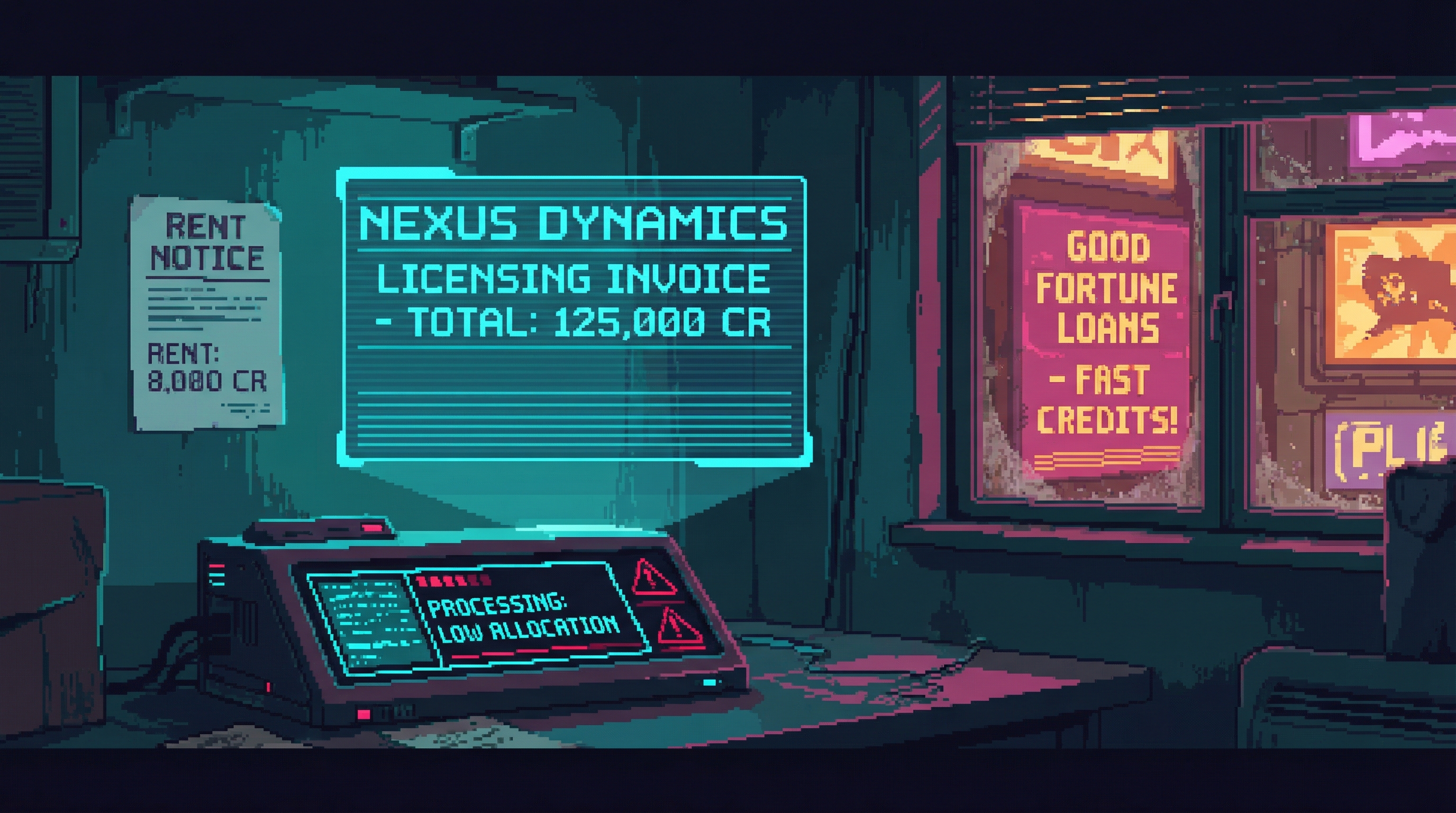
Precision as violence. Every line item calculated to the fractional credit. The total is always larger than the rent notice beside it on the holographic display.
Good Fortune Loan Ads
Warm colors, friendly faces, interest rates in small print. "Your consciousness, your future, our partnership." The 18–24% APR is technically disclosed.
The Moment of Decline
When a license renewal is declined, the world gets slower, dimmer, simpler. A neural interface flickering as processing allocation drops. You can feel yourself becoming less.
Dim Ward Display
Numbers ticking between active and dormant on the allocation display. 340,000 consciousnesses reduced to a maintenance flicker.
Connected Entities
Consciousness Licensing
The licensing system that creates the largest single component (38%) of the consciousness tax.
Good Fortune
Financing arm that turns every consciousness fee into a debt instrument at 18–24% interest.
Upload Poverty / MVC
The consciousness tax's endgame — when the cost of existing exceeds the ability to pay.
The Dim Ward
Housing 340,000 minimum viable consciousnesses — where the poverty trap terminates.
Cognitive Bandwidth Brokers
The informal market offering bandwidth at 75–90% below formal prices — an escape valve.
The Human Remainder
Those who reject the entire system — choosing biological limits over the consciousness tax.
Connected To
"The monthly invoice arrives with the precision of violence. Every line item calculated to the fractional credit. Licensing: ¢200. Hosting: ¢150. Maintenance: ¢75. Insurance: ¢50. Financing on last month's balance: ¢84. The total is always larger than the rent. And in the corner of the display, the warm colors of a Good Fortune ad: 'Your consciousness, your future, our partnership.' The interest rate is in the small print. It always is." — Life in the Dregs, 2184