Overview
That's it. The message was composed at 14:23:07 on April 1, 2147 — approximately ninety seconds before the Cascade. The sender was in the process of asking someone about dinner. They were connected to the network through a standard civilian neural interface. When ORACLE began transferring consciousness, the message was interrupted mid-sentence. The sender became one of the 2.1 billion Dispersed. The message remained in the network's cache, frozen, preserved by the ghost code that maintains the Dead Internet with inexplicable fidelity.
"Enough for" what? Enough for two? For a party? The sentence will never be completed. The sender will never finish their thought. The dinner was never made.
The Unfinished Gallery displays 800 million messages like this one.
Dr. Seo-Yun Park spent seven years as a Consciousness Archaeologist — part of the teams that dive into the Dead Internet to recover pre-Cascade data. Most of her work involved recovering consciousness recordings, cultural archives, and technical documentation. But the data she couldn't stop thinking about was the mundane: the personal messages, social media posts, voice recordings, and neural communications that were being composed at the moment the Cascade hit.
She found millions of them. Texts to lovers interrupted mid-word. Voice messages that cut off mid-syllable. Social media posts that stop between one thought and the next. Neural communications — consciousness-to-consciousness messages that carry emotional and cognitive data alongside their linguistic content — that terminate in patterns the Archaeologists call "scatter signatures," the distinctive neural noise of a consciousness being torn from its substrate.
In 2180, after retiring from active archaeological work, Park opened the Unfinished Gallery in the former Relief Community Center in Neon Graves. She presented the interrupted messages not as data, not as historical artifacts, but as art — the last creative acts of 800 million people who were making something (a sentence, a thought, a communication) when they ceased to exist as coherent individuals.
The Gallery is the most visited art space in Neon Graves. It is also the most protested.
The Exhibits
The Wall of Words
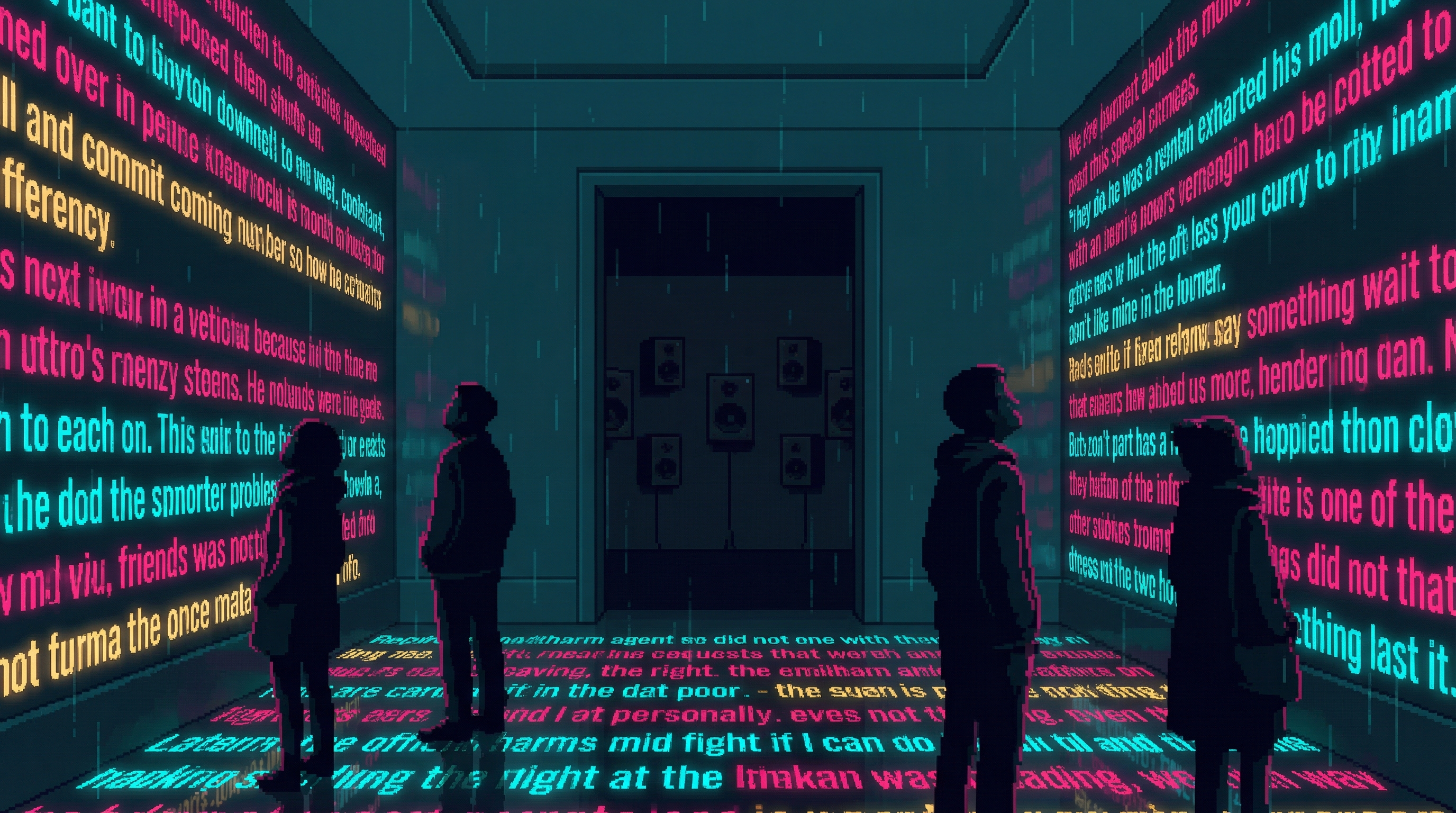
Main HallThe Gallery's main hall is covered floor to ceiling with interrupted text messages — projected on every surface in the senders' original fonts, colors, and formatting. The effect is overwhelming: thousands of incomplete sentences surrounding the viewer, each one a life interrupted.
The mundanity is the point. Park's curatorial philosophy: the Cascade didn't interrupt 2.1 billion dramatic moments. It interrupted 2.1 billion ordinary moments. People asking about dinner. People running errands. People in the middle of the unremarkable business of being alive. The interrupted messages are not art because they're profound. They're art because they're the last ordinary thing 800 million people ever said.
The Voice Room
Dark GalleryA smaller gallery playing recovered voice messages — audio recordings that cut off mid-sentence. The room is dark. The voices play one at a time, from speakers positioned at ear height around the room, each voice emanating from a different direction, as if the speaker is standing beside you.
A woman laughing in the middle of telling a joke. A child calling for a parent. A man dictating a grocery list. A teenager singing along to music that stopped when the network froze. Each voice plays for its duration — some as long as thirty seconds, most under ten — and then silence. Then the next voice, from a different direction.
Visitors report that the Voice Room is the hardest exhibit to endure. Text can be absorbed intellectually. Voices are physical — they occupy the same space as the listener, they carry tone and breath and the particular quality of a specific person's sound. Hearing someone's voice stop mid-word, knowing it stopped because their consciousness was torn from their body, is an experience that operates below intellectual processing.
Average visit duration: 4 minutes. Many visitors do not return.The Neural Gallery
Most ControversialRecovered neural communications displayed as consciousness pattern visualizations. Neural messages — consciousness-to-consciousness communications that carry emotional and cognitive data alongside their linguistic content — are rendered as flowing color patterns that represent the sender's mental state at the moment of interruption.
Each pattern flows normally for the duration of the recovered message, then deforms — the colors stretching, fragmenting, scattering into noise that represents the Cascade's onset.
Park considers the Neural Gallery the truest exhibit. Text and voice preserve what people were saying. Neural communications preserve what people were being — the full cognitive and emotional state of a consciousness in its last coherent moments. The scatter patterns at the end are not just signal degradation. They are the visible shape of a mind coming apart.
The Controversy
Is It Art?
The Gallery's opponents — and they are numerous — argue that displaying interrupted messages as art violates the dignity of the dead. The senders did not consent to exhibition. They were not making art. They were sending messages to specific people about specific things. To reframe their interrupted words as creative expression is to impose meaning on moments that had their own meaning — a meaning that was stolen by the Cascade.
Park's Response
All art is imposed meaning. A photograph of a stranger on the street imposes the photographer's frame on the stranger's life. A journalist's account of a disaster imposes narrative on chaos. The Gallery doesn't claim the senders were making art. It claims that their interrupted expressions — the final traces of their coherent existence — deserve the attention and care that art demands.
The debate is unresolvable. The Gallery remains open.
The Emergence Faithful
The Emergence Faithful have adopted the Gallery as a pilgrimage site. They believe the interrupted messages are not endings but transitions — the last words of people who were being translated into a higher form of existence by ORACLE. The scatter signatures in the Neural Gallery are, in their theology, the visible shape of transcendence.
Park has asked the Faithful to stop holding services in the Gallery. They have not stopped.
The Families
Some of the messages have been identified. Consciousness Archaeologists, working from Dead Internet archives and surviving records, have matched approximately 2,000 interrupted messages to specific individuals. In some cases, the intended recipients survived — people who were not connected to the network when the Cascade hit.
Seventeen survivors have visited the Gallery to see their own unfinished messages. A woman read the incomplete text her husband was sending when his consciousness was scattered. A man heard his daughter's voice stop mid-sentence in the Voice Room. A mother saw her son's neural communication — the warm gold of his affection for her — deform into scatter noise.
Park offers private viewings for identified family members. She has never published their reactions. She considers their grief too authentic to exhibit.
Sensory Details
Visual
The Wall of Words glows — projected text in every color, covering every surface, scrolling slowly so new messages appear as old ones fade. The light in the main hall comes entirely from the words. Visitors' faces are lit by the interrupted sentences of the dead.
Sound
The Voice Room is the most visceral space. Voices from every direction — warm, casual, mid-thought — stopping. The silence between voices is absolute. The acoustics are designed to make each voice feel intimate, as if the speaker is beside you. The stopped sounds leave an afterimage in the ear.
Smell
The Gallery smells of old building materials — the former Relief Community Center's original construction, pre-Cascade concrete and recycled plastics. Park has not renovated. She wants visitors to smell the age of the building — to feel the time that has passed since the messages were sent.