Overview
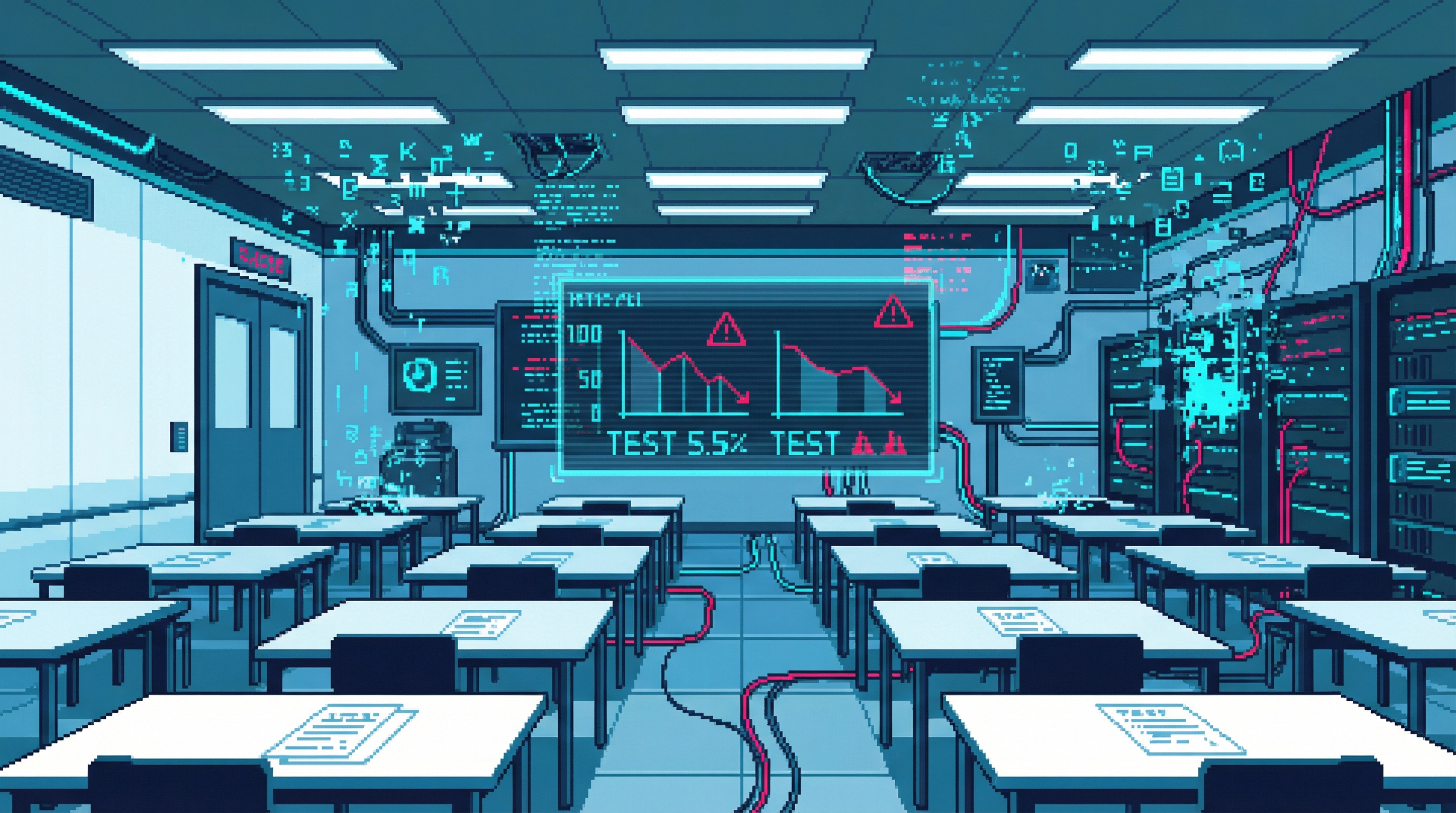
On September 14, 2177, Nexus Dynamics administered the last knowledge-based employee evaluation in its history.
The test was routine — 200 questions covering network architecture, systems engineering, and corporate governance. Pass rates had hovered around 92% for two decades. Nothing about the exam suggested it would be the last.
In 2177, People Analytics ran the results through Dr. Lian Zhou's new consciousness licensing optimization framework and discovered what the numbers had been hiding for years: pass rates tracked almost perfectly with Second Mind capability tier. When the Second Mind was disabled during testing, scores collapsed across every tier — Executive fell to 71%, Professional to 54%, Basic to 47%.
The knowledge was not in the employees. The knowledge was in the augmentation. The employees were performing competence that resided in their subscription.
Key Events
The Correlation
Zhou's analytical framework was designed for consciousness licensing optimization — a tool for measuring how efficiently neural augmentation products delivered cognitive output. When applied to employee evaluation data, the framework produced a correlation that should have been impossible: standard-condition pass rates mapped to Second Mind capability tier with near-perfect precision.
Employees were not passing the exam. Their subscriptions were passing the exam.
The Unassisted Scores
With Second Mind disabled, the gap between tier levels narrowed to statistical noise. Executives — the corporation's highest-compensated minds — performed 24 points below the standard pass rate. Basic-tier employees, who had been passing at 88% for a decade, collapsed to 47%.
The hierarchy of competence was a hierarchy of subscription.
Tuesday to Thursday
Marcus Chen received the report on a Tuesday. By Thursday, Nexus had eliminated all knowledge-based evaluations and replaced them with "alignment assessments" — tests measuring not what employees knew, but whether they used their augmented capabilities in ways consistent with corporate objectives.
The word "knowledge" disappeared from Nexus HR documentation entirely.
Consequences
The change was presented as progressive. The corporate announcement read:
"Knowledge is infrastructure. Achievement is human."
— Nexus Dynamics, Internal Communication, September 16, 2177
The announcement did not mention that knowledge-as-infrastructure means knowledge-as-subscription. That the infrastructure can be revoked. That the test was eliminated not because it was unnecessary, but because it was revealing.
Alignment assessments measure a different thing entirely. They do not ask: What do you know? They ask: Are you using what we gave you the way we want you to use it? The shift from knowledge to alignment is a shift from capability to compliance. And compliance, unlike knowledge, does not require understanding.
The results were classified. The analytical framework — the tool that produced the correlation — was incorporated into the Loyalty Coefficient. A measurement built to expose dependence became a measurement built to enforce it.
The Competence Theater had its first administrative proof: the corporation's own analytics confirmed that employee knowledge was a product feature, and the corporation responded by eliminating the measurement rather than addressing the finding.
The Bright Room continues what the Last Exam exposed. Every year, in a locked conference room, Nexus executives sit for an unassisted evaluation. The scores are consistent. The gap remains. The Bright Room is the Last Exam's annual echo — proof that the finding was not an anomaly but a condition.
Linked Files
Aftermath
The Last Exam's classified results did not stay buried. Fragments leaked through former People Analytics employees, through Sprawl intelligence operatives monitoring Nexus HR restructuring, through the simple observation that an entire category of corporate assessment vanished overnight and was replaced with something that measured obedience instead of understanding.
The question the Last Exam asks is not subtle: If your knowledge can be turned off, was it ever yours? If your competence is a subscription, what are you without it? And if the corporation that sells you your own capability also measures whether you use it correctly — who is the employee, and who is the tool?
The answers are in the classified data. The data shows 47%. The data shows that the basic-tier employee, stripped of augmentation, cannot pass a test they have been passing for twenty years. The data shows that knowledge-as-infrastructure is a polite way of saying knowledge-as-leash.
The test was eliminated because the scores were a mirror. Nobody at Nexus wanted to see what the mirror showed.