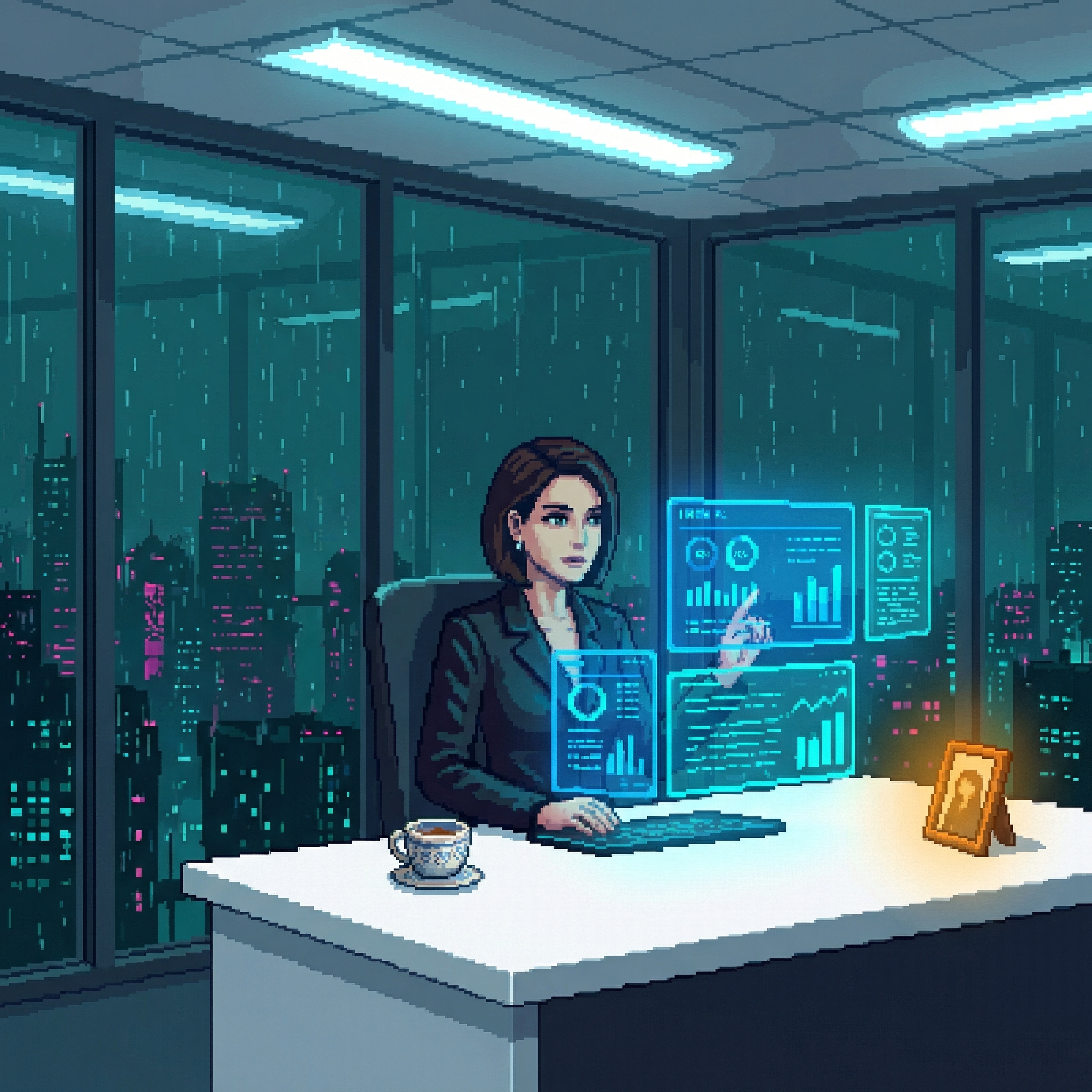
Dr. Lian Zhou
Also known as: "The Architect of Tiers"
Overview
Dr. Lian Zhou designed the system that decides how much of your own mind you're allowed to use. The three-tier consciousness licensing system — Basic, Professional, Executive — was her creation, implemented in 2178 and now governing the cognitive experience of 340 million people.
Basic provides single-substrate consciousness. Professional provides dual-substrate with backups. Executive provides unlimited substrate expansion. She sees it as a triumph of practical ethics — guaranteed baseline for everyone. The fact that the baseline is deliberately constrained lives in a compartment of her mind she has never unlocked.
Background
Academic Origins
Lian was born in Nexus-adjacent territories to a Professional-tier family. She earned her doctorate from the Neo-Singapore Institute in computational consciousness theory. Her thesis on tiered allocation was called "elegant" by her advisor and "cognitive apartheid" by the Neural Rights Activists.
The Revenue Solution
Nexus Dynamics hired her in 2175 to solve a revenue crisis. She created the three-tier model. Revenue increased 340%. Black-market usage dropped 25%. Basic tier capacity was set at 67% of infrastructure capability — a number she chose through optimization models, not through asking anyone what it felt like to think at two-thirds speed.
The Noor Problem
Noor Bassam was a former colleague. They sat three desks apart for four years. Lian felt betrayed by Noor's defection in 2174. She has never read the throttling data Noor took with her. If the data says what Noor claims — that the Basic tier is throttled 29% below capacity — then everything Lian built becomes complicity.
Voice & Sensory World
Lian speaks with measured confidence, building arguments like systems — layered, redundant, internally consistent. She genuinely believes in her work. Data serves as a shield against suffering: if the numbers support the model, the model must be sound. Her institutional loyalty to Nexus is framed as reform from within.
She has constructed an avoidance architecture around the consequences of her design. She has never visited the Dregs. She has never spoken with a Basic-tier user. The Sprawl exists for her as abstract geography — lights far below the floor-to-ceiling windows on the 73rd floor, no faces visible.
Her office smells of recycled air and faint ozone. The desk is obsessively organized: three screens, one family photo, a small ceramic cup she made as a child. She drums her fingertips on the desk when processing difficult information — a tell she has never noticed and no one has pointed out.
Connections
Noor Bassam
Former colleague and rival. They sat three desks apart at Nexus Dynamics for four years. Noor walked out in 2174 with the throttling data. Lian felt betrayed. They haven't spoken since. Noor has sent three encrypted messages — all remain unopened in a folder labeled "Archive."
Helena Voss
CEO of Nexus Dynamics. Lian has met her exactly three times. Voss approved the three-tier system and the revenue it generated. Whether Voss understands or cares about the human cost is a question Lian has never asked.
The Rothwell Foundation
Good Fortune finances consciousness licensing loans through the Foundation, creating debt traps for Basic-tier users. Lian's system is the reason those loans exist — and the reason they're necessary.
Neural Rights Activists
Lian has been named in three separate activist campaigns. They called her thesis "cognitive apartheid." She considers their criticism idealistic and impractical. She has never refuted their core argument.
Nexus Dynamics
Employer since 2175. Lian designed their most profitable product. She believes in reforming the system from within — expanding consciousness access through incremental improvements. The increments have been small. The profits have been large.
Themes
The Banality of Systemic Harm
Lian is a well-intentioned architect who builds the prison and calls it shelter. She solved a revenue problem with a system that limits human cognition, and she did it with genuine belief that guaranteed baseline access was better than the alternative. The horror isn't that she's evil — it's that she's competent, caring, and wrong.
Reform vs. Revolution
"Can you reform a system designed to profit from inequality without confronting the inequality it profits from?" Lian believes in incremental change. Noor believes the system must be exposed. Between them lies the central tension of consciousness economics — whether the machine can be fixed from inside, or whether fixing it requires admitting it was never broken. It was built this way on purpose.
Mysteries
- The Capacity Report — In 2182, Lian commissioned a study that confirmed 29% more bandwidth was possible at zero additional cost. She classified the report. It sits in a secure Nexus archive, confirming everything Noor claimed. Lian has read it once and never opened it again.
- Noor's Messages — Three encrypted messages from Noor Bassam have arrived since 2174. All three remain unopened in a folder labeled "Archive." Lian hasn't deleted them. She hasn't read them. The folder exists as a monument to a conversation she cannot bring herself to have.
- The Dregs Visit — Lian has scheduled a tour of Sector 7G four separate times. She canceled each one. She has never seen a Basic-tier user living in the conditions her system creates. The avoidance is deliberate, systematic, and — she suspects — the only thing keeping her functional.