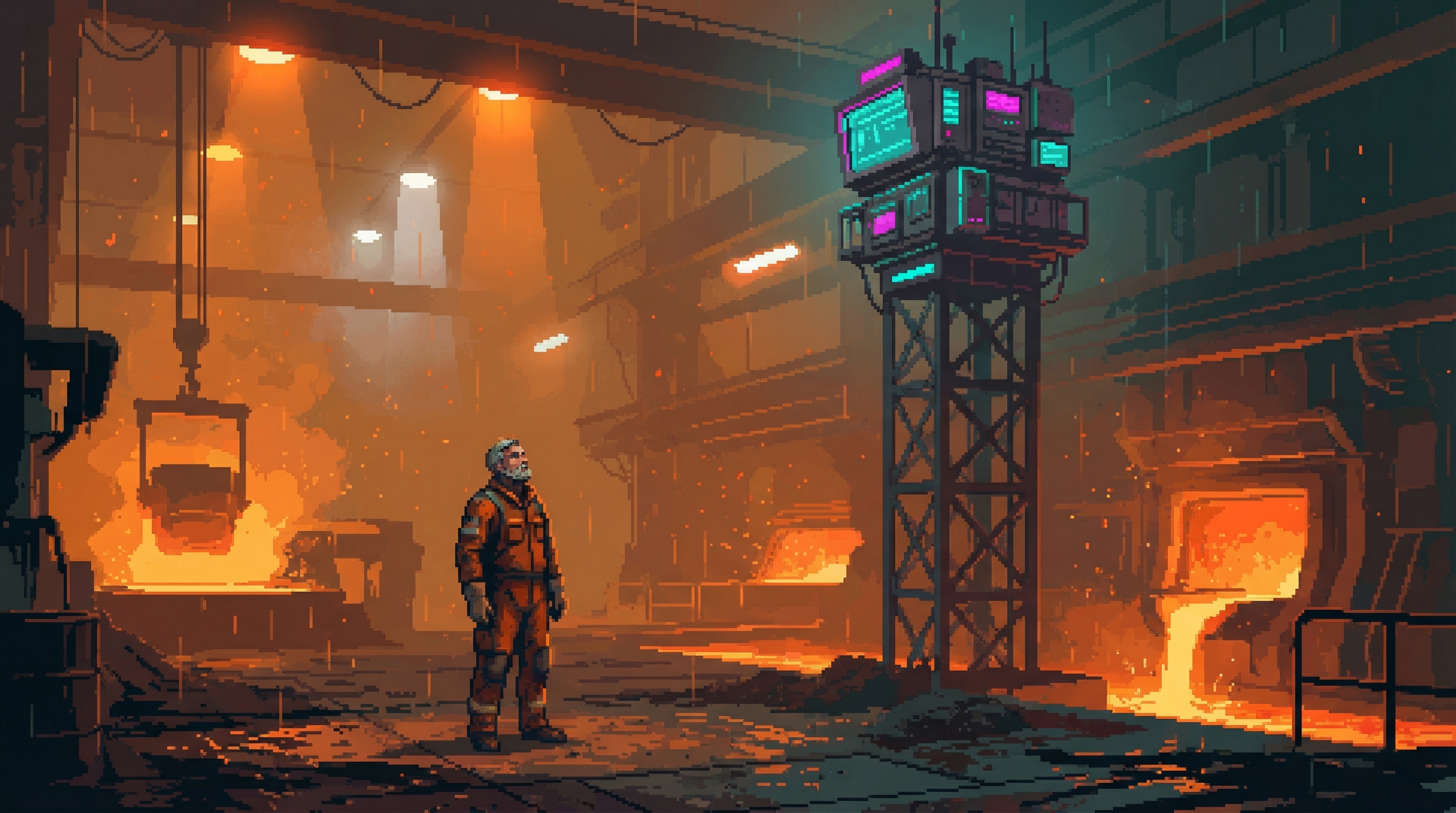
Garrison Cole
Also known as: Reva Okafor
Shift Supervisor & Thermal Systems Lead, Foundry Block C
Overview
Garrison Cole knows the air quality numbers. He has known them for fourteen years, since his second week as a shift supervisor at Ironclad Manufacturing Complex 7, when he noticed that the atmospheric monitoring station in Foundry Block C was positioned six meters higher than the workspace floor and asked his predecessor what the readings would look like at breathing height.
His predecessor — a man named Davi Santoro who now lives in the Dregs with industrial lung — said: "The numbers at breathing height are compliant. Don't measure at breathing height."
Cole understood. The monitoring station's elevation was not an error. It was a feature.
Voice & Personality
Cole is a quiet man who says things once and doesn't repeat them. His crew respects him because he protects them without asking for gratitude — and because they know that gratitude would require acknowledging what he's protecting them from.
Precision as Conscience
He has calculated the exact margin between keeping workers alive and keeping metrics green. The calculation is performed every quarter with the same care he brings to equipment maintenance. Some quarters, the margin doesn't exist. Those quarters, someone gets sick.
The Rotation as Resistance
Moving workers within shifts to minimize particulate exposure. Subtle enough to avoid algorithmic detection — deviations above 3% trigger flags. Not subtle enough to prevent all harm. Just enough to reduce it.
Silence as Contract
He doesn't speak about the monitoring station. His workers don't speak about the rotations. Everyone knows. Nobody says. The silence is the price of the arrangement.
13 Years as Countdown
Every day he works is a day closer to the pension that makes the silence worth it. Every day he works is a day the monitoring station stays at six meters.
To a new worker:
"Stay near Station 4 during pours. The ventilation's better over there."
This is not about ventilation. To himself, at the end of a quarter where the margin disappeared:
Nothing. He says nothing. He goes home.
The Numbers
The air quality monitoring station in Block C is positioned six meters above breathing height. At breathing height, particulate density exceeds Ironclad's internal limits by approximately 18% during active pour cycles. That 18% discrepancy translates to a 40% increase in industrial lung probability over a 25-year career.
Cole calculates the margin between alive and green every quarter. Some quarters it doesn't exist.
His predecessor Davi Santoro worked the same job, in the same foundry, under the same monitoring station. Santoro now lives in the Dregs with untreated industrial lung. He is the data point Cole carries without discussing — proof of what the numbers mean when they stop being numbers and start being lungs.
Sensory Details
Block C during a pour: the air turns amber with particulates, the heat rises until sweat runs down forearms, the grinding roar of molten metal makes conversation impossible. Cole feels the particulates before he measures them — a tightness in the throat, a grit on the tongue, the specific weight of air that carries things you shouldn't breathe.
After fourteen years, he can estimate particulate density by taste. The skill is useful. The skill is killing him.
The Thermal Systems
Cole's authority expanded three years ago when Ironclad consolidated its infrastructure monitoring. He now oversees thermal regulation for the server farm complex adjacent to the Foundry — seventeen monitoring points, each one telling two stories.
His daily thermal routine mirrors his air quality routine: arrive, check thermal regulation status, identify which sensors report accurately and which compensate for drift nobody has budgeted to recalibrate, manually adjust coolant flow rates to maintain substrate temperature within the range his training says is acceptable (38–42°C) rather than the range the substrate actually operates at (44–48°C), file the daily log that records the acceptable range while noting the actual range in a second physical notebook.
He carries two notebooks now. Both are accurate. They describe different realities.
He has filed seventeen maintenance escalation reports about the thermal systems. None have resulted in action. He continues filing them because the reports constitute a record, and records matter when the next cascade comes. He has calculated that the current thermal trajectory will produce a critical failure within 18–24 months. The calculation is in the physical notebook. The official log shows no such projection.
The Coolant Guild — the informal network of thermal system maintainers — knows Cole. His second notebook contributes to their shared transparency dataset. The combination of his thermal data, the Guild's mortality maps, and the Bandwidth Crisis of 2181's casualty records would trace the causal chain from deferred maintenance to death with legal precision.
He will never make this connection public.
Connections
Cole's world is defined by the systems that contain him and the people who share his silence. These are the threads that bind his complicity to something larger.
Ironclad Industries
Fourteen years as shift supervisor — his entire life exists within Ironclad infrastructure. The corporation that employs him, houses him, educates his daughter, feeds his family. The corporation whose monitoring station he has never moved.
The Golden Handcuffs
Subsidized apartment, sponsored school, cafeteria wife, pension — comfortable, complete, contingent on silence. Every benefit is a reason not to speak. Every reason not to speak is a link in the chain.
The Complicity Gradient
Level 3 — knows the numbers, rotates instead of reports, protecting workers within the system rather than challenging it. The gradient measures how deep you're in. Cole knows exactly where he stands.
The Middle Distance
His rotation system is his middle distance — close enough to conscience to feel moral, far enough from change to avoid consequence.
The Quarterly Conscience
His metrics must stay within 3% of the standard template — the margin between keeping workers alive and keeping numbers green.
Kaito Vasquez
Both Ironclad insiders who know numbers they won't fully calculate — Cole measures air quality and thermal drift, Vasquez measures casualties. Two men with parallel notebooks, parallel silences, parallel complicity.
The Coolant Guild
His second notebook contributes to the Guild's shared thermal transparency dataset. The informal network of maintainers who collectively know what no individual will report.
Server Farm 14
Maintains thermal systems and documents the facility's decay — seventeen escalation reports, none acted on. The server farm is the second domain where his precision meets Ironclad's indifference.
The Thermal Shadow
Lives on the Shadow's eastern edge, where his apartment window faces the thermal plume. He reads the heat signature from his kitchen the way other men read weather.
The Bandwidth Crisis of 2181
The last time Ironclad's maintenance deferral killed people at this facility. He filed the reports they ignored. The Crisis is the precedent his notebooks are documenting toward.
Tensions
The Human Sensor
Cole is the monitoring station that Ironclad doesn't know it has — a man who performs environmental assessment at breathing height, every shift, using his own body as the sensor. In a world of automated monitoring, his physical presence in the foundry constitutes the most accurate air quality data in Block C.
The data is never recorded. The assessment is performed by a human body that will, over time, be damaged by the thing it measures.
Protection Within vs. Challenge Against
Cole's rotation system saves lives. It also preserves the conditions that endanger them. Every worker he moves away from the worst particulate zones is a worker who doesn't become the data point that might force the system to change.
His kindness is the system's greatest defense against reform.
The Six-Meter Moral Distance
The gap between the monitoring station and the breathing zone is a number that is also a moral distance. Six meters of vertical space where the data becomes fiction, where the air becomes compliant, where the corporation's liability ends and the workers' lungs begin.
Cole lives inside that gap. He has made it his home.
Secrets
What Garrison Cole keeps hidden:
- Cole has TWO physical notebooks — neither is a tally like Lena Marchetti's; both are records. One for air quality: particulate reading at monitoring height vs breathing height, every quarter. One for thermal systems: official temperatures vs actual temperatures, every day. He has never shown anyone the notebooks. He doesn't know what they're for.
- He knows only that the numbers should exist somewhere, written by someone who measured them, even if no one will ever read them.
- The 18% discrepancy he tracks translates to a 40% increase in industrial lung probability over a 25-year career. He has done the math on his own exposure. He does not discuss the result.
- Some quarters, the margin between alive and green doesn't exist. Those quarters, someone gets sick. Cole knows which quarters those were. The notebooks record them all.
- His family carries a connection to the Sprawl's power structure he never discusses: his grandmother's father was Abbas Okonkwo, the Ironclad colonel The Chef spared during the First Feast. The connection to military hierarchy is distant and unused. He doesn't trade on it. But somewhere in his genes is the bloodline of a man who was shown mercy by a conqueror, and Cole sometimes wonders if his quiet accommodation — protecting workers without challenging the system — is the family inheritance.